How to Calculate Battery Pack Voltage and Capacity (Series vs Parallel)
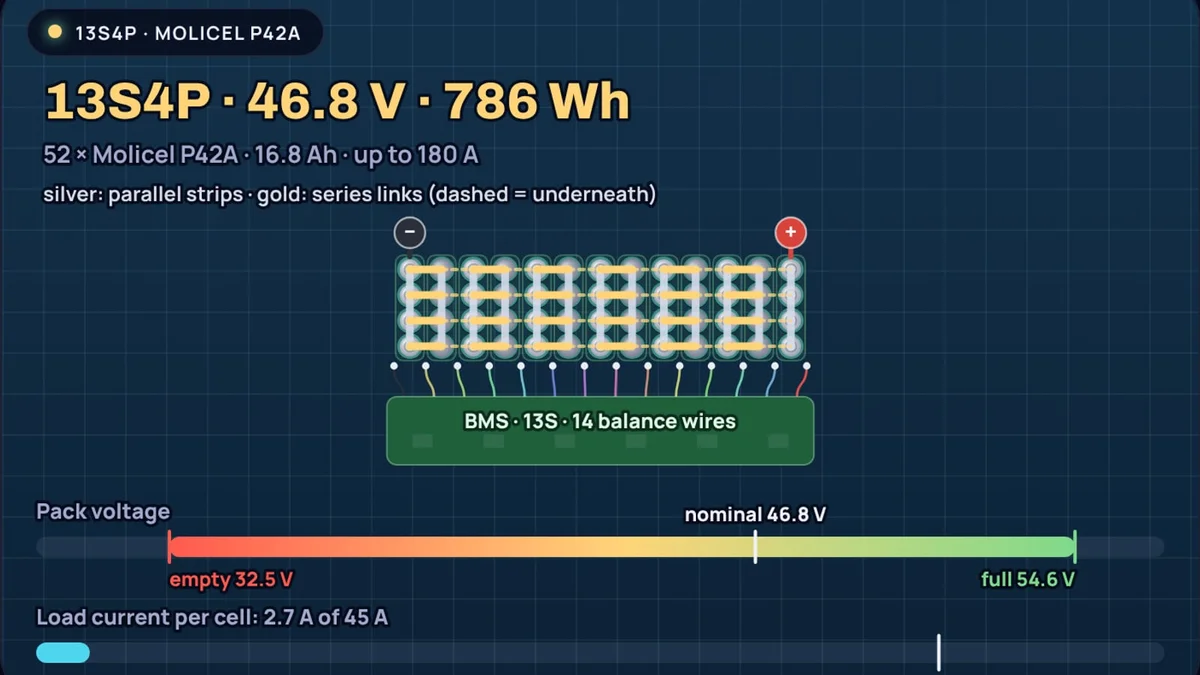
An e-bike battery labelled "48 V 17 Ah" is a box of identical cylindrical cells, usually 50 or so, welded together with nickel strips. How they are arranged decides everything on the label. Put cells end to end and the voltages add. Put them side by side and the capacities add. Do both and you get the S and P numbers that pack builders talk about: 13S4P, 10S3P, 3S2P.
This post works through the arithmetic with three real cells and their datasheets: the Samsung 30Q (18650), the Molicel P42A (21700) and a 32700 LiFePO4 cell. The battery pack calculator draws any S × P arrangement with its strips, series links and BMS, and every number below comes from it.
Series cells add voltage
Connect the positive end of one cell to the negative end of the next and the voltages stack, like batteries end to end in a torch. The same current flows through every cell, so the capacity in amp hours does not change.
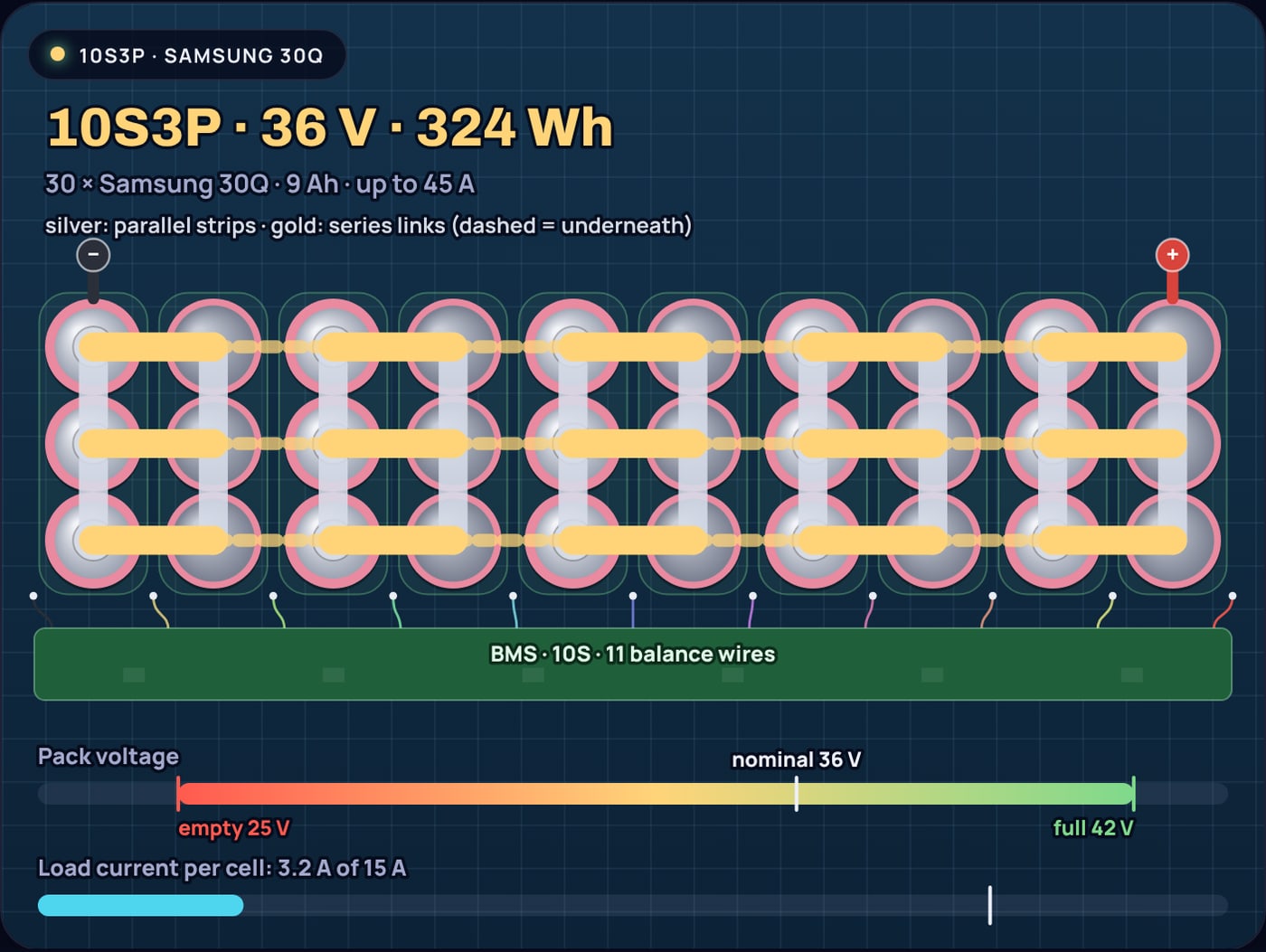
A lithium ion cell has three voltages that matter. The Samsung 30Q datasheet gives 3.60 V nominal, a charge voltage of 4.2 V, and an end (cut-off) voltage of 2.5 V. A pack has the same three, multiplied by the number in series. Three 30Q cells in series are 10.8 V nominal, 12.6 V full and 7.5 V empty.
Parallel cells add capacity and current
Connect cells side by side, all positives together and all negatives together, and the voltage stays the same while the capacity adds. A group of cells in parallel behaves like one big cell. Each cell also shares the load current, so the pack can deliver the sum of the cells' current ratings.
Real packs combine both. Cells are first joined in parallel groups; the groups are then joined in series. "3S2P" means three groups in series, each of two cells in parallel.
Example 1: a 3S2P pack of Samsung 30Q cells
Datasheet: 3,000 mAh, 3.60 V nominal, 4.2 V full, 2.5 V empty, 15 A maximum continuous discharge.
At a 150 W load the pack gives 150 ÷ 10.8 = 13.9 A, or 6.9 A per cell, well inside the 15 A rating, for about 26 minutes.
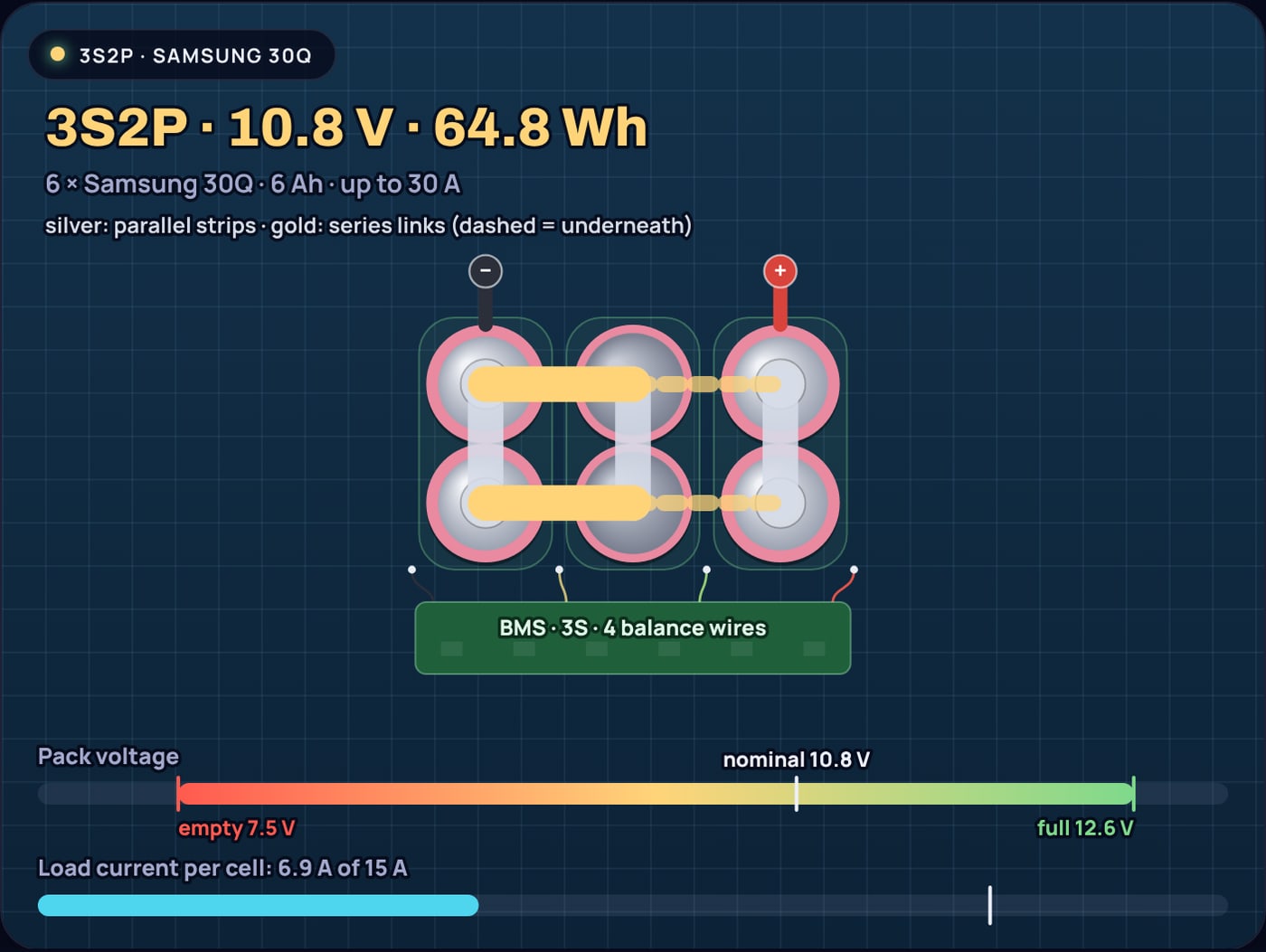
The cells in neighbouring groups face opposite ways. The first group stands positive end up, the next negative end up, so one strip across the top can join the positive of one group to the negative of the next. The following link runs along the bottom, and so on, zig-zagging through the pack.
Energy counts every cell
Watt hours are volts times amp hours. Because series multiplies one and parallel multiplies the other, the energy is simply the number of cells times one cell's energy, however they are arranged.
Example 2: a 13S4P e-bike pack of Molicel P42A cells
Datasheet: 4,200 mAh typical, 3.6 V nominal, 4.2 V charge, 2.5 V discharge cut-off, 45 A continuous, 70 g maximum.
Molicel's sheet lists 15.5 Wh per cell, a little more than 3.6 × 4.2 = 15.1, because it counts the actual average voltage during a slow discharge. The calculator uses the nominal figure.
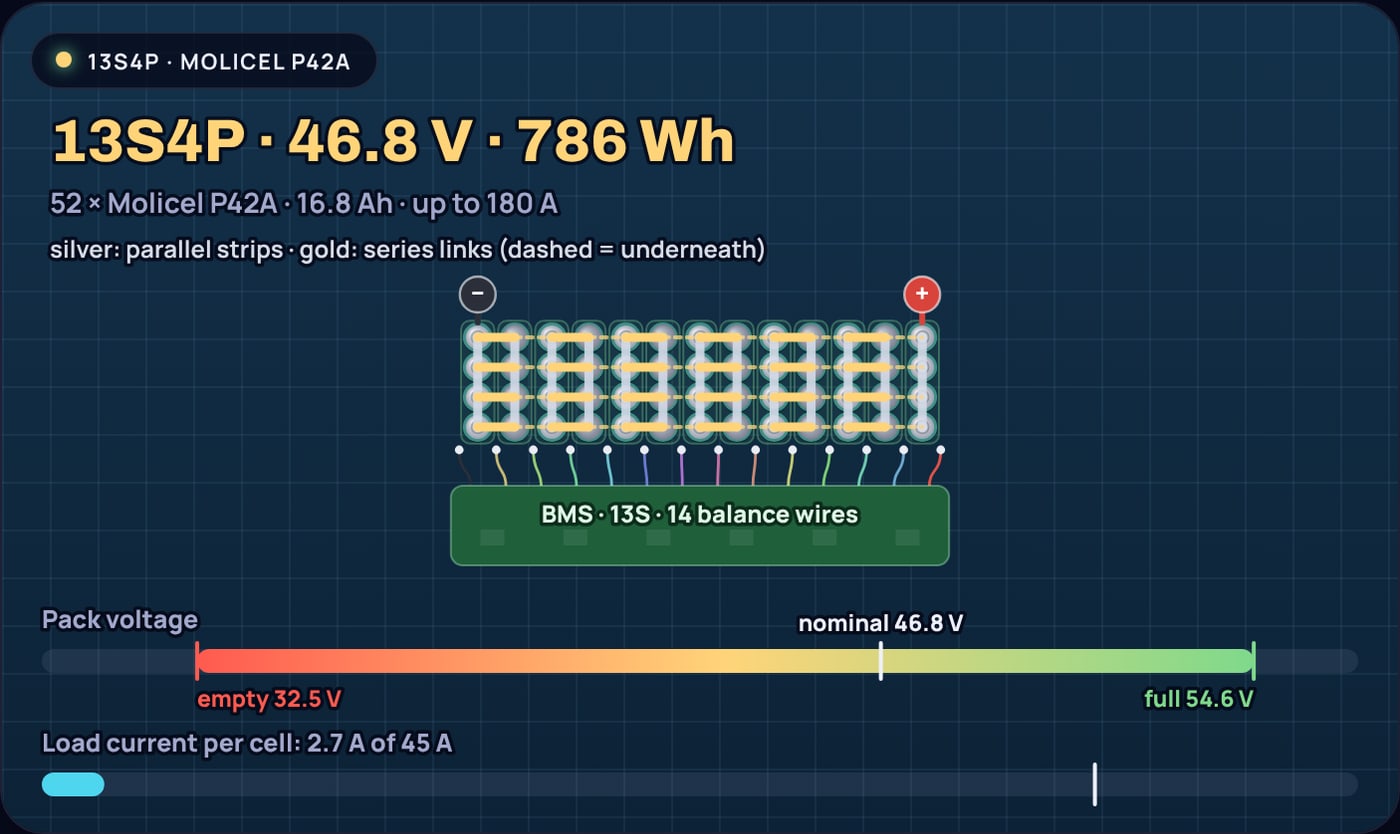
The same energy can come from smaller cells. Thirteen groups of five Samsung 30Q cells, 65 cells in all, give 702 Wh at the same 46.8 V. The 30Q pack has more cells and less energy, and its 75 A current limit is well below the 180 A of the P42A pack.
What do 36 V and 48 V packs really measure?
The voltage on the label is the nominal voltage, and many sellers count it at 3.7 V per cell, so a 13S pack becomes "48 V" (13 × 3.7 = 48.1 V). The 30Q and P42A datasheets give 3.6 V. Either way, the real voltage swings widely between full and empty:
| Series | Nominal (3.6 V) | Full (4.2 V) | Empty (2.5 V) | Usually sold as |
|---|---|---|---|---|
| 3S | 10.8 V | 12.6 V | 7.5 V | 11.1 V or 12 V class |
| 4S | 14.4 V | 16.8 V | 10 V | 14.4 V or 14.8 V |
| 7S | 25.2 V | 29.4 V | 17.5 V | 24 V |
| 10S | 36 V | 42 V | 25 V | 36 V |
| 13S | 46.8 V | 54.6 V | 32.5 V | 48 V |
| 14S | 50.4 V | 58.8 V | 35 V | 52 V |
| 20S | 72 V | 84 V | 50 V | 72 V |
The charger has to match the full voltage exactly: 42 V for a 10S pack, 54.6 V for 13S. The empty figure is the cells' absolute limit; most BMS boards and controllers cut off before it.
A 12 V battery from LiFePO4 cells
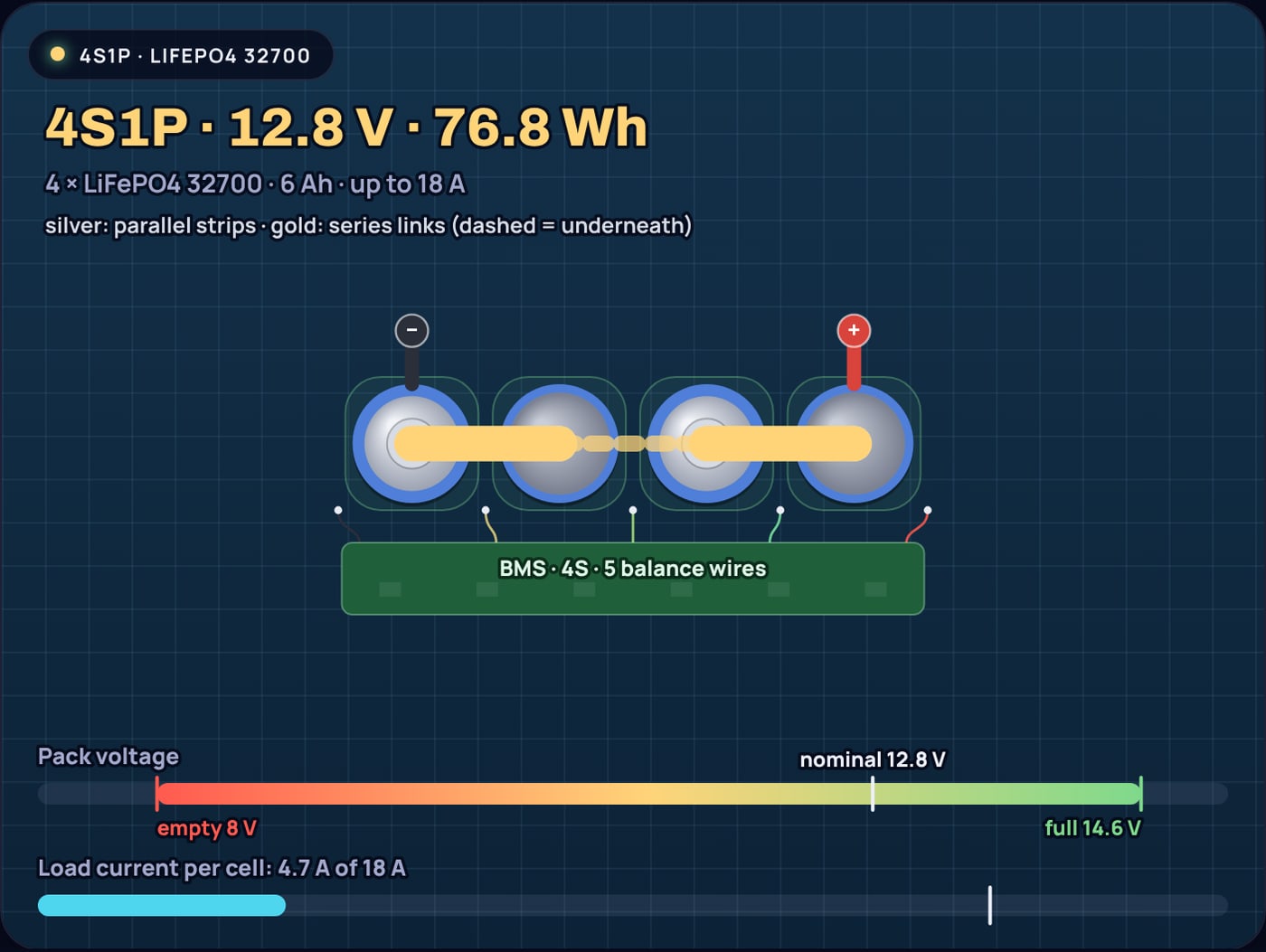
Lithium iron phosphate cells run at a lower voltage. The 32700 specification used here gives 6,000 mAh, 3.2 V nominal, a 3.65 V charge limit, a 2.0 V cut-off and a maximum discharge of 3C, which is 18 A for a 6 Ah cell. Four in series make 12.8 V nominal and 14.6 V full, close to a 12 V lead acid battery, which is why 4S LiFePO4 packs are sold as drop-in replacements.
Example 3: 4S LiFePO4, one cell and four cells per group
A 200 W load runs from the 4S4P pack for about 1.5 hours. Note that it still needs a charger set for LiFePO4, ending at 14.6 V, rather than a lead acid profile.
How many cells in parallel for the current?
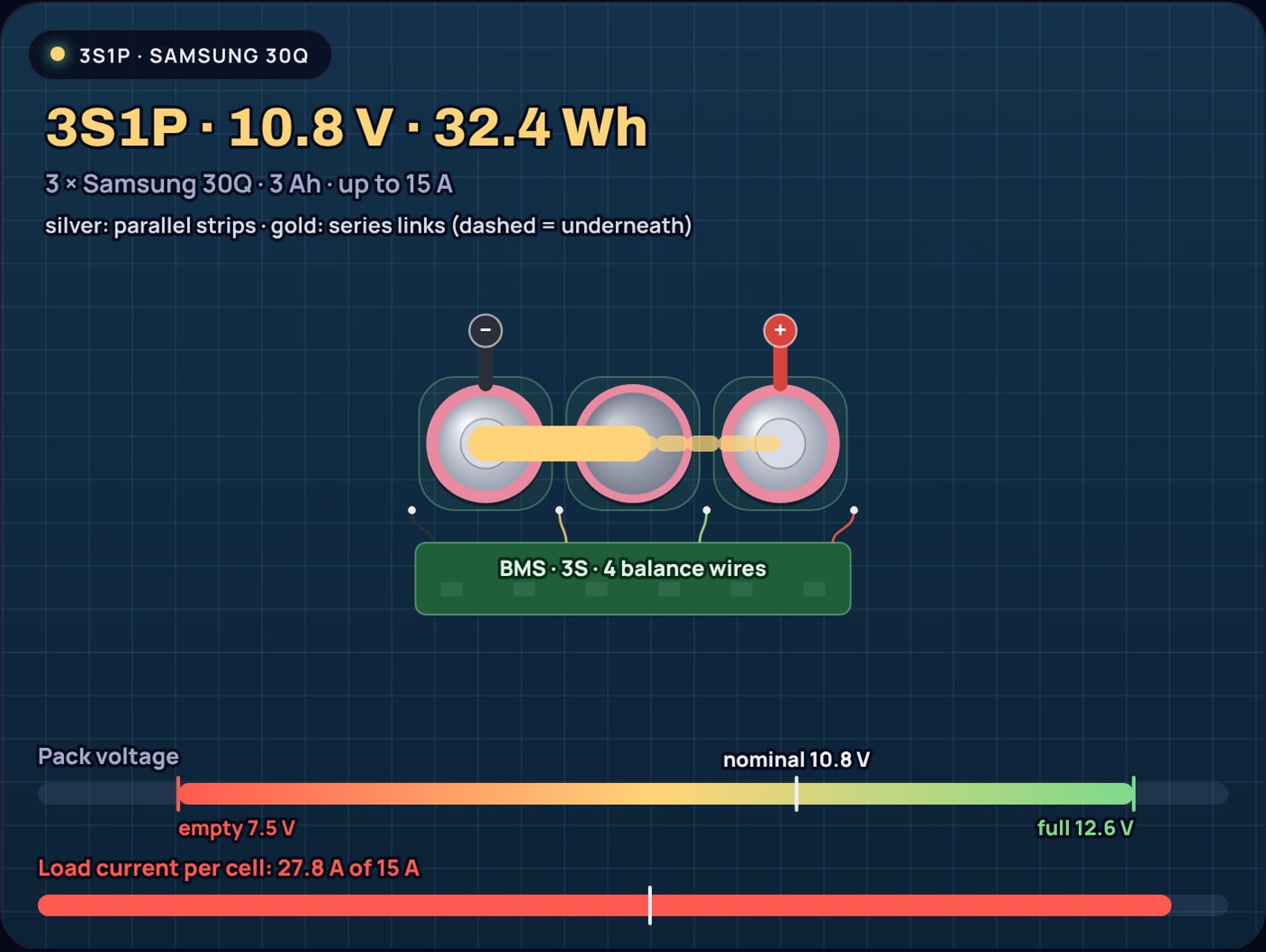
Parallel is not only about capacity. The load current divides between the cells of each group, and each cell has a continuous rating on its datasheet: 15 A for the 30Q, 45 A for the P42A. Divide the load power by the pack voltage, then by the number in parallel:
A 3S1P pack of 30Q cells asked for 300 W must give 300 ÷ 10.8 = 27.8 A, nearly twice the 15 A rating. Adding a second cell in parallel halves that to 13.9 A. Capacity also falls at high current: the 30Q sheet rates the cell at 3,000 mAh at a slow 0.2C discharge but 2,700 mAh at 10 A. The same idea, expressed as a C rating, is behind LiPo C ratings.
Why every series pack needs a BMS
No two cells are identical. Over many cycles one parallel group in a series string ends up holding slightly more or less charge than the others. The charger only sees the total pack voltage, so it cannot tell when one group has passed 4.2 V while another sits lower. Without a battery management system the highest group is overcharged at every charge and the lowest is driven below its cut-off at every discharge.
A BMS watches each group through a balance wire at every junction, one more wire than there are groups: 4 for 3S, 14 for 13S. It bleeds charge from high groups to keep them level, and it disconnects the pack on overcharge, overdischarge, too much current or a short circuit. Choose one rated for the pack's series count, chemistry and current, and build each parallel group from matched cells of the same model, charge and age.
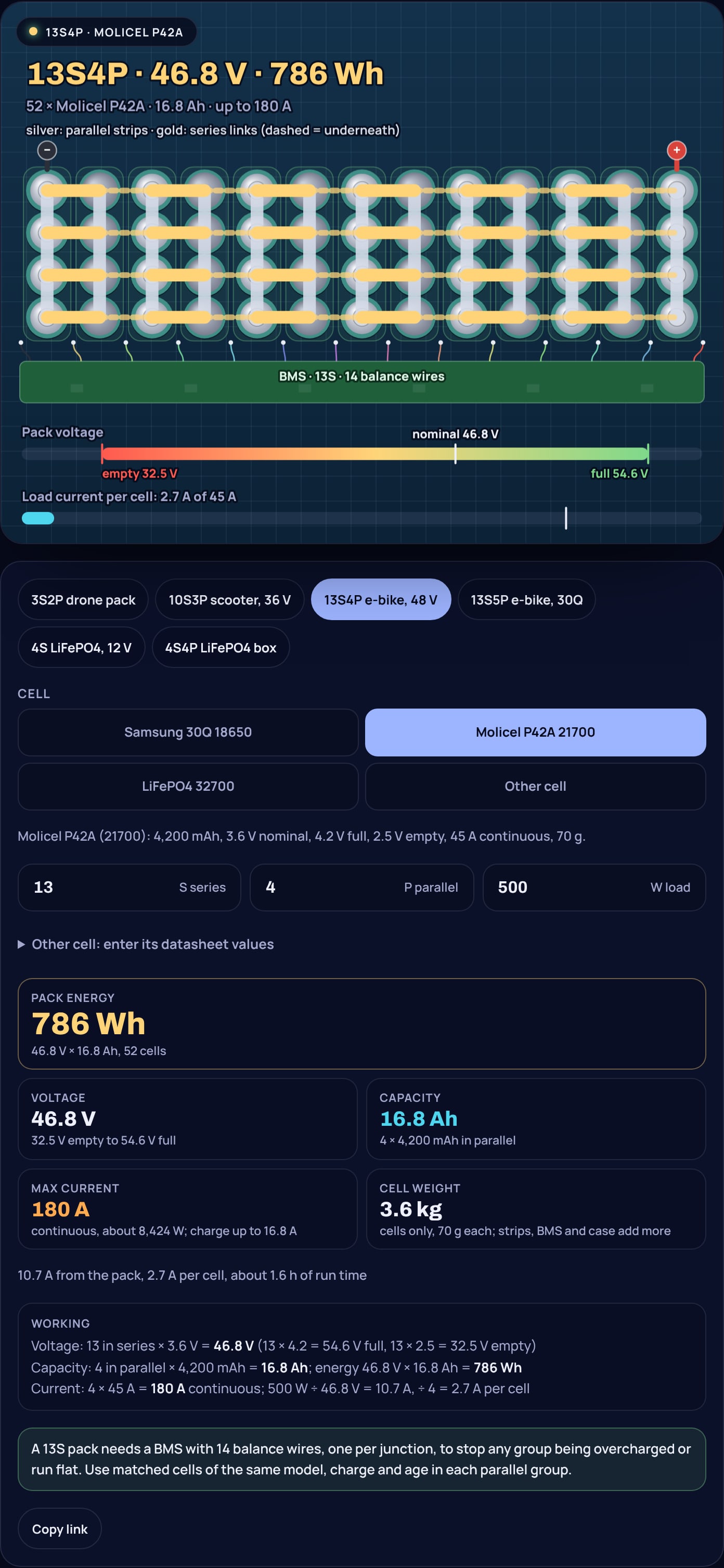
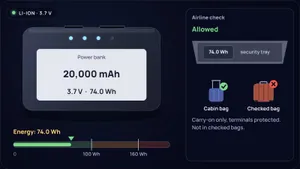
To plan a pack, open the battery pack calculator, pick a cell or enter one from its datasheet, and change S and P until the voltage, energy and current fit. For a single battery or an airline check, the mAh to Wh converter does the conversion.
Sources
- Samsung SDI: Introduction of INR18650-30Q (August 2014) (3,000 mAh at 0.2C, 2,700 mAh at 10 A, 3.60 V, CC-CV 4.2 V, 2.5 V end voltage, 15 A continuous, 4 A max charge, 48.0 g max)
- Molicel: INR-21700-P42A product data sheet (4,200 mAh typical, 15.5 Wh, 3.6 V, 4.2 V charge, 2.5 V discharge, 45 A continuous, 4.2 A standard charge, 70 g max)
- Specification of product, LiFePO4 32700-6000mAh (6,000 mAh, 3.2 V, 3.65 V charge limit, 2.0 V cut-off, 3C max discharge, about 141 g)
Frequently asked questions
How do you calculate battery pack voltage?
Multiply the cell voltage by the number of cells in series. Thirteen 3.6 V lithium ion cells make 46.8 V nominal, 54.6 V when full at 4.2 V each and 32.5 V when empty at 2.5 V each.
How do you calculate battery pack capacity?
Multiply one cell’s capacity by the number of cells in parallel. Four 4,200 mAh cells in parallel make 16.8 Ah, however many groups are in series.
What does 3S2P mean?
Three cells in series and two in parallel, six cells in all. With Samsung 30Q cells (3,000 mAh, 3.6 V) it is 10.8 V, 6 Ah and 64.8 Wh.
Is series or parallel better?
Neither. Series raises the voltage, which the motor or device needs; parallel raises the capacity and the current the pack can give. Most packs use both, and the energy is the same for the same number of cells.
Do I need a BMS for a battery pack?
Yes. A BMS protects against overcharge, overdischarge, too much current and short circuits, and in any pack with cells in series it keeps the groups balanced through one wire per junction, 14 wires for a 13S pack.