Series vs Parallel Circuits: Why Houses Are Wired in Parallel
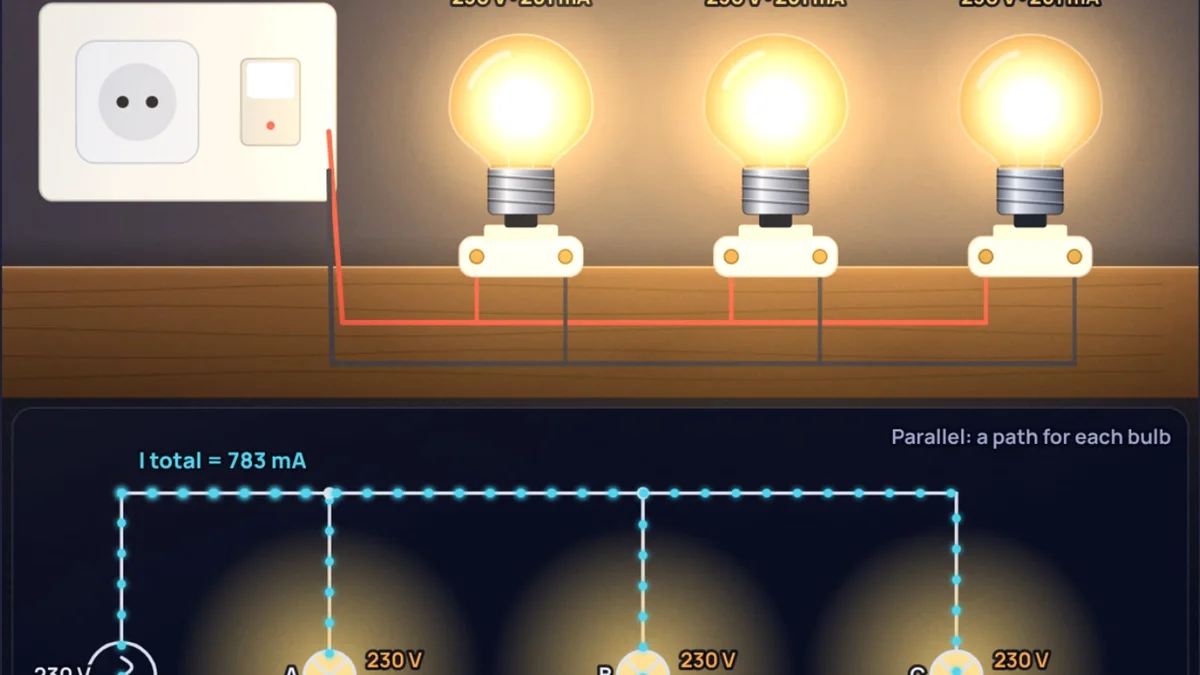
Every Diwali someone in the family untangles last year's string of lights, plugs it in, and half of it stays dark. One bulb has failed and taken fifty others with it. Meanwhile the tube light, the fan and the fridge in the same room carry on, no matter which of them is switched off. The difference is not the quality of the parts. It is how they are connected: the light string is wired in series, the house is wired in parallel. You can wire both yourself, and unscrew bulbs to see what happens, in our series and parallel circuits simulator.
What is a series circuit?
In a series circuit the parts sit one after another on a single loop. Charge leaving the battery has to pass through the first bulb, then the second, then return. There is nowhere else to go, so the current is the same at every point in the loop.
Take two identical torch bulbs rated 6 V 3 W, the kind that runs from four AA cells. A bulb's working resistance follows from its rating, because power is .
Worked example: two 6 V 3 W bulbs in series on 6 V
Each bulb gets half the voltage but only a quarter of its 3 W rating. Power goes as voltage squared, so halving the voltage quarters the power.
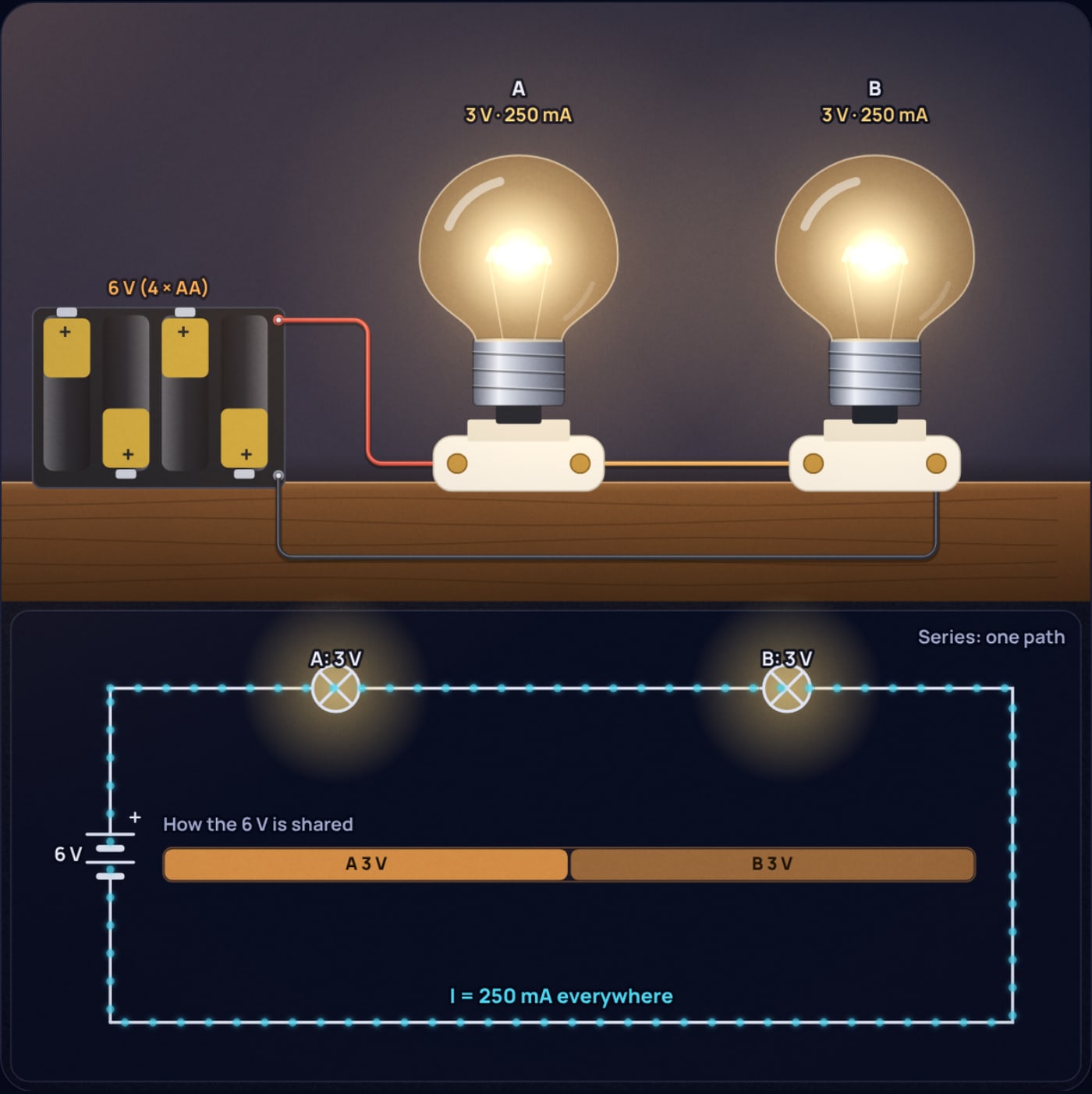
Add a third bulb and it gets worse: 36 Ω total, 167 mA, 2 V per bulb and 0.33 W each, which is 11 percent of rated power. Every bulb you add to a series string dims all the others.
What is a parallel circuit?
In a parallel circuit each bulb has its own branch from one side of the supply to the other. Both ends of every bulb connect directly to the battery terminals, so every bulb sees the full battery voltage. The branches do not care about each other.
Worked example: the same bulbs in parallel on 6 V
Each bulb is at full rated power. The battery pays: it now supplies 1 A instead of 0.25 A, four times as much, and will go flat four times sooner.
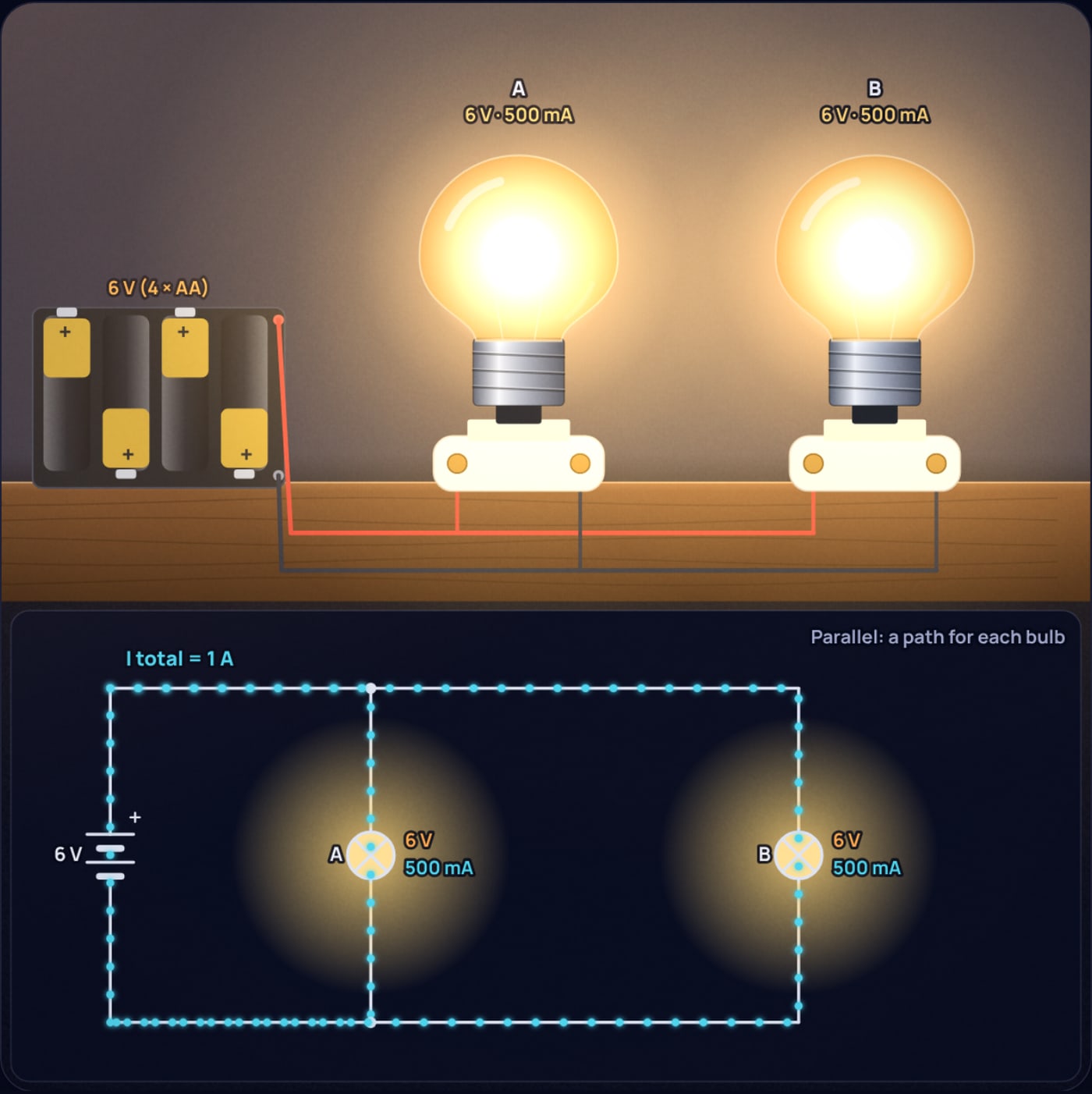
Notice the total resistance fell to 6 Ω, less than either bulb on its own. Adding a parallel branch always lowers the total resistance, because you are adding another path for the charge. That is the source of a lot of confusion: more bulbs, less resistance.
Series vs parallel at a glance
| Series | Parallel | |
|---|---|---|
| Paths for current | One | One per branch |
| Current | Same everywhere | Adds up: I = I1 + I2 + … |
| Voltage | Shared: V = V1 + V2 + … | Same across every branch |
| Total resistance | R1 + R2 + … | 1/R = 1/R1 + 1/R2 + … |
| 2 bulbs (6 V 3 W on 6 V) | 24 Ω, 0.25 A, 0.75 W each | 6 Ω, 1 A, 3 W each |
| One bulb removed | All go dark | The rest carry on |
| Where you find it | Old festive light strings, cells in a torch, fuses and switches | House wiring, car electrics, power strips |
What happens when one bulb goes out?
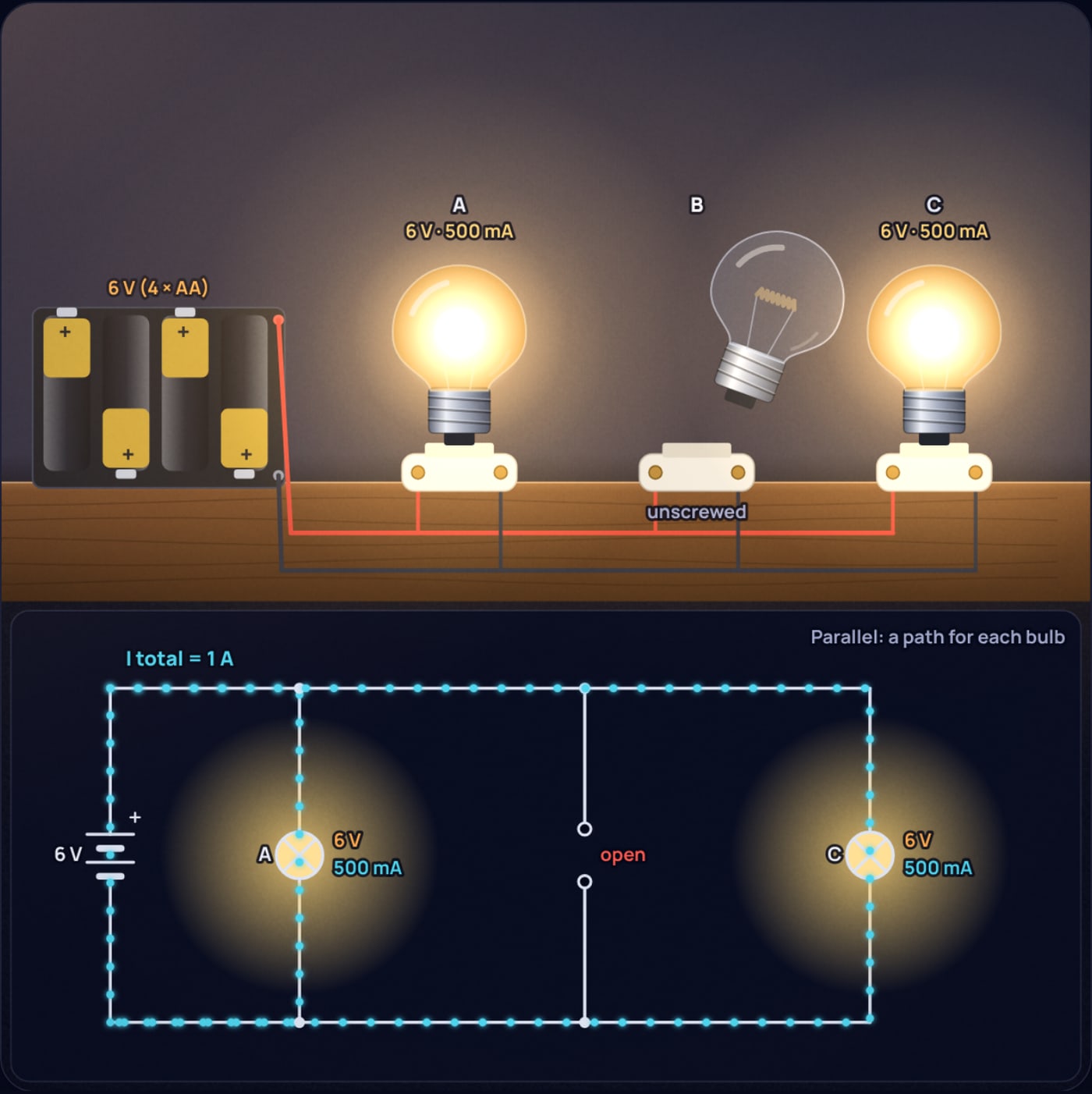
In series, removing a bulb opens the only loop there is. The current drops to zero everywhere, and every bulb goes dark, including the healthy ones. The whole 6 V now sits across the empty holder, which is a handy fault-finding trick: with a multimeter across each bulb of a dead series string, the one showing the full supply voltage is the broken one.
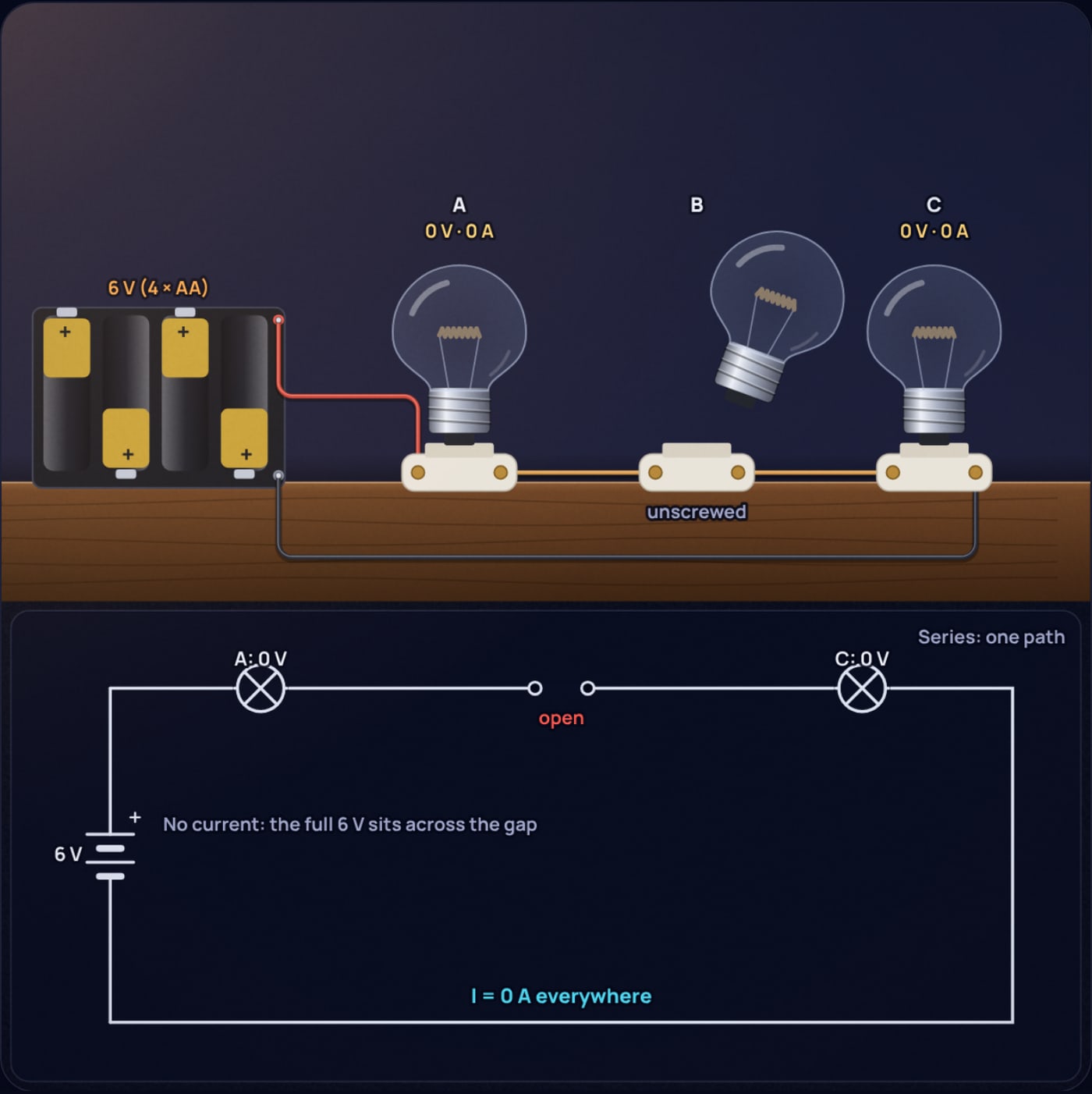
In parallel, removing bulb B only opens its own branch. A and C keep their full 6 V and 500 mA each, and the battery current simply drops from 1.5 A to 1 A.
Festive mini-light strings are the classic series circuit. A common design puts 50 bulbs on each circuit, so on a 120 V American supply each bulb runs at about 2.4 V. Since the early 1970s these bulbs have carried a hair-thin shunt wire in the base that takes over when the filament fails, so a burnt-out bulb no longer kills the string. A bulb pulled out of its socket still does, because the shunt goes with it.
Why are houses wired in parallel?
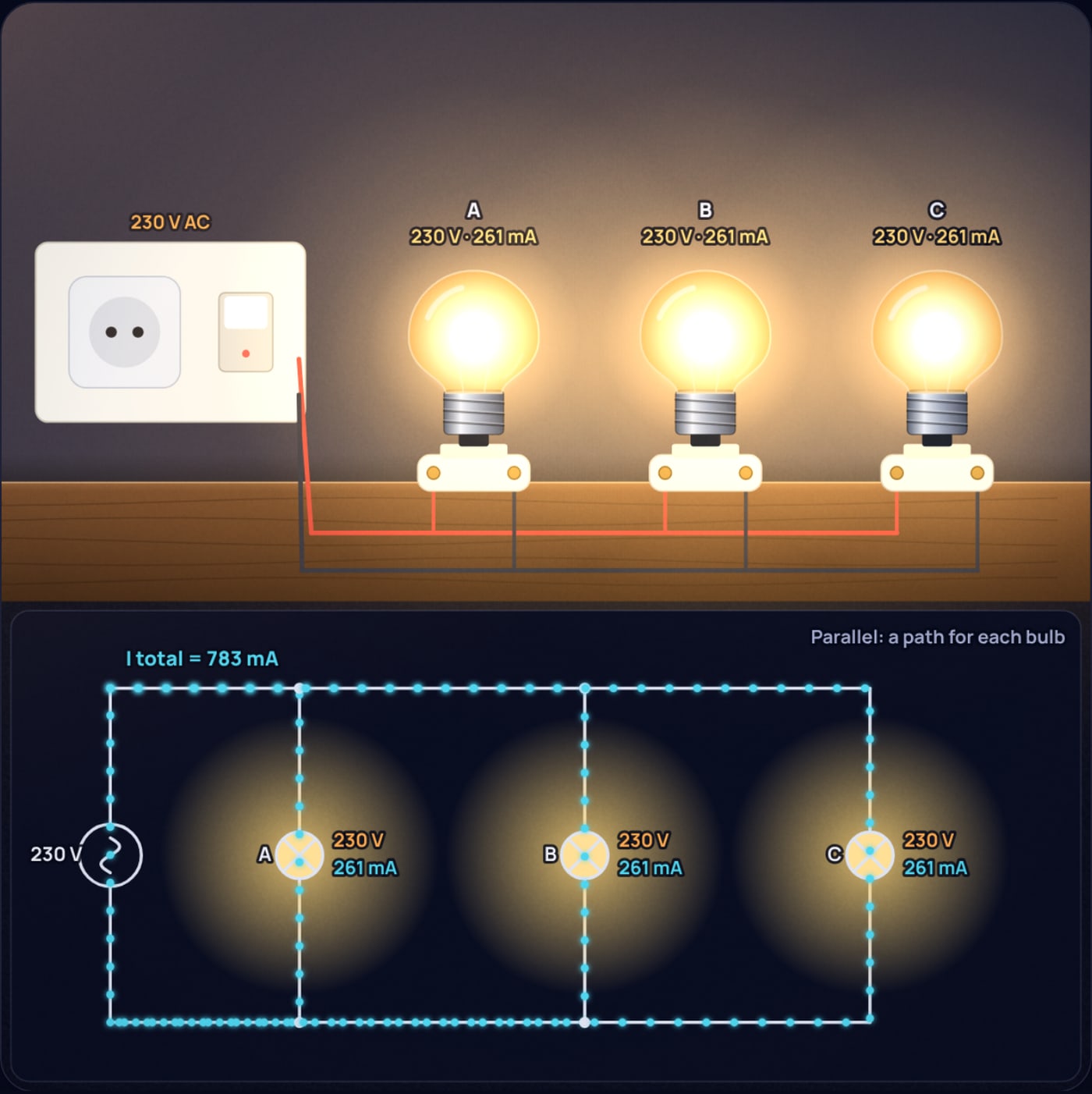
India's mains supply is 230 V at 50 Hz. Every light, fan and socket in a home is connected across those 230 V, each in its own branch with its own switch. That gives three things a series layout cannot: every appliance gets the voltage it was designed for, each can be switched independently, and a failure in one does not cut the others.
Worked example: three 60 W bulbs on 230 V
Wired in series, each 60 W bulb would run at about 11 percent of its power: a dull orange glow, and the whole room dark the moment one bulb fails.
The catch with parallel is that the currents add up, and the wire and the circuit breaker have to carry the total. Indian heavy-duty sockets (Type M) are rated 16 A. Run a 2,000 W geyser and a 1,500 W iron on the same circuit and the total current is 3,500 / 230 = 15.2 A, right at the limit. Add a 1,000 W kettle and it is 19.6 A, and the MCB trips. Adding appliances in parallel never dims them; it loads the wiring instead. That is also why power lines use high voltage: for the same power, a higher voltage means a smaller current in the wires.
Is a higher wattage bulb always brighter?
Only in parallel. In series it is the other way round, and it surprises nearly everyone the first time. A 6 V 6 W bulb has a resistance of 6 Ω; a 6 V 3 W bulb has 12 Ω. Put them in series on 6 V and they share one current, 6 / 18 = 0.333 A. The voltage divides in proportion to resistance: 2 V across the 6 W bulb, 4 V across the 3 W bulb.
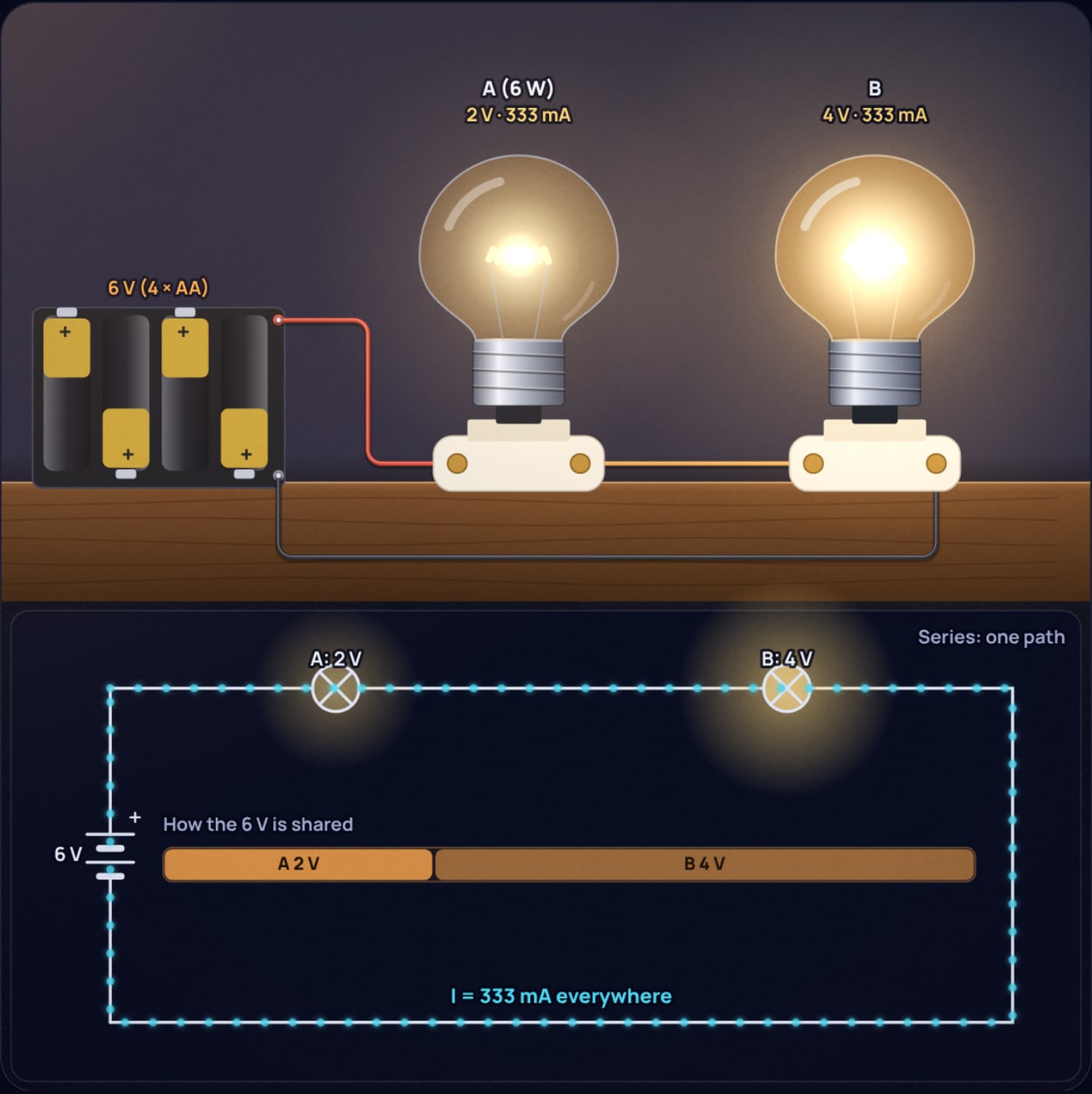
So the "stronger" bulb glows dimmer. Wattage is not a property of the bulb alone; it is what the bulb does at its rated voltage. Move the same two bulbs into parallel and the 6 W bulb is twice as bright again. This is a favourite board exam question, usually with 100 W and 60 W household bulbs, and the answer is the same.
A misconception worth dropping: current gets used up
A lot of students picture the first bulb in a series string "using up" some current so less is left for the next one. If that were true the first bulb would be brighter. It is not: in the simulator, and in any real circuit, identical bulbs in series glow identically, and an ammeter reads the same current before, between and after them. What the bulbs use up is energy. Each coulomb of charge arrives at a bulb with some energy per coulomb (that is what voltage means), leaves some of it as heat and light, and carries the rest on. The current, the rate at which charge goes round, is the same all the way.
One real-world caveat to the simple numbers above: a tungsten filament's resistance rises steeply with temperature, about 14 times from room temperature to 2,700 K. An underpowered bulb in series runs cooler and has lower resistance than its rating suggests, so it draws a bit more current and glows a little brighter than the fixed-resistance model predicts, though with a redder colour. The pattern, dim in series and full in parallel, does not change.
Try it yourself
Load three household bulbs in series on 230 V and watch them barely glow, then switch to parallel. Tap any bulb on the stage to unscrew it. For more on how components share voltage, see our post on whether a voltage divider can work as a power supply, and for why the series resistor matters with LEDs, why LEDs need a resistor. And if you have ever wondered why a bird on one wire is safe, it is a parallel circuit question too.
Sources
- WorldStandards, India plugs, sockets and voltage (230 V, 50 Hz, Type D 6 A and Type M 16 A): worldstandards.eu/electricity/plug-voltage-by-country/india
- Christmas Light Source, "If a mini light bulb burns out, will the rest stay lit?" (two circuits of 50 lights, shunt wire since the early 1970s): christmas-light-source.com
- The Physics Factbook, "Resistivity of Tungsten" (5.65 µΩ cm at 300 K, 81.0 µΩ cm at 2,700 K, ratio 14.3): hypertextbook.com/facts/2004/DeannaStewart.shtml
Frequently asked questions
Why are houses wired in parallel?
So that every light and appliance gets the full mains voltage (230 V in India) and can be switched on or off without affecting the others. In series the voltage would be shared, so three 60 W bulbs would get about 77 V each and glow at about 11 percent of their power, and one failure would cut the whole circuit.
What happens if one bulb goes out in a series circuit?
The loop is broken, so the current drops to zero everywhere and every bulb goes dark. The full supply voltage appears across the gap where the bulb was. In a parallel circuit the other bulbs keep working at full brightness.
Is current the same in series or in parallel?
In series the current is the same through every component, because there is only one path. In parallel the voltage is the same across every branch, and the currents in the branches add up to the current from the supply.
Which is brighter, bulbs in series or bulbs in parallel?
Bulbs in parallel. Each gets the full supply voltage. Two identical bulbs in series each get half the voltage, and because power goes as voltage squared, each gives only about a quarter of its rated power.
Why is a 100 W bulb dimmer than a 60 W bulb in series?
A higher wattage bulb has a lower resistance. In series both carry the same current, so the voltage divides in proportion to resistance and the lower resistance bulb gets the smaller share. In parallel the 100 W bulb is brighter, because both get the full voltage.
 555 Timer Frequency Formula: Where 1.44 Comes From
 ADC Resolution vs Accuracy: ENOB, INL and the Reference