What is the difference between series and parallel circuits?
In a series circuit the components sit one after another on a single loop, so the same current flows through all of them and they share the supply voltage. In a parallel circuit each component has its own branch straight across the supply, so each gets the full voltage and the currents add up. That is why two identical bulbs in series glow dimly and two in parallel glow at full brightness, and why unscrewing one bulb kills a series string but leaves a parallel one lit.
The numbers make it concrete. Two 6 V 3 W torch bulbs (12 Ω each when hot) in series on a 6 V battery get 3 V each and draw 250 mA: each runs at 25% of its rated power. The same two bulbs in parallel get the full 6 V each and the battery supplies 1 A. For more on resistance and why power matters, see why LEDs need a resistor and the LED resistor calculator.
Key results from the simulation
- Series shares voltage: 2 bulbs on 6 V get 3 V each; 3 bulbs get 2 V each and only 11% of rated power. Every bulb you add makes all of them dimmer.
- Parallel shares current: each bulb draws its own 500 mA, so 3 bulbs pull 1.5 A from the battery and the total resistance falls to 4 Ω. More bulbs means more current, not dimmer bulbs.
- One out, all out (series only): unscrew bulb B in a 3 bulb series string and the current drops to 0 A everywhere. In parallel the other two stay at 100% and the battery current falls to 1 A.
- In series the bigger bulb is dimmer: a 6 W and a 3 W bulb in series on 6 V get 2 V and 4 V. The 6 W bulb runs at 11% of its rating, the 3 W one at 44%.
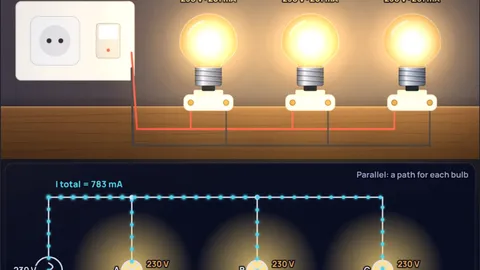
- Houses are parallel: three 60 W bulbs on 230 V each get the full 230 V and draw 261 mA; the total is 783 mA and 180 W. Wired in series they would get 76.7 V each and glow at 11% power.
Six setups to try
Each setup uses identical 6 V 3 W torch bulbs on a 6 V pack of four AA cells, except the mains setup, which uses 230 V 60 W bulbs. The button loads the same setup on the stage. Tap any bulb on the stage to unscrew it.
Two bulbs in series: half the voltage, a quarter of the power
Series, 6 V batteryWith two bulbs in a row the current has one path. The total resistance is 12 + 12 = 24 Ω, so Ohm's law gives I = 6 ÷ 24 = 250 mA, the same through both bulbs. Each bulb has 3 V across it, half the supply.
Half the voltage does not mean half the light. Power is V²/R, so half the voltage gives a quarter of the power: 0.75 W instead of 3 W. The voltage bar on the stage shows how the 6 V is split.
Two bulbs in parallel: full brightness, double the current
Parallel, 6 V batteryNow each bulb has its own branch from the + side to the − side of the battery. Each sees the full 6 V, draws 500 mA and glows at 100% of its rating. The battery supplies both branches: 1 A in total.
The total resistance drops to 6 Ω, half of one bulb. That sounds odd until you think of it as two doors instead of one: more paths, easier flow. The price is paid by the battery, which empties twice as fast.
Unscrew one bulb in series and they all go dark
Series, 3 bulbs, bulb B removedTake bulb B out of a three bulb series string and the loop is broken. No current flows anywhere, so bulbs A and C go dark too, even though they are perfectly fine. The whole 6 V now sits across the empty holder, which is why you can measure the supply voltage across a dead bulb in a series string.
This was the problem with old festival light strings: one blown bulb and the whole string went out, and you had to test them one by one. Modern strings put a shunt in each bulb or wire small groups in parallel.
Unscrew one bulb in parallel and the rest carry on
Parallel, 3 bulbs, bulb B removedIn parallel, removing bulb B only opens its own branch. Bulbs A and C still have a complete path across the battery, keep their 6 V and stay at 100% brightness. The battery current falls from 1.5 A to 1 A because one branch stopped drawing.
This independence is the whole point of house wiring: switching off the kitchen light does not switch off the fridge.
House wiring: every appliance across 230 V
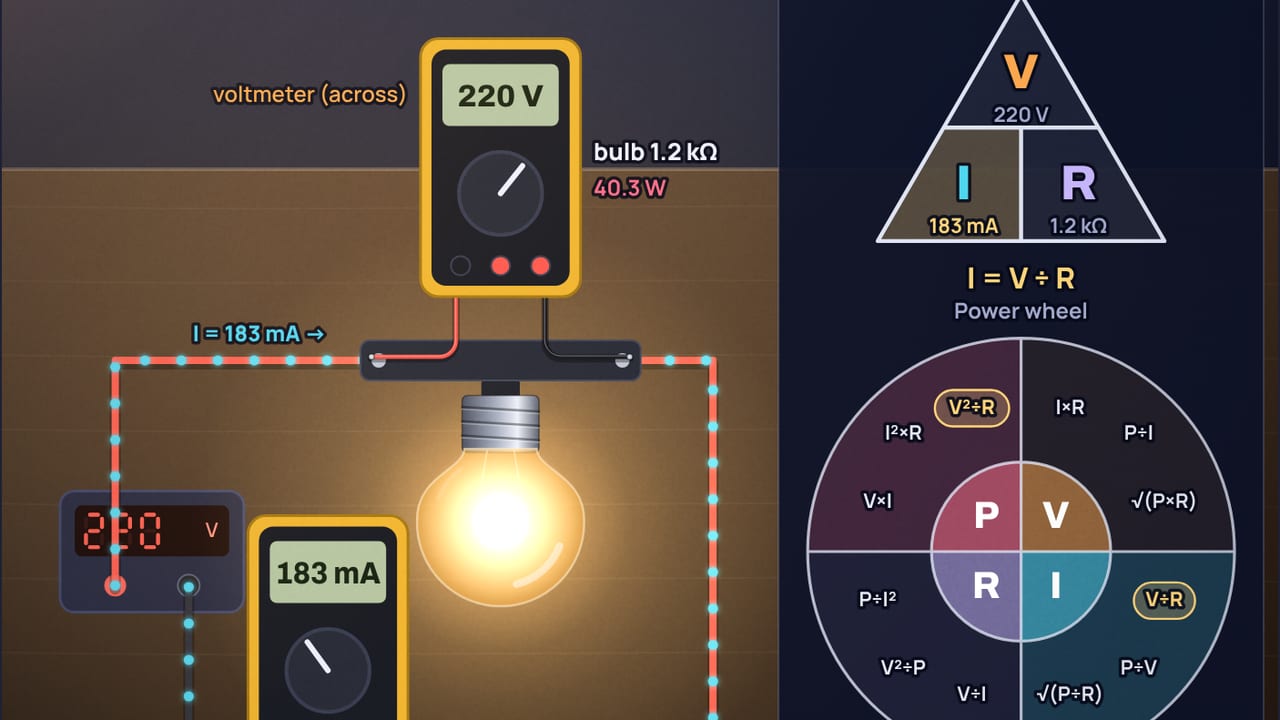
Parallel, 230 V mains, 60 W bulbsA 60 W bulb made for 230 V has a hot resistance of 882 Ω. Three of them in parallel each draw 261 mA, the total is 783 mA and the room uses 180 W. Every socket and light in a home sits across the same 230 V in parallel, and each has its own switch in its own branch.
Wire the same three bulbs in series and each gets 76.7 V and 6.67 W, about 11% of its rating: a dull orange glow. Try it with the Series button while the mains supply is selected. The page on why power lines use high voltage explains how the 230 V reaches your house.
A 6 W and a 3 W bulb in series: the bigger bulb is dimmer
Series, unequal bulbsA 6 W bulb for 6 V has 6 Ω, the 3 W one 12 Ω. In series they carry the same 333 mA, and the voltage divides in proportion to resistance: 2 V across the 6 W bulb, 4 V across the 3 W bulb.
So the 6 W bulb gets 0.67 W (11% of rating) and the 3 W bulb 1.33 W (44%). The "more powerful" bulb is the dimmer one. In parallel the order flips back, and the 6 W bulb is brighter, because both get the full voltage.
Series against parallel, side by side (6 V 3 W bulbs on 6 V)
| Setup | Total R | Supply current | Voltage per bulb | Power per bulb | Brightness |
|---|---|---|---|---|---|
| 1 bulb | 12 Ω | 500 mA | 6 V | 3 W | 100% |
| 2 in series | 24 Ω | 250 mA | 3 V | 0.75 W | 25% |
| 3 in series | 36 Ω | 167 mA | 2 V | 0.33 W | 11% |
| 2 in parallel | 6 Ω | 1000 mA | 6 V | 3 W | 100% |
| 3 in parallel | 4 Ω | 1500 mA | 6 V | 3 W | 100% |
Bulbs modelled as fixed resistances equal to their hot resistance, R = V² / P = 12 Ω. Brightness is the power a bulb gets as a share of its rated power. Real filaments run cooler and lower in resistance when underpowered, see below.
How the simulation works
Each bulb is treated as a resistor equal to its working resistance, R = V² / P from its rating: 12 Ω for a 6 V 3 W torch bulb, 882 Ω for a 230 V 60 W lamp. In series the resistances add and one current flows, I = V / (R1 + R2 + …). In parallel every bulb sees the supply voltage, each branch current is V / R, and the supply current is their sum.
Brightness on the stage follows the power each bulb actually dissipates, P = I²R, as a fraction of its rated power. The glow is drawn on a gentle curve because the eye does not see light linearly. The moving dots in the circuit diagram travel at a speed proportional to the current in each branch, so you can see the currents add where the branches join.
The battery is a pack of AA cells at 1.5 V each, with no internal resistance, so its voltage does not sag under load. The mains option uses India's nominal 230 V single phase supply and treats it as its RMS value. Removing a bulb makes its branch an open circuit with zero current.
What the model leaves out
- Filament resistance changes with temperature: tungsten is about 14 times more resistive at 2,700 K than at room temperature. An underpowered bulb runs cooler, its resistance falls and it draws more current than the fixed-resistance model says, so a series string is a little brighter in real life than shown here. It also glows redder, since a cooler filament gives off less visible light per watt.
- Battery internal resistance: real AA cells have a fraction of an ohm to an ohm of internal resistance, so the voltage drops a little when many bulbs are in parallel. The model treats the battery as ideal.
- AC details: mains voltage is alternating at 50 Hz. For a resistive load like a filament bulb, the RMS values used here give the correct average power.
- Wiring resistance and safety devices: house circuits have wire resistance, switches, MCBs and earth wires that the stage leaves out.
Common misconceptions
"Current gets used up as it goes round." No. In a series circuit the current is the same everywhere in the loop, before and after every bulb. What the bulbs use up is energy: each coulomb of charge loses some energy (voltage) in each bulb.
"The higher wattage bulb is always brighter." Only when the bulbs get their rated voltage, as in parallel. In series a 6 W bulb has lower resistance than a 3 W bulb, gets less of the voltage and glows dimmer.
"Parallel bulbs share the battery voltage." They share the current the battery delivers, not the voltage. Each parallel branch gets the full supply voltage.
Frequently asked questions
Why do bulbs get dimmer when you add more in series?
Because they share the supply voltage. With two identical bulbs on 6 V each gets 3 V, and since power goes as voltage squared over resistance, each gives 25% of its rated power. With three each gets 2 V and 11%.
Why are houses wired in parallel and not in series?
So that every appliance gets the full 230 V and can be switched on and off independently. In series, switching off or losing one appliance would break the whole circuit, and the voltage would be shared, so three 60 W bulbs in series would get only 76.7 V each and glow faintly.
What happens when one bulb is removed in a series circuit?
The circuit is broken, so no current flows and every other bulb goes out too. The full supply voltage appears across the empty socket. In a parallel circuit the other bulbs keep working because each has its own path.
Is the current the same in a parallel circuit?
No. The voltage is the same across each branch; the current in each branch depends on its resistance. The supply current is the sum of the branch currents: three 6 V 3 W bulbs in parallel draw 500 mA each and 1.5 A in total.
How do you calculate total resistance in series and parallel?
In series, add them: R = R1 + R2 + R3. In parallel, add the reciprocals: 1/R = 1/R1 + 1/R2 + 1/R3. Two 12 Ω bulbs give 24 Ω in series and 6 Ω in parallel. The parallel total is always smaller than the smallest branch.
Keep learning
Series vs Parallel Circuits: Why Houses Are Wired in Parallel
Bulbs in series share the voltage and all go dark when one fails; in parallel each gets the full 230 V. Worked numbers, diagrams and a live simulator.

Why Do LEDs Need a Resistor? The I-V Curve Explained
An LED's current rises exponentially with voltage: 0.1 V extra takes a red LED from 20 mA to 56 mA. Here is the physics, the resistor math and the fixes.

Why Is Electricity Transmitted at High Voltage? The Math
Why is electricity transmitted at high voltage? We work the I²R loss for a real 345 kV line, show why 1,100 kV is about the ceiling, and when HVDC wins.

Why Don't Birds Get Electrocuted on Power Lines?
A bird on a live wire feels about 4 millivolts and 4 microamps. We work the numbers, bust the 'not grounded' myth, and show when birds really do die.