Why Are Sunsets Red, and Why Are Mars Sunsets Blue?
On 15 April 2015, at the end of its 956th Martian day, NASA's Curiosity rover pointed its Mastcam at the western rim of Gale Crater and recorded its first sunset in colour: a small white Sun sinking behind the crater rim inside a cold blue glow. On the same planet, a few hours earlier, the sky had been the colour of butterscotch. Earth does exactly the opposite: blue skies by day, orange and red at sunset.
Both come from the same physics, scattering of sunlight by whatever is floating in the air. The difference is the size of the particles. The sky colour and sunset simulator computes every colour of the sky from that physics, for Earth and for Mars, and this post walks through the numbers.
How much more air does the setting Sun shine through?
Astronomers call it air mass: the amount of atmosphere along the line of sight, divided by the amount straight up. Overhead it is 1. For a flat atmosphere it would be 1 ÷ sin(altitude), which blows up at the horizon, but Earth's atmosphere is curved, so the real value levels off. Kasten and Young fitted it in 1989 with a formula that is still the standard:
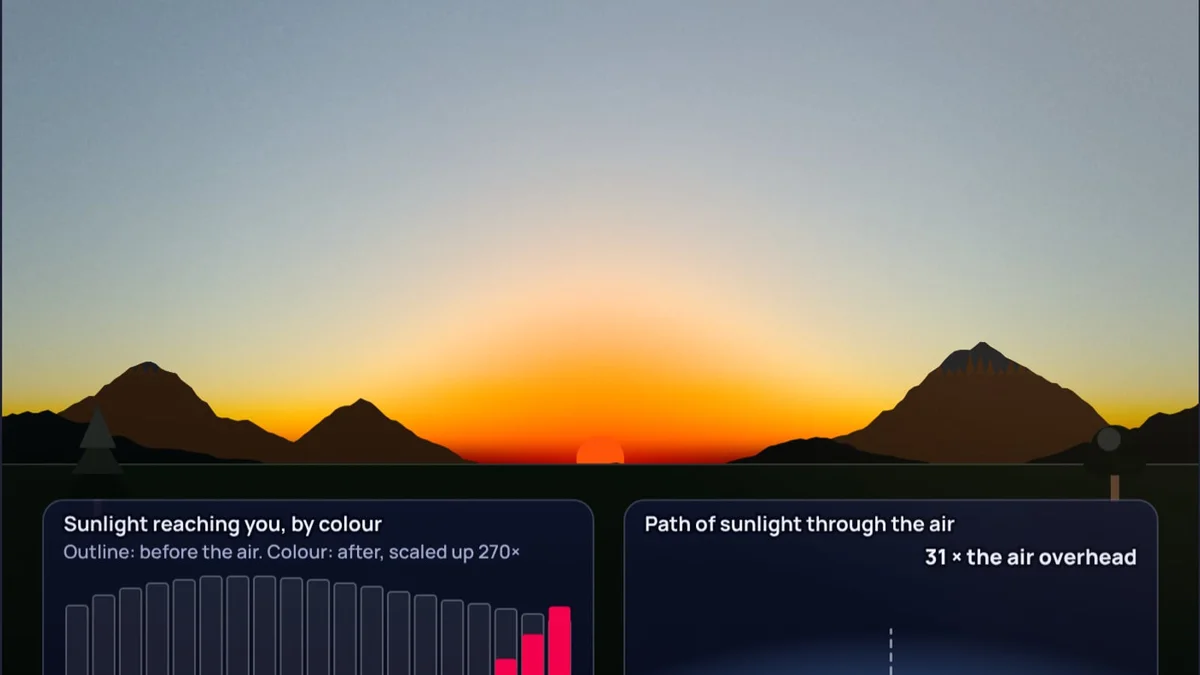
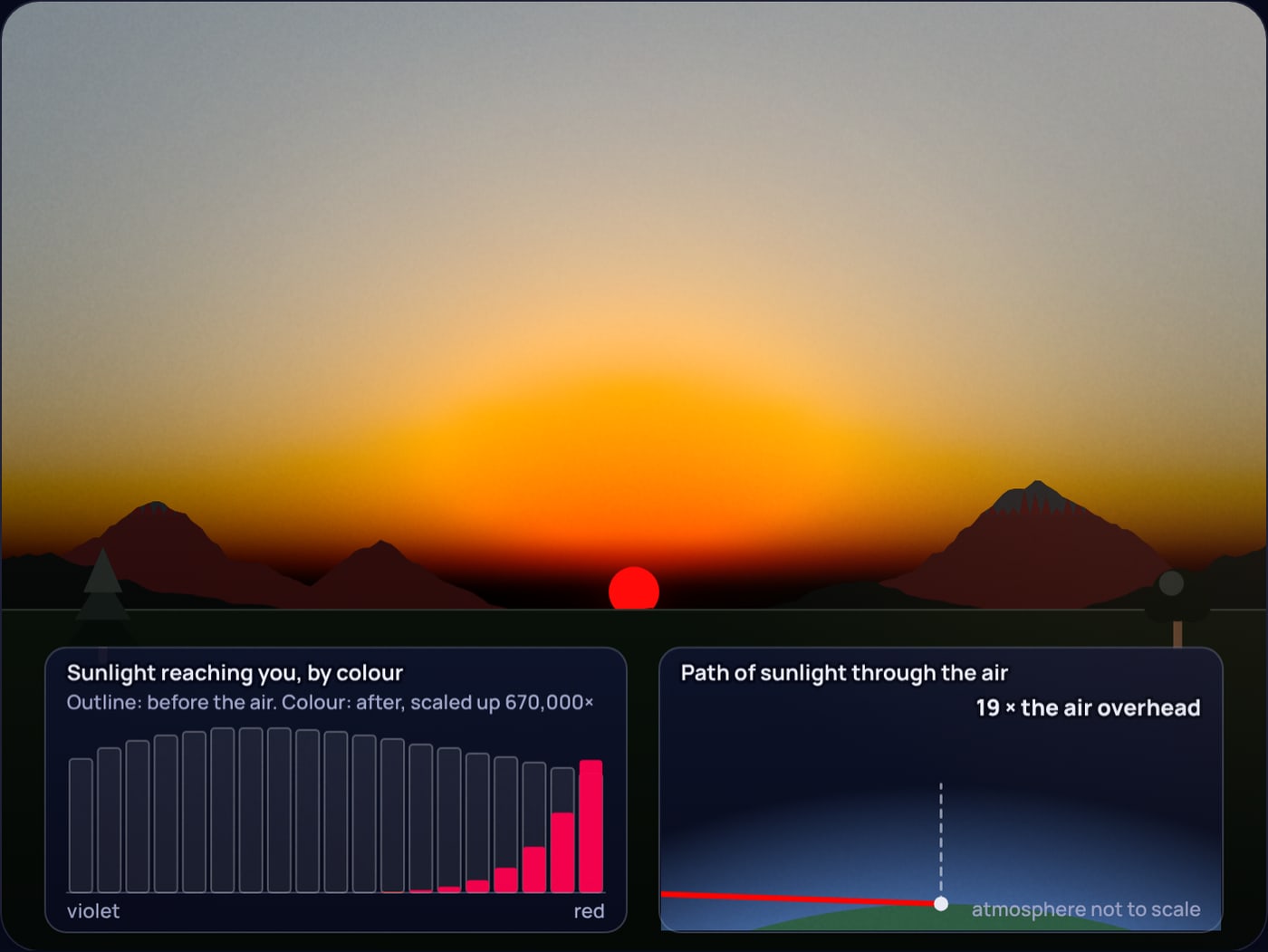
where is the Sun's angle from the zenith in degrees. It gives 2.0 with the Sun 30 degrees up, 10.3 at 5 degrees and 37.9 at the horizon. A setting Sun's light crosses nearly 38 times the air that midday light does, the equivalent of about 320 km of air at sea level density.
Why does that path remove the blue?
Molecules of nitrogen and oxygen are about a thousand times smaller than a wavelength of visible light. Particles that small scatter light with a strength proportional to , Rayleigh's law. Integrated up through the whole atmosphere, the scattering optical depth at sea level is well described by the Hansen and Travis formula, with in micrometres:
That gives 0.221 at 450 nm (blue) and 0.049 at 650 nm (red), a ratio of 4.5. The direct beam keeps the fraction of each colour.
Blue, 450 nm: , so . About 0.02% of the blue survives.
Red, 650 nm: , so . About 15% of the red survives.
Red now outnumbers blue by a factor of about 680 compared with sunlight in space. Ozone's weak absorption in the red trims the red to 12%, and the simulator computes the Sun's colour as #FF7500, deep orange, with no haze at all.
So pollution is not needed for a red sunset. Clean air and a long path are enough.
When does the Sun start to turn gold?
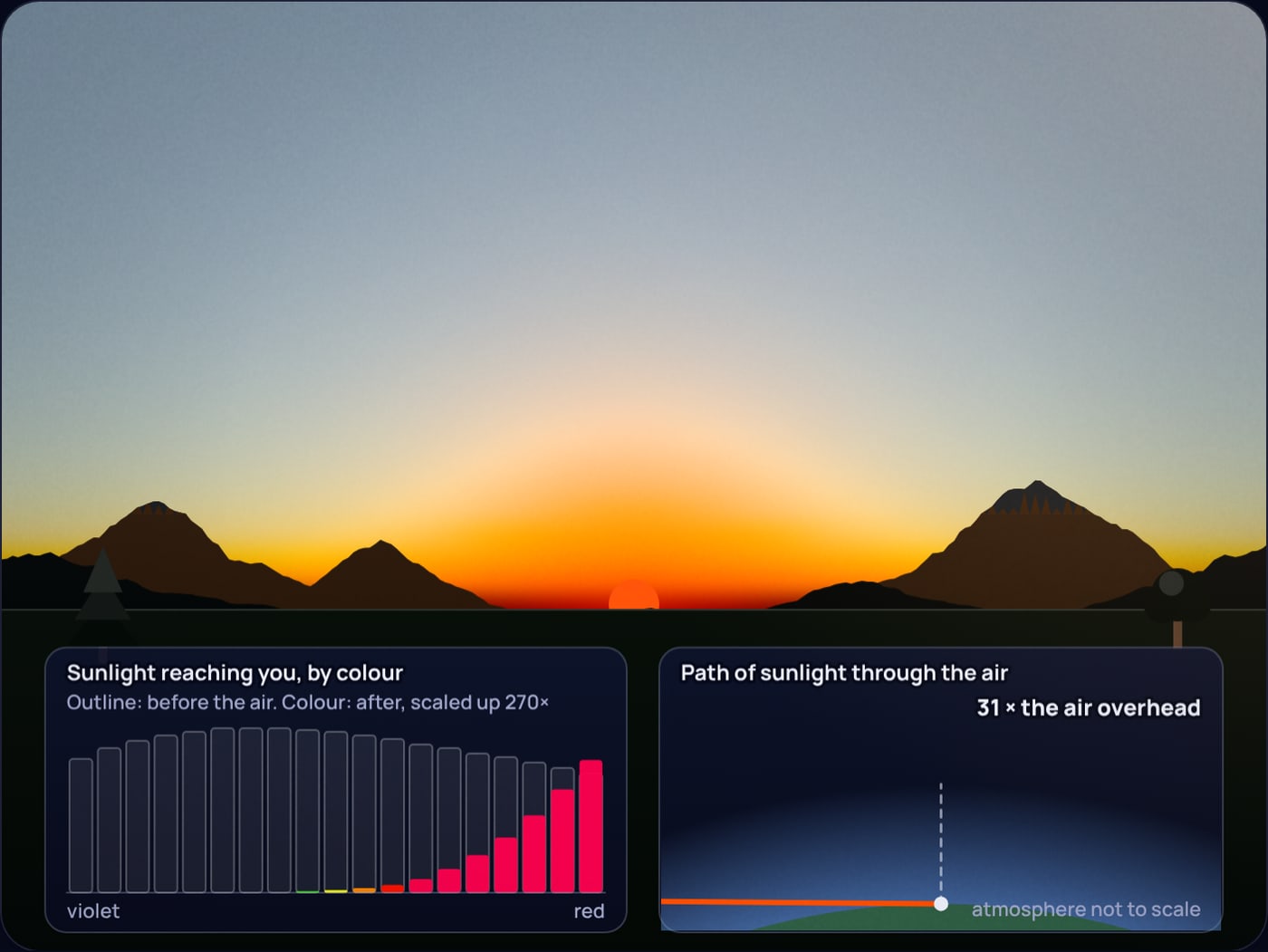
Gradually, and later than you might think. The table gives the simulator's values for an ordinary clear day, with a little haze (aerosol optical depth 0.1 at 550 nm) and normal ozone.
| Sun altitude | Air mass | Blue (450 nm) left | Red (650 nm) left | Sun colour |
|---|---|---|---|---|
| 90° | 1.0 | 70% | 86% | #FFEBD6 |
| 30° | 2.0 | 49% | 74% | #FFE6C4 |
| 10° | 5.6 | 14% | 43% | #FFD18B |
| 6° | 8.8 | 4.1% | 26% | #FFBE61 |
| 5° | 10.3 | 2.3% | 21% | #FFB54F |
| 2° | 19.4 | under 0.1% | 3.6% | #FF8700 |
| 0° | 37.9 | under 0.01% | under 0.1% | #FF2700 |
Air mass: .
Air alone: blue keeps , red keeps .
Haze lies in the lowest kilometre or so, so a low Sun's path through it is even longer than through the air. Adding it, the simulator gets 4.1% of the blue and 26% of the red, and a Sun of #FFBE61, the warm gold photographers call golden hour.
Why is the sky near the Sun orange while overhead stays blue?
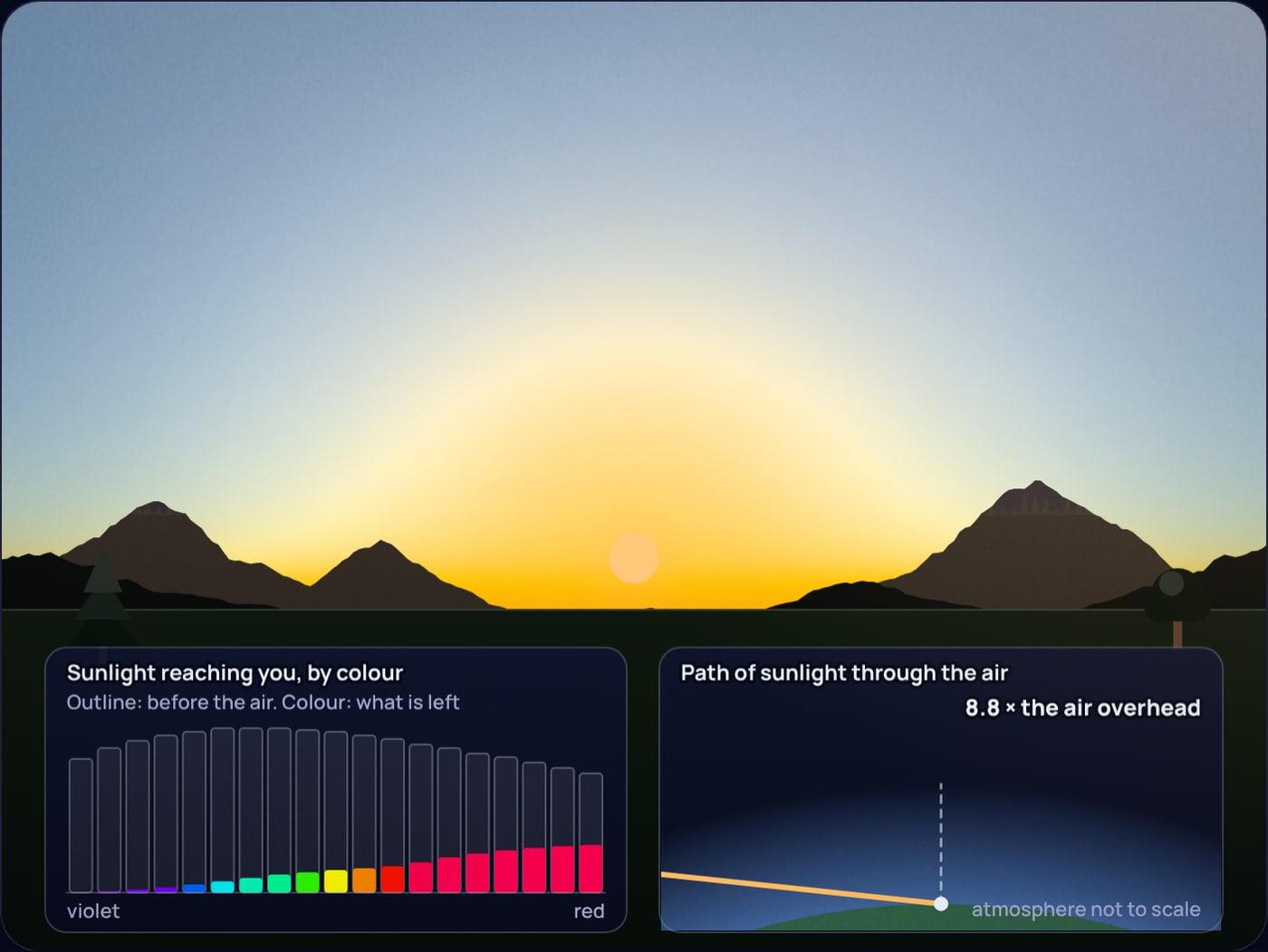
Because the sky is lit by many different paths. The glow around a setting Sun is sunlight that has already crossed hundreds of kilometres of air, lost its blue, and is then scattered once more toward you by the dense air and haze near the ground. The sky overhead is lit by sunlight scattered down from high altitude, where the air is thin and the beam has kept more of its blue.
There is a second, less known reason, and it explains why twilight overhead looks blue rather than grey. Ozone absorbs weakly in the orange, in the Chappuis band, which peaks at 603 nm with a cross-section of 5.23 × 10⁻²¹ cm² per molecule. For a typical ozone column of 300 Dobson units that is an optical depth of only 0.042, invisible at midday. But twilight light skims through the ozone layer at a grazing angle, about 12 times its vertical thickness, and the orange loss becomes significant. Edward Hulburt showed in the early 1950s that without ozone the zenith sky at sunset would be noticeably greyer and dimmer.
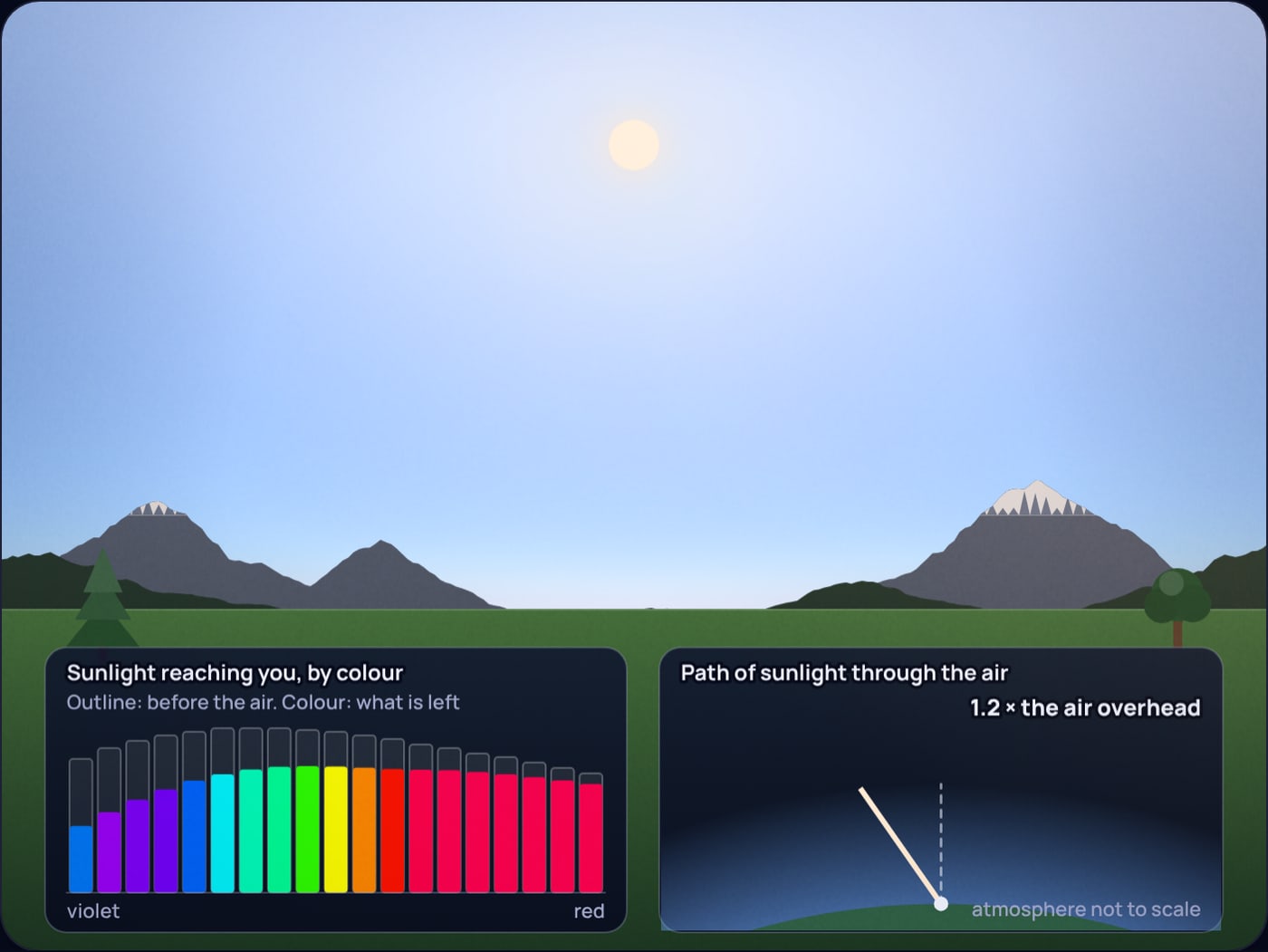
Our post on why the sky is blue and not violet covers the other half of that midday picture: why the scattered light looks blue rather than violet, even though violet is scattered even more.
Why do smoke, dust and volcanoes make redder sunsets?
Particles of smoke, dust, sea salt and sulphate, collectively called aerosol, add their own extinction on top of the air. Two things make them powerful at sunset. They are concentrated in the lowest one or two kilometres, so a grazing path through them is very long, roughly times the vertical thickness for a 1.2 km layer on a 6,371 km Earth. And small smoke particles scatter blue somewhat more than red (an Angstrom exponent near 1.3), which reddens the beam further.
Set the haze slider to 0.7, a smoky day, with the Sun 2 degrees up, and the simulated Sun becomes #FF0300, nearly pure red, dim enough to look at. That is the blood red Sun seen through wildfire smoke, and the reason sunsets glowed unusually red around the world after the 1883 Krakatoa and 1991 Pinatubo eruptions.
The misconception: “the air scatters red light at sunset”
A common explanation says the sky turns red at sunset because the air starts scattering red. It does not. Air scatters red weakly at every hour of the day. What changes at sunset is the subtraction: the beam has had most of its blue removed before it reaches the part of the sky you are looking at. The blue is not destroyed either. It has been scattered sideways and is lighting the afternoon sky for people further west, under the stretch of atmosphere the sunbeam has just crossed.
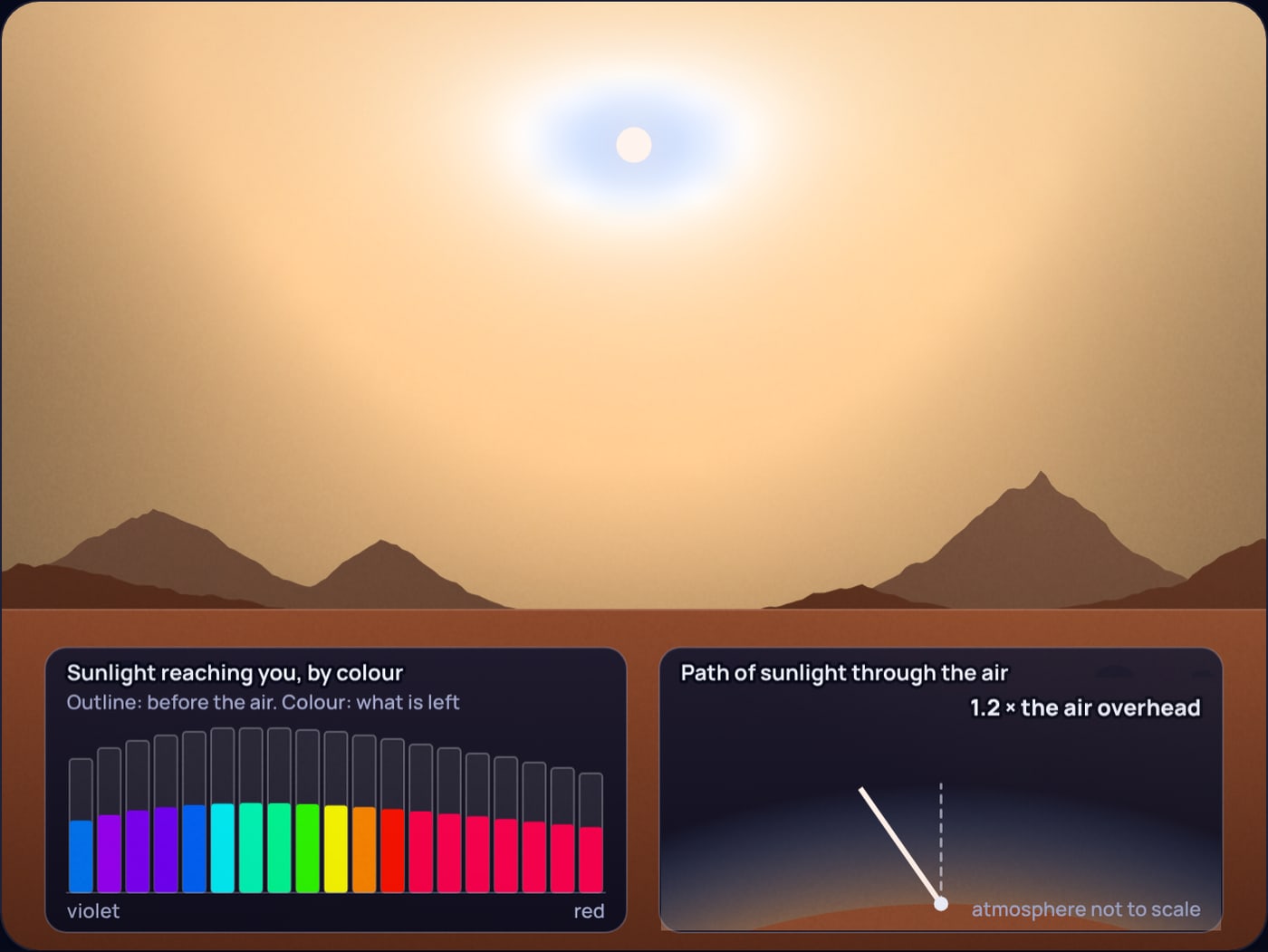
Why is the Martian sky butterscotch?
Mars has a surface pressure of about 6.4 millibars and a carbon dioxide atmosphere, according to NASA's Mars fact sheet. Carbon dioxide scatters more strongly per molecule than air, roughly 2.4 times, but there is very little of it.
Molecules per square metre of ground scale as pressure ÷ (gravity × molecular mass).
Mars: . Earth: . Ratio 1.09%.
Optical depth at 550 nm: , about 40 times less than Earth's.
With so little molecular scattering, the colour of the Martian sky is set by dust. The grains, typically 1 to 2 micrometres across, are made largely of iron oxides, and they absorb some blue light. The result is a pale tan sky, #FFDEBC in the simulator.
So why are sunsets on Mars blue?
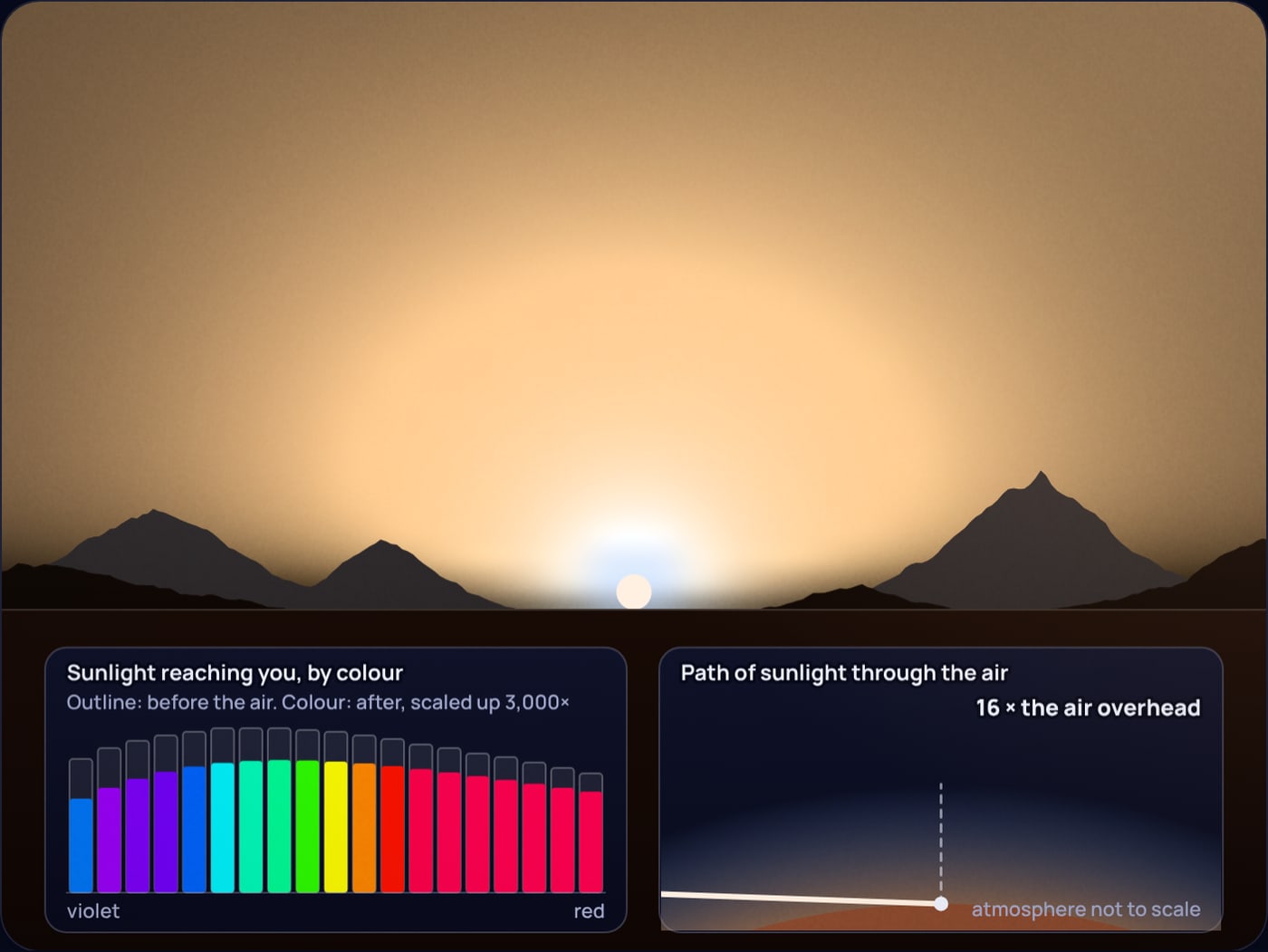
NASA's explanation, from Curiosity team member Mark Lemmon, is that the fine dust lets blue light penetrate the atmosphere slightly more efficiently, and that when blue light scatters off the dust it stays closer to the direction of the Sun than other colours do. That is diffraction. A grain about 1.5 micrometres in radius scatters most of its light into a forward cone whose width scales with wavelength, roughly radians: about 9 degrees for blue at 450 nm and 13 degrees for red at 650 nm. Blue is concentrated into the smaller patch of sky around the Sun.
At midday that blue aureole is faint against the bright tan sky. At sunset, looking through about 16 air masses of dusty air, the forward scattered light near the Sun dominates, and a blue glow appears around the Sun while the rest of the sky stays tan. In the simulator, with the Sun 2 degrees up, the sky next to the Sun computes to #DBE8FF.
Mars dust also drives its weather, as our post on Martian dust storms explains, and the Sun's own colour before any atmosphere touches it is white, as the blackbody star colour simulator shows.
Try it yourself
Open the simulator in the afternoon and drag the Sun altitude slowly down to zero, watching the spectrum panel lose its blue bars one by one. Then set the haze slider to 0 and repeat: the sunset is still orange. Finally switch to Mars and do the same. For the brief green rim that can appear as the Sun disappears, see what causes the green flash.
Sources
- NASA JPL, NASA’s Curiosity Rover Views Serene Sundown on Mars (sol 956, Mark Lemmon’s explanation)
- NASA Science, Sunset at Mars Gale Crater (Curiosity, 2015)
- NASA Mars Fact Sheet (pressure, scale height, radius)
- NASA Earth Fact Sheet (scale height 8.5 km)
- pvlib implementation of the Kasten and Young (1989) air mass formula, Applied Optics 28, 4735
- Teillet, Rayleigh optical depth comparisons, quoting Hansen and Travis (1974)
- Chappuis absorption by ozone (cross-sections, Hulburt’s twilight measurements)
Frequently asked questions
Why are sunsets red?
Near the horizon, sunlight crosses about 38 times more air than when the Sun is overhead. Air scatters blue light about 4.5 times more than red, so along that long path almost all the blue is scattered out of the beam. What reaches you is mostly orange and red light.
Why are sunsets on Mars blue?
Martian dust grains, around 1.5 micrometres across, scatter blue light into a narrower cone around the Sun’s direction than red light. Looking toward the setting Sun through a long path of dusty air, you see a blue glow around the Sun while the rest of the sky stays butterscotch. NASA’s Curiosity rover photographed this in Gale Crater in April 2015.
Do you need pollution for a red sunset?
No. Clean air alone turns the Sun on the horizon deep orange: Rayleigh scattering removes about 99.98% of its blue light along 38 air masses. Smoke, dust and volcanic aerosol add extra extinction and make sunsets deeper red.
Why is the sky overhead still blue at sunset?
Light scattered down from the sky overhead has travelled a much shorter path through dense air than the direct sunbeam, so it keeps some blue. Ozone also absorbs orange light in its Chappuis band, which keeps the twilight sky overhead blue rather than grey.
What colour is the sky on Mars during the day?
Butterscotch or pale tan. Mars has under 1% of Earth’s air, so molecules barely scatter, and the sky colour is set by fine iron oxide dust that absorbs some blue light.
 What Causes the Green Flash at Sunset? The Numbers
 How Long Does Sunlight Take to Reach Earth?