How do you read a capacitor code?
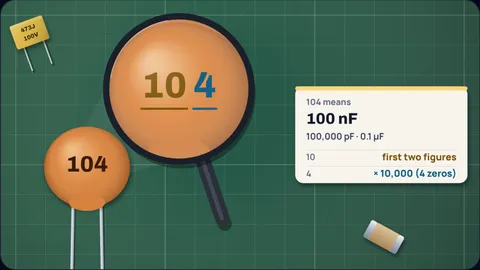
Read the first two digits as a number and add as many zeros as the third digit says. The result is in picofarads. 104 is 10 followed by four zeros, 100,000 pF, which is 100 nF or 0.1 µF. A letter after the number is the tolerance, and a two-character prefix such as 2A is the rated voltage.
The calculator decodes all of these, plus the R notation used for small values (4R7 is 4.7 pF) and the letter codes laser-marked on some ceramic chips. Switch to value to code to find what a 22 nF part should say. For why 100 nF sits beside nearly every chip, read why 100 nF is the standard decoupling capacitor.
Key facts about capacitor codes
- The code is always in picofarads: 101 is 100 pF, 102 is 1 nF, 103 is 10 nF, 104 is 100 nF and 105 is 1 µF.
- Tolerance letters: J is ±5%, K is ±10%, M is ±20% and Z is +80% / −20%. Below 10 pF the letters B, C and D give the tolerance in picofarads instead.
- Voltage codes put a digit and a letter before the value: 1H is 50 V, 2A is 100 V and 2E is 250 V.
- The dielectric code describes temperature behaviour: X7R holds ±15% from -55 to 125 °C, while Y5V can swing +22% / −82%.
Seven markings decoded
Each example puts the part on the mat, magnifies its marking and loads the value into the calculator.
What does 104 mean on a capacitor?
100 nF10 are the significant figures and 4 is the number of zeros, so 104 is 100,000 pF. Divide by a thousand for 100 nF, and again for 0.1 µF. You will find it on almost every circuit board, because it is the standard decoupling value.
If the disc says 104 with nothing after it, the tolerance and voltage are not marked. The bag label or the datasheet is then the only way to know them.
2A104J on a film capacitor
100 nF, ±5%, 100 VFilm capacitors often print the whole specification in one line. 2A is the voltage code for 100 V, 104 is 100 nF and J is ±5%, so a good part measures 95 to 105 nF.
Film parts are chosen for audio and timing because their value barely changes with voltage, unlike most ceramics. The voltage code is only a guide across makers; some film series use their own letters, so check the datasheet when a code looks unfamiliar.
Small values: 4R7 is 4.7 pF
4.7 pF ±0.25 pFA three-digit code cannot write a value below 10 pF, so the R notation takes over: the R is the decimal point. 4R7 is 4.7 pF and 0R5 is 0.5 pF.
At this size a percentage tolerance makes little sense, so the letter gives picofarads instead: C means ±0.25 pF, a range of 4.45 to 4.95 pF. Parts this small are usually C0G, which keeps them stable in oscillators and radio circuits.
471 is 470 pF, not 471 pF
470 pFThe last digit is a multiplier, not a figure. 471 is 47 followed by one zero, 470 pF, which is 0.47 nF. With K, the range is 423 to 517 pF.
The same rule explains 470 (47 pF, no zeros added) and 100 (10 pF). Reading 100 as 100 pF is the most common slip on small discs.
Letter codes on ceramic chips: S4
47 nFMost chip capacitors are not marked at all. Those that are use two characters: a letter for the first figures and a digit for the power of ten. S stands for 4.7, so S4 is 4.7 × 10,000 = 47,000 pF, or 47 nF.
The letters follow the E24 series, A for 1.0 up to Z for 9.1, with a few lower-case letters for values such as 2.5 and 3.5. The calculator holds the full table.
105Z: 1 µF that might be much less
1 µF, +80% / −20%105 is 1 µF and Z means the part can be 20% below or 80% above it, 0.8 to 1.8 µF. Z tolerance usually goes with Y5V, a dielectric that trades stability for capacitance in a small case.
Y5V can change by +22% / −82% between -30 and 85 °C, so on a cold morning or in a hot box the real value can be a fraction of what is printed. Fine for bulk decoupling, never for timing.
What code is 22 nF?
22322 nF is 22,000 pF: the figures 22 followed by three zeros, so the code is 223. With J tolerance and a 50 V rating it would be printed as 1H223J on a film part, or 223J on a disc.
If the value you want has more than two significant figures, such as 22.5 nF, there is no code for it: capacitors come in standard series, and the calculator shows the nearest one.
Common capacitor codes
| Code | pF | nF | µF |
|---|---|---|---|
| 100 | 10 | 0.01 | 0.00001 |
| 101 | 100 | 0.1 | 0.0001 |
| 221 | 220 | 0.22 | 0.00022 |
| 471 | 470 | 0.47 | 0.00047 |
| 102 | 1,000 | 1 | 0.001 |
| 222 | 2,200 | 2.2 | 0.0022 |
| 472 | 4,700 | 4.7 | 0.0047 |
| 103 | 10,000 | 10 | 0.01 |
| 223 | 22,000 | 22 | 0.022 |
| 473 | 47,000 | 47 | 0.047 |
| 104 | 100,000 | 100 | 0.1 |
| 224 | 220,000 | 220 | 0.22 |
| 474 | 470,000 | 470 | 0.47 |
| 105 | 1,000,000 | 1,000 | 1 |
| 106 | 10,000,000 | 10,000 | 10 |
Each code is two significant figures and a count of zeros, in picofarads. 1 nF = 1,000 pF and 1 µF = 1,000 nF.
How the calculator works
The code is split into its parts: an optional voltage code at the front (two characters such as 2A), the value (three digits, R notation, or a letter and digit on chips), an optional tolerance letter, and an optional voltage written in full such as 50V.
Three digits are read as two figures times ten to the power of the third, in picofarads. A third digit of 7, 8 or 9 is rejected, because capacitor codes do not use them. R marks the decimal point. Chip letter codes use the E24 letter table from Vishay's marking document.
Tolerance letters (B, C, D, F, G, H, J, K, M, Z and V) come from Vishay's MLCC ordering guide. Voltage codes from 0J (6.3 V) to 2E (250 V) come from KEMET's A759 datasheet.
In value to code mode, the value is rounded to two significant figures and written back as a code, with a warning when the value you typed has no exact code.
What the model leaves out
- Colour bands. Old tubular and some axial capacitors use colour bands like resistors. This calculator reads printed codes only.
- Electrolytic capacitors. These print the value in full, such as 470 µF 25V, so they need no decoding. Their polarity stripe matters more than any code.
- Maker-specific marks. Some series use their own voltage letters or date codes. When a mark is not in the tables here, the datasheet for that series is the only reliable key.
- Rare dielectric codes. Only C0G (NP0), X7R, X5R and Y5V are explained, the four that cover almost every ceramic part people buy.
Common misconceptions
"104 means 104 pF." The last digit is a count of zeros, so 104 is 100,000 pF.
"A higher voltage rating changes the value." The voltage code only says how much DC the part can take. The value comes from the three digits.
"A 1 µF ceramic always gives 1 µF." Class II and III ceramics lose capacitance with temperature and DC voltage. Y5V can lose most of it.
Frequently asked questions
What does 104 mean on a capacitor?
104 means 10 followed by four zeros in picofarads: 100,000 pF, which is 100 nF or 0.1 µF. It is the standard decoupling capacitor value.
What does the K mean after 104?
K is the tolerance letter for ±10%, so 104K can measure from 90 to 110 nF. J is ±5% and M is ±20%.
What is 103 in nF?
103 is 10 followed by three zeros, 10,000 pF, which is 10 nF or 0.01 µF.
What does 2A mean on a capacitor?
2A is a voltage code meaning 100 V DC. Other common codes are 1H for 50 V and 2E for 250 V. Some series use their own letters, so check the datasheet when unsure.
What is the difference between X7R and C0G?
C0G is Class I and changes by only 0 ±30 ppm/°C from -55 to 125 °C, so it suits timing and filters. X7R is Class II, changes by up to ±15% over the same range, and packs far more capacitance into the same size.
Keep learning
What Does 104 Mean on a Capacitor? Codes Explained
104 on a capacitor means 100,000 pF, which is 100 nF or 0.1 µF. How to read the three-digit code, tolerance letters, voltage codes and X7R or C0G.
Why 100nF Decoupling Capacitors? The Impedance Math
Why is every decoupling capacitor 100 nF? Impedance plots with ESL and via inductance show what the value really does and when 1 µF is better.

RC Low Pass Filter Cutoff Frequency: What −3 dB Means
fc = 1/(2πRC) is where the output is 0.707 of the input, half power and −45°. Why the slope there is only 10 dB/decade, and how loading moves it.

How to Calculate Crystal Load Capacitors (With Stray C)
CL = C1·C2/(C1+C2) + Cstray, but which stray? Worked 18 pF example, the ppm error from getting it wrong, and the gain margin check most guides skip.