Resistor Color Code Chart and a Mnemonic That Works
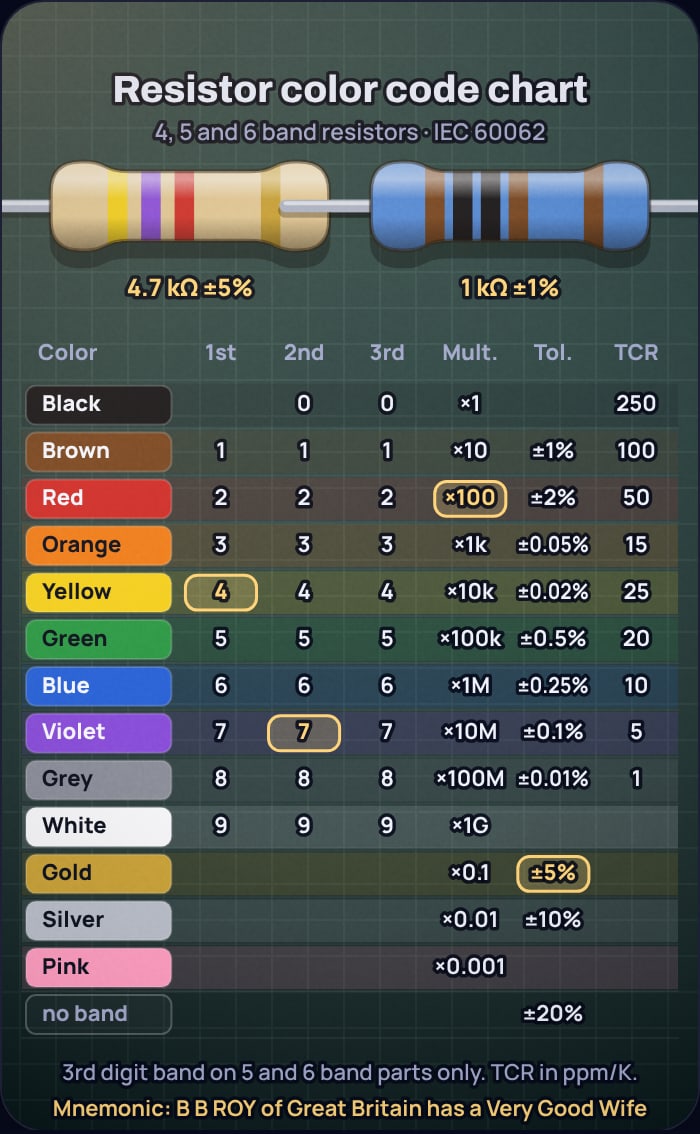
Ten colours carry ten digits, and seven of them are already in your head in the right order. Red, orange, yellow, green, blue, violet: the rainbow you learned as a child is the resistor color code for 2 to 7. You only have to memorise four more colours, two at each end, and the whole code falls into place. That is the mnemonic that works, and this post builds the rest of the system around it.
Below is the full chart, the rules for 4, 5 and 6 band resistors, and a table of the values you will actually meet. If you want to check a part while you read, the resistor color code calculator lets you tap each band to change its colour, or type a value like 4k7 and see its bands.
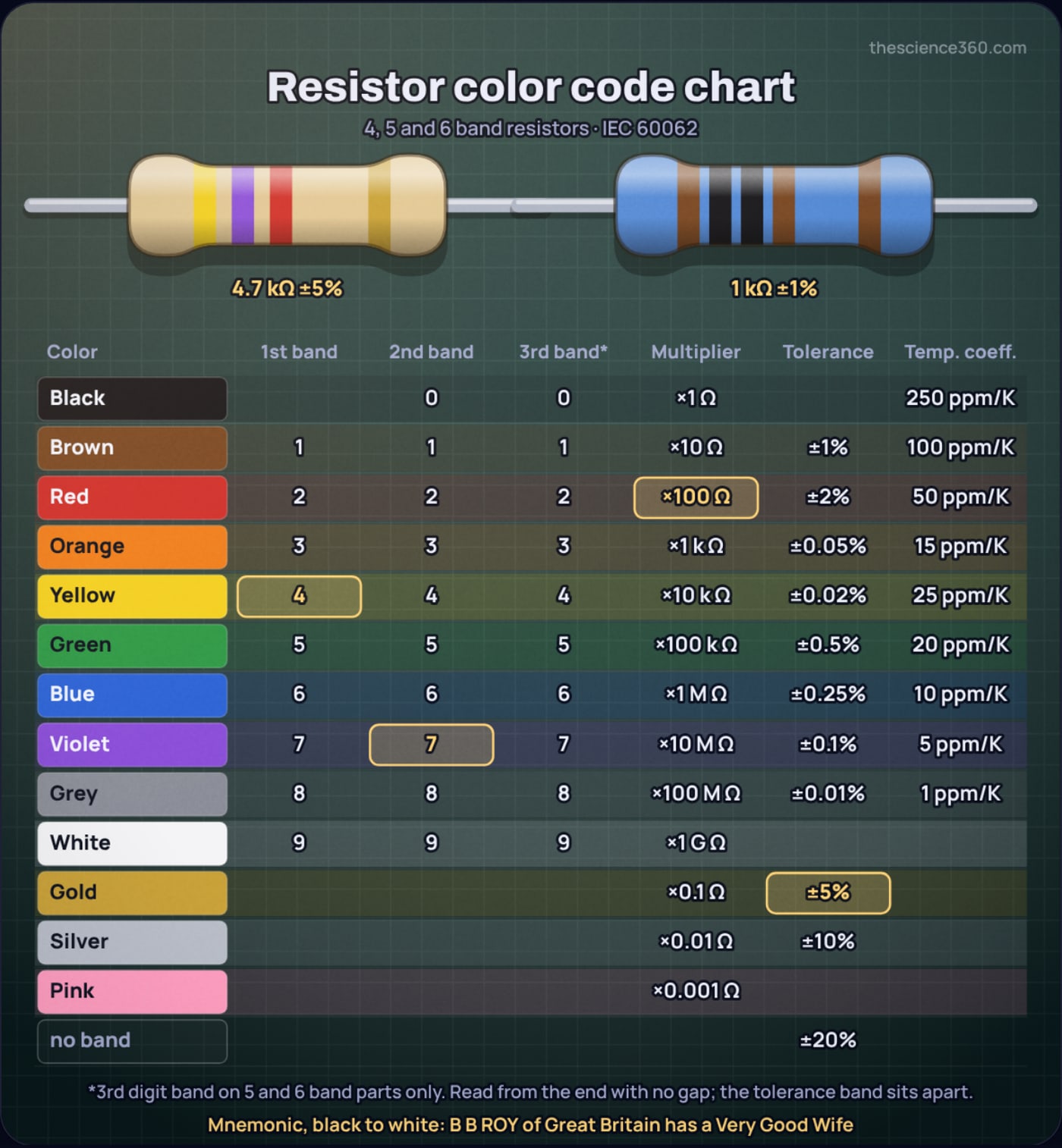
What is the mnemonic for the resistor color code?
Split the ten colours into three groups:
- Two dark colours first: black 0, brown 1. Dark comes before light, and black is darker than brown.
- The rainbow in the middle: red 2, orange 3, yellow 4, green 5, blue 6, violet 7. This is ROY G BV, the rainbow without indigo.
- Two pale colours last: grey 8, white 9. Grey before white, the way dark comes before light.
If you want one sentence, use "B B ROY of Great Britain has a Very Good Wife": black, brown, red, orange, yellow, green, blue, violet, grey, white. It works because the middle of it is the rainbow you already know, so you only need the sentence for the ends. Many older mnemonics for this code are crude or offensive; you do not need them.
Two more anchors help when you are reading a real part. Brown is 1 and red is 2, so a brown or red final band on a precision resistor reads ±1% or ±2%, the same digits. And the multiplier band is simply the number of zeros to write after the digits: orange is 3, so three zeros.
How do you read a 4 band resistor?
Turn the resistor so the bunched-up bands are on the left and the band set apart (usually gold or silver) is on the right. Then read left to right: digit, digit, multiplier, tolerance.
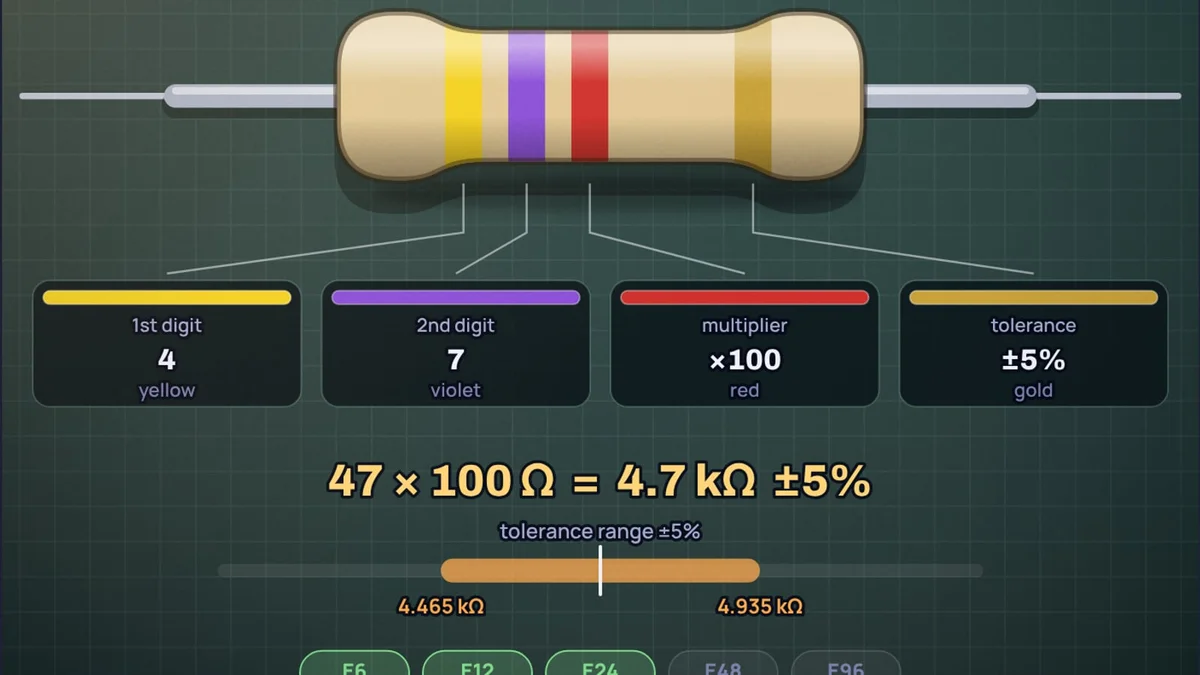
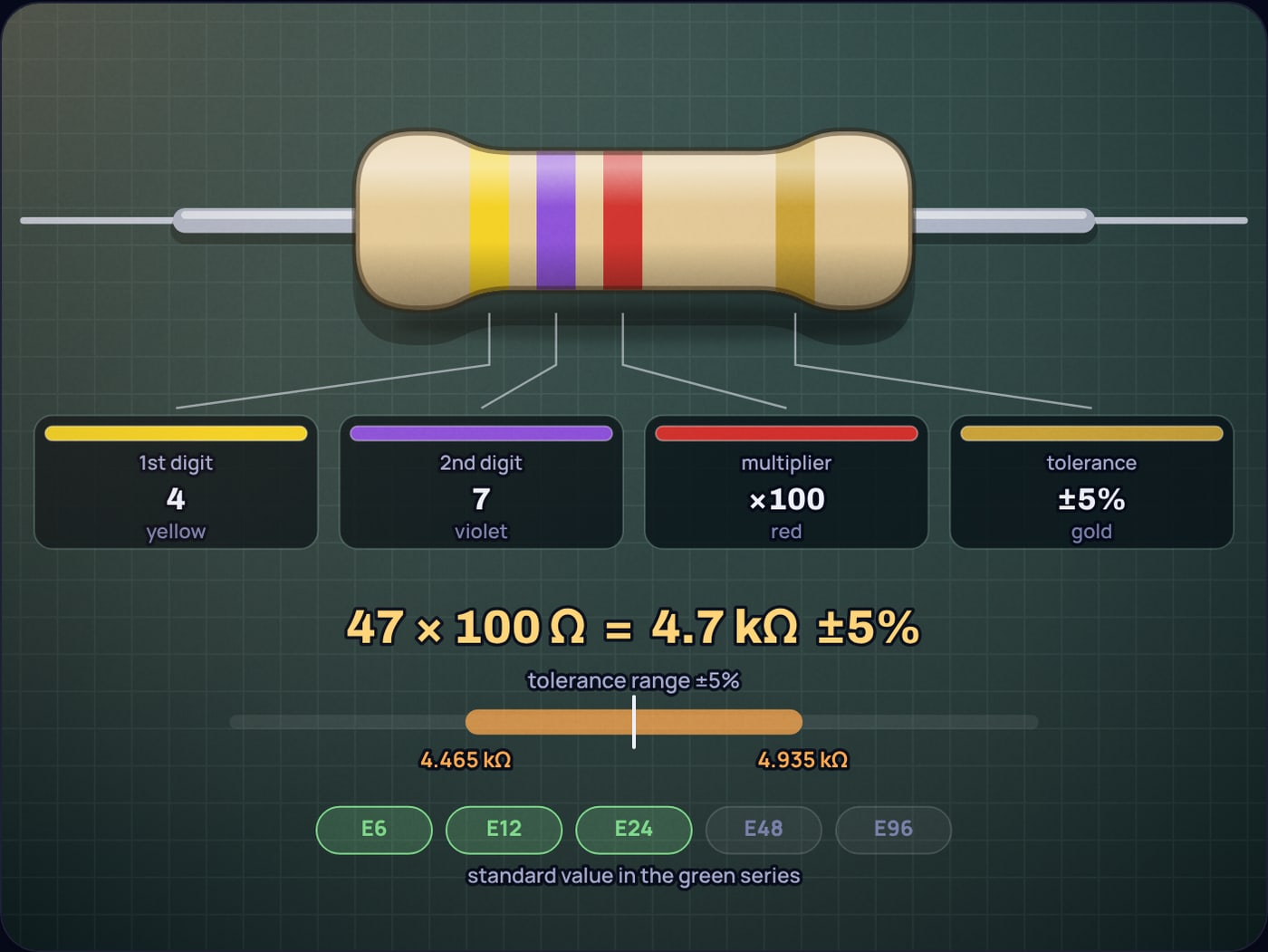
Example 1: yellow, violet, red, gold
Red as the third band means two zeros, not the digit 2. Gold at the end is ±5%, so any part that measures between 4.465 kΩ and 4.935 kΩ is in spec. On schematics this value is often written 4K7, with the letter where the decimal point would be.
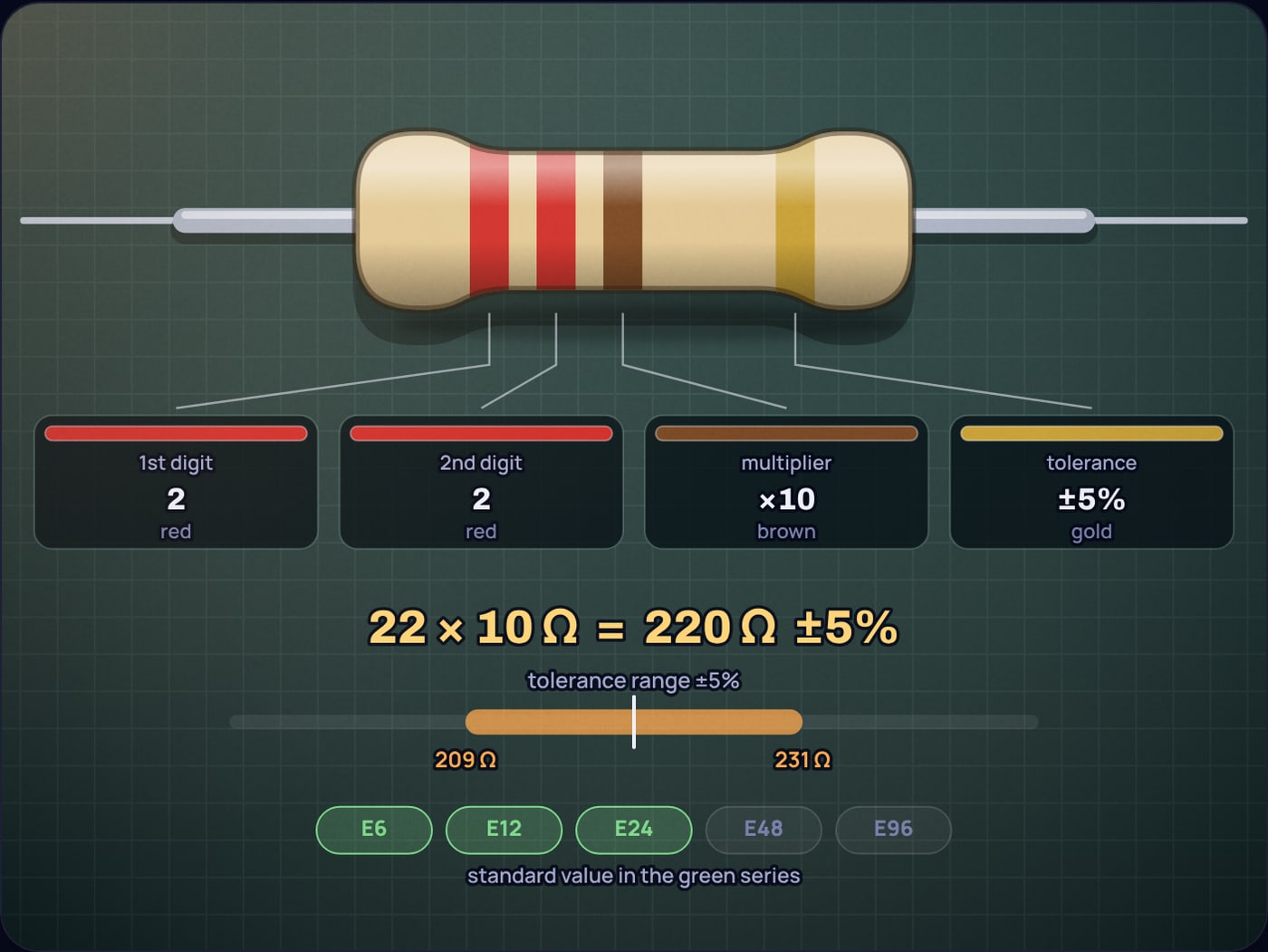
The most common mistake is treating the third band as a digit. Red, red, brown, gold is 22 with one zero, 220 Ω, not 221 Ω. A quick sanity check catches this every time: real resistors only come in standard values, and 221 Ω is not one of them in the 5% range.
Which end of a resistor do you read first?
Start at the end where the bands are closer to the edge and to each other. The tolerance band usually has a slightly wider gap before it. Two rules settle most doubtful cases. First, gold and silver are never a first digit, so if one end is gold or silver, that end is the tolerance. Second, only one direction usually gives a standard value: brown, black, orange, gold read forwards is 10 kΩ, read backwards it starts with gold, which is impossible.
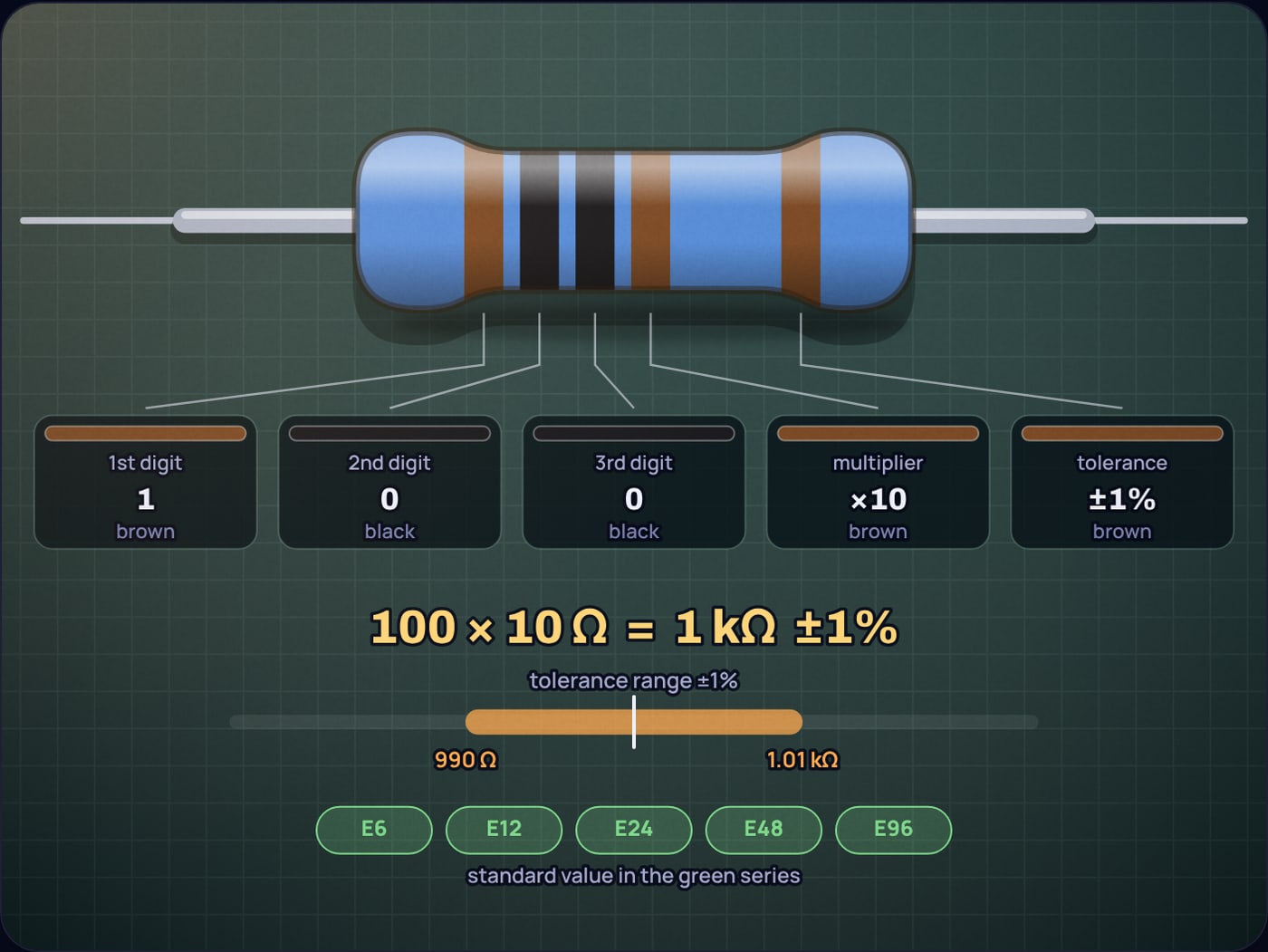
The hard case is a 5 band precision part with brown at both ends, such as brown, black, black, brown, brown (1 kΩ ±1%). Read backwards it gives brown, brown, black, black: 110 Ω, which also exists. Look closely for the gap, and if you still cannot tell, measure it. A multimeter costs less than a debugging evening.
How do 5 band and 6 band resistors differ?
A 5 band resistor has three significant digits before the multiplier, so it can mark values like 4.99 kΩ or 1.02 kΩ that two digits cannot. These are usually 1% metal film parts on a blue body, and they use the E96 series of 96 values per decade.
Example 2: brown, black, black, brown, brown
Notice the multiplier is brown (×10) here, while on a 4 band 1 kΩ (brown, black, red) it is red (×100). The extra digit takes one of the zeros.
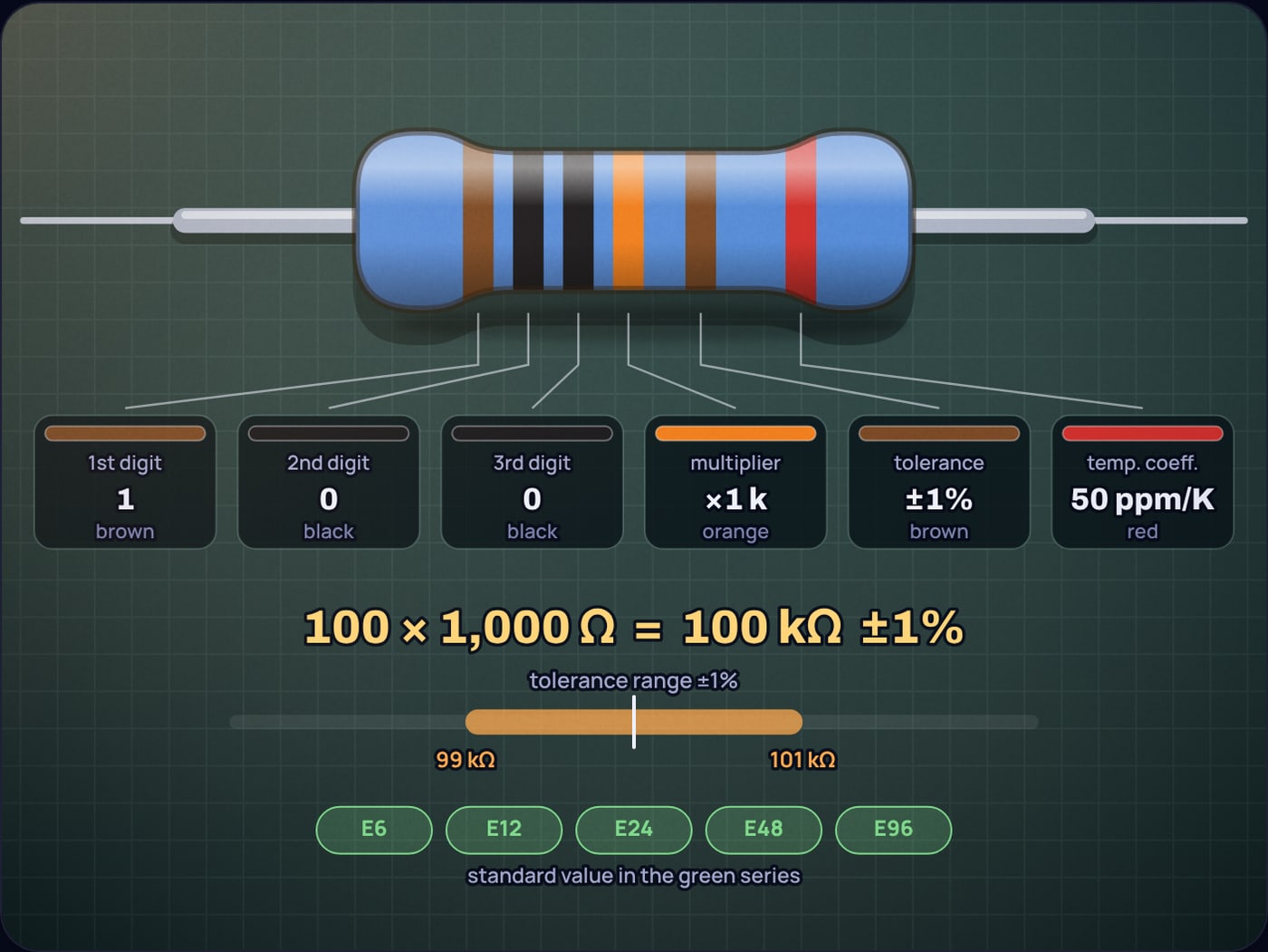
A 6 band resistor is a 5 band code with one more band at the end for the temperature coefficient, how much the resistance moves per degree. Brown is 100 ppm/K, red 50, yellow 25, orange 15, blue 10 and violet 5.
Example 3: how much does a 6 band resistor drift?
Brown, black, black, orange, brown, red is 100 × 1000 = 100 kΩ, ±1%, 50 ppm/K. Over a 50 °C rise:
That is 0.25%, a quarter of the tolerance. It matters in measurement circuits and precision filters, and almost nowhere else.
Common resistor values and their colours
These are the values that fill most parts drawers. Learn the first two bands of the E12 series and you can recognise almost any 5% resistor at a glance.
| Value | 4 band (±5%) | 5 band (±1%) | Typical use |
|---|---|---|---|
| 10 Ω | brown black black gold | brown black black gold brown | current sense, gate resistor |
| 100 Ω | brown black brown gold | brown black black black brown | series protection |
| 220 Ω | red red brown gold | red red black black brown | LED on 5 V |
| 330 Ω | orange orange brown gold | orange orange black black brown | LED, dimmer |
| 470 Ω | yellow violet brown gold | yellow violet black black brown | LED on 12 V |
| 1 kΩ | brown black red gold | brown black black brown brown | transistor base |
| 2.2 kΩ | red red red gold | red red black brown brown | I2C pull-up |
| 4.7 kΩ | yellow violet red gold | yellow violet black brown brown | pull-up, I2C |
| 10 kΩ | brown black orange gold | brown black black red brown | pull-up, divider |
| 47 kΩ | yellow violet orange gold | yellow violet black red brown | divider, bias |
| 100 kΩ | brown black yellow gold | brown black black orange brown | high impedance divider |
| 1 MΩ | brown black green gold | brown black black yellow brown | bleed resistor |
Why these values and not round numbers like 500 Ω? The E12 series (10, 12, 15, 18, 22, 27, 33, 39, 47, 56, 68, 82) is spaced so that each value is about 21% above the last, the step that lets ±10% tolerance ranges just touch. E24 halves the step for 5% parts and E96 does the same for 1%. So if you decode a resistor as 5 kΩ, stop: 5 kΩ is in none of the series. The nearest E24 value is 5.1 kΩ (green, brown, red), and you have probably misread a band. Our guides to pull-up resistor values and LED resistors on Arduino show where the common values come from.
What about gold and silver in the middle?
Gold and silver do two jobs. In the last position they are tolerances: gold ±5%, silver ±10%. In the multiplier position they divide: gold ×0.1, silver ×0.01. That is how values under 10 Ω are marked. Yellow, violet, gold, gold is 47 × 0.1 = 4.7 Ω ±5%, and yellow, violet, silver, gold is 0.47 Ω, a typical current sense resistor in a power supply. Position tells you which job a gold band is doing.
Common mistakes when reading resistors
- Reading the multiplier as a digit. Red, red, red is 2.2 kΩ, not 222 Ω.
- Confusing red, orange and brown. Under warm light and on old or heat-browned parts they look alike. A 1 kΩ (brown, black, red) and a 10 kΩ (brown, black, orange) differ only in that band. Measure before you solder.
- Trusting the body colour. Blue bodies often mean 1% metal film and beige 5% carbon film, but it is a convention, not part of the code.
- Using colours on SMD parts. Surface mount resistors use printed numbers instead: 103 is 10 × 10³ = 10 kΩ, and 4R7 is 4.7 Ω.
Try it yourself
Open the 220 Ω resistor in the simulator and tap its third band to step brown, red, orange. Watch the value jump from 220 Ω to 2.2 kΩ to 22 kΩ while the digits stay the same. Then switch to 5 bands and see the same value re-coded with an extra digit, or open the colour chart view to print the table. For the LED resistor you are about to pick, the LED resistor calculator works out the value and why LEDs need a resistor explains the reason.
Sources
- Wikipedia, "Electronic color code", resistor table per IEC 60062:2016 (digits, multipliers, tolerance letters, temperature coefficients, and the 2016 changes to grey, orange and yellow tolerances): en.wikipedia.org/wiki/Electronic_color_code
- Vishay, "Marking of resistors" document 20020 (six band code and the sixth band temperature coefficient colours: brown 100, red 50, yellow 25, orange 15, blue 10, violet 5 ppm/K): vishay.com/docs/20020/smdresistormarking.pdf
Frequently asked questions
What is the easiest way to remember the resistor color code?
Learn it as a rainbow with two colours on each end. Black 0 and brown 1 come first, then the rainbow red, orange, yellow, green, blue, violet for 2 to 7, then grey 8 and white 9. The phrase B B ROY of Great Britain has a Very Good Wife spells the order.
What is the color code of a 10k ohm resistor?
Brown, black, orange, gold on a 4 band resistor: 1, 0, three zeros, plus or minus 5 percent. On a 5 band 1 percent resistor it is brown, black, black, red, brown.
How do I know which end of a resistor to read from?
Start at the end where the bands are bunched together. The tolerance band, usually gold, silver or brown, sits a little apart at the other end. Gold and silver are never the first band, and usually only one reading direction gives a standard value.
What does the third band on a resistor mean?
On a 4 band resistor the third band is the multiplier, the number of zeros after the first two digits. Red means two zeros, so red red red is 2,200 ohms. On a 5 or 6 band resistor the third band is a third digit and the fourth band is the multiplier.
What does a gold band on a resistor mean?
In the last position gold means plus or minus 5 percent tolerance. In the multiplier position it means times 0.1, so yellow violet gold gold is 4.7 ohms with 5 percent tolerance.
 555 Timer Frequency Formula: Where 1.44 Comes From
 ADC Resolution vs Accuracy: ENOB, INL and the Reference