How a dip in starlight reveals an exoplanet’s size
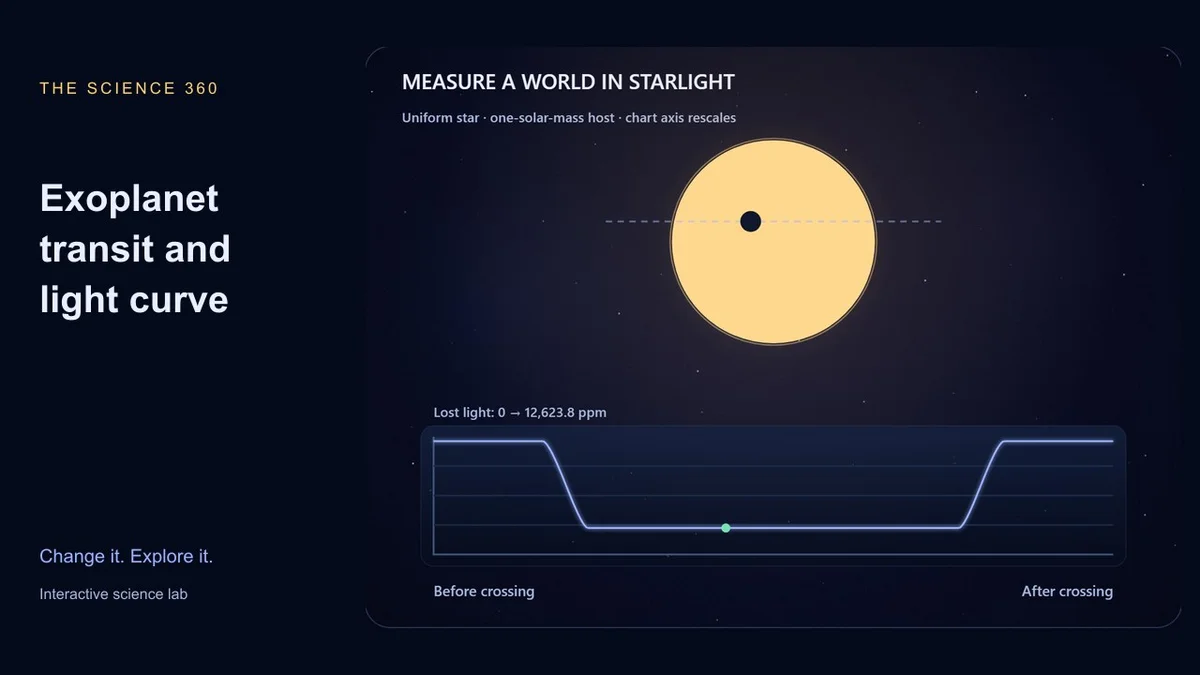
A planet need not be photographed directly to leave a measurable signature. When it passes in front of its star from our viewpoint, the blocked light creates a transit. The resulting brightness-versus-time graph is a light curve.
The exoplanet transit simulator links the geometry to a quantitative curve. Change the planet radius, star radius, crossing offset and orbital period, then compare the readings rather than just the apparent height of the graph.
Recover a size ratio from blocked area
For a uniformly bright star and a planet fully inside its visible disk, the fractional depth is:
depth = (planet radius / star radius)²
A one-percent dip means a radius ratio of √0.01 = 0.1. It does not mean the planet has one percent of the star’s radius. Area is proportional to radius squared.
If the star has the Sun’s radius, a planet about one tenth as wide in radius is roughly Jupiter-sized. But without an independent stellar radius, the depth alone supplies a ratio, not a unique planet radius in kilometres.
Why an Earth-sized signal is difficult
An Earth-sized disk against a Sun-sized star blocks about 84 parts per million in this ideal model. One part per million is a millionth of the baseline brightness; 84 ppm is about 0.0084%.
Load the Earth preset, then the Jupiter-size preset. The chart rescales vertically to keep either signal visible. A tall-looking Earth dip therefore does not imply the same depth as Jupiter’s. Read the axis and the ppm measurement.
Try doubling the Earth-sized planet’s radius while keeping all other inputs fixed. Predict a fourfold depth increase before checking it. Then double the star’s radius and explain why the same planet gives a shallower signal.
A grazing planet hides only part of its disk
The impact parameter describes the crossing offset in stellar-radius units. Near the stellar edge, the overlap is a lens rather than the planet’s whole area. The simple squared-radius depth interpretation then fails.
The simulator calculates the disk overlap directly, so a grazing dip becomes shallower and more rounded. Once the centre separation is always larger than the two radii added together, there is no transit at all. Absence of a transit is not absence of a planet.
Duration and confirmation ask other questions
For an inference challenge, load Mystery planet. Its disk is hidden and the observed curve stays tied to a fixed synthetic planet. Move your radius estimate until the dashed prediction aligns with that curve. Calculate the expected answer from the square root of the fractional depth and the known stellar radius, then compare it with your matched estimate.
Period and orbital geometry affect duration. Here the duration calculation assumes a circular orbit around a one-solar-mass star. The playback moves uniformly through projected position for clarity and does not recreate a detailed observing cadence.
Real stars are not uniformly bright disks. Limb darkening, starspots and measurement noise complicate the inference. A dip can also have another cause, including an eclipsing stellar companion. Repeated events and additional checks are needed before claiming a confirmed planet.
Continue with the planet-size comparison to put the recovered size ratio into a familiar scale.