What size wire for a 12 V run?
At 12 V, a 10 A load 5 m from the battery needs 10 AWG (5.26 mm²) to stay within a 3% drop, because the current makes a 10 m round trip. A 5 A fridge at the same distance needs 12 AWG. Ampacity only decides the size on short, heavy runs such as an inverter's battery cables.
For the background on voltage drop at 12 V, see what gauge wire for 12 V. For battery cables on an inverter, where the fuse and the heat set the size, see what size cable for a 2000 W inverter.
Key results from the calculator
- 5 A fridge, 5 m, 12 V: 12 AWG, 0.27 V drop, 11.73 V at the fridge.
- 10 A light bar, 3 m: 12 AWG; it reaches the 3% limit at 3.39 m.
- 145 A inverter, 1.5 m: 25 mm² at 12 V, 10 mm² for the same power at 24 V.
- 14 AWG at 10 A over 5 m drops 7.0%, more than twice the 3% target.
Six runs
Each example loads the voltage, current, one-way length and drop target.
A 5 A fridge 5 m from the battery
Compressor fridge10 m of wire in the loop. A 3% drop allows 0.36 V, which needs at least 2.44 mm²: 12 AWG. The fridge sees 11.73 V.
A 10 A light bar 3 m away
LED lightingTwice the current over a shorter run lands on the same size. 12 AWG drops 2.7%, close to the limit; 3.39 m is as far as it goes at 3%.
An 8 A pump 10 m away at 10%
Non-critical loadA 10% target is for loads that tolerate low voltage. It lets 12 AWG reach 10 m with 11.15 V left; at 3% the same run would need much thicker cable.
A 145 A inverter, 1.5 m of cable
Battery cablesAbout 1,600 W of AC at 92% efficiency draws 145 A from 12 V. The drop needs 21.2 mm², so 25 mm². Victron's manual asks for 70 mm² because the cable must also carry the 300 A fuse.
The same power at 24 V
Higher voltageHalf the current and twice the allowed drop: the drop alone needs 5.3 mm², a quarter of the 12 V figure. Heat then sets the size at 10 mm².
14 AWG carrying 10 A over 5 m
Common mistake14 AWG is rated well above 10 A, so it will not overheat. It still drops 0.84 V (7.0%), leaving 11.16 V. Its 3% limit at 10 A is 2.13 m.
Longest one-way run at 12 V and a 3% drop (copper at 25 °C)
| Wire | mm² | 5 A | 10 A | 20 A | ABYC rating |
|---|---|---|---|---|---|
| 16 AWG | 1.31 | 2.68 m | 1.34 m | 0.67 m | 25 A |
| 14 AWG | 2.08 | 4.26 m | 2.13 m | 1.07 m | 35 A |
| 12 AWG | 3.31 | 6.78 m | 3.39 m | 1.69 m | 45 A |
| 10 AWG | 5.26 | 10.8 m | 5.39 m | 2.69 m | 60 A |
| 8 AWG | 8.37 | 17.1 m | 8.57 m | 4.28 m | 80 A |
| 6 AWG | 13.30 | 27.2 m | 13.6 m | 6.81 m | 120 A |
| 4 AWG | 21.15 | 43.3 m | 21.7 m | 10.8 m | 160 A |
| 2 AWG | 33.63 | 68.9 m | 34.4 m | 17.2 m | 210 A |
| 0 AWG | 53.48 | 110 m | 54.8 m | 27.4 m | 285 A |
Lengths are one way; the wire in the loop is twice as long. Halve them for twice the current. At 24 V they double. Ratings are ABYC E-11 Table VII-A (two or fewer conductors bundled, 105 °C insulation, outside engine spaces).
How the calculator works
Resistance: copper resistivity 0.017241 Ω·mm²/m at 20 °C, rising 0.393% per °C (NBS Handbook 100), times the round-trip length, divided by the cross-section.
AWG areas: from the gauge definition, 0.46 in for 4/0 and 0.005 in for 36 AWG with 39 steps between them.
Size: the smallest size whose drop is within the target, or the smallest whose ABYC ampacity covers the current, whichever is larger.
mm² ratings: each metric size takes the ABYC rating of the largest AWG size no bigger than it, which errs on the safe side.
What the model leaves out
- Connections: every lug, fuse and switch adds resistance; Victron lists about 0.06 mΩ per connection and 0.35 mΩ for a 150 A fuse.
- Bundles and engine spaces: ABYC derates wires in bundles of three or more and inside engine rooms; this uses the figure for two or fewer, outside engine spaces.
- Chassis returns: if the vehicle body is the return path, only the positive wire counts, but the body joint adds its own resistance.
- Aluminium and CCA cable: copper-clad aluminium has higher resistance than copper of the same size.
Common misconceptions
"The wire is rated for 20 A, so it is fine at 20 A." That rating is about heat. At 12 V the drop usually needs a thicker wire first.
"Use the distance to the load." Use twice that: the current goes out and comes back.
"Thicker is always overkill." Each step up in size cuts the loss by about a fifth; on an inverter that is tens of watts.
Frequently asked questions
What size wire for 10 A at 12 V?
It depends on the run. For a 3% drop: 10 AWG to 5 m one way, and 14 AWG to 2 m. Ampacity alone would allow much thinner wire.
Do I double the length for voltage drop?
Yes, for a two-wire circuit. The current flows out on the positive and back on the negative, so a load 5 m away has 10 m of wire in its loop.
Is 3% or 10% voltage drop right?
ABYC E-11 sets 3% for panelboard feeders, bilge blowers, electronics, navigation lights and other circuits where drop must be kept low, and 10% for other lighting and circuits where it is not critical. Victron advises 2.5% for inverter cables.
Does 24 V need thinner wire than 12 V?
For the same power, yes: half the current and twice the allowed drop let the wire be a quarter of the area, until the heat limit takes over.
How hot can the wire be?
The ratings here are for 105 °C insulation in free air outside an engine space. Bundled wires and hot spaces carry less; the calculator also raises resistance with the temperature you enter.
Keep learning
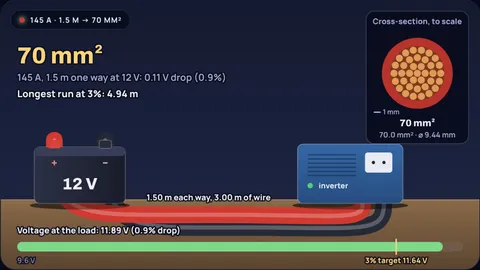
What Size Cable for a 2000 W Inverter at 12 V?
A 2000 VA inverter on 12 V draws about 145 A flat out. Voltage drop alone allows 25 to 35 mm² over 1.5 m; Victron's manual asks for 70 mm² and a 300 A fuse. Here is why, with 24 V and 48 V compared.
What Gauge Wire for 12V? Size for Voltage Drop
At 12 V, voltage drop, not ampacity, picks the wire. How to size 12 V wire from round-trip length and a 3% limit, with LED strip and fridge examples.
PCB Trace Width for Current: IPC-2221 vs IPC-2152
IPC-2221 says internal traces need 2.6x the width. IPC-2152 test data says they run cooler. How to size a trace for 2 A, its voltage drop, and vias.