What Size Cable for a 2000 W Inverter at 12 V?
An inverter's battery cables are the thickest wires most people will ever crimp, and the size that comes up is often a surprise. A 2000 W inverter on a 12 V battery can draw well over 100 A for hours at a time. Pick the cable from an ordinary ampacity chart and it may be too thin; pick it from voltage drop alone and it may still be thinner than the maker asks for.
This post works through one real inverter, the Victron Phoenix Inverter Smart 12/2000, from watts to amps to millimetres of copper. The wire size calculator does the voltage drop and ampacity steps for any current and run; every cable figure below comes from it. For smaller 12 V loads such as lights and fridges, where voltage drop sets the size, see what gauge wire for 12 V.
Step 1: from watts to amps
The "2000" in an inverter's name is usually its rating in volt-amperes, not the watts it can deliver all day. Victron's datasheet for the Phoenix Inverter Smart 12/2000 gives 2,000 VA, 1,600 W continuous at 25 °C, 1,450 W at 40 °C, and a 4,000 W peak. Its maximum efficiency at 12 V is 92%.
The battery has to supply the output power plus the inverter's losses, and current is that power divided by the battery voltage:
Battery current for a 12/2000 at full continuous load
A generic "2000 W" inverter that really delivers 2,000 W at the same efficiency draws 2000 ÷ (0.92 × 12) = 181 A.
Two things push the current higher. As the battery runs down its voltage falls, and the inverter draws more current to hold its output. The 12/2000 accepts inputs down to 9.3 V. And any voltage lost in the cable has the same effect: Victron's "Wiring Unlimited" guide works an example where a 2,400 W load on 12 V draws 200 A, loses 0.64 V in two 1.5 m cables of 16 mm², and so pushes the current up to 210 A.
Step 2: the size for voltage drop
Voltage drop at 12 V is unforgiving because the budget is tiny. Victron advises keeping it under 2.5%, which is 0.3 V. ABYC's E-11 standard for boats uses 3% (0.36 V) for panelboard feeders, electronics and other circuits where drop must be kept low. The current flows out along the positive cable and back along the negative, so both count:
With copper's resistivity of 0.017241 Ω·mm²/m at 20 °C (NBS Handbook 100), rising 0.393% per °C to 0.01758 at 25 °C:
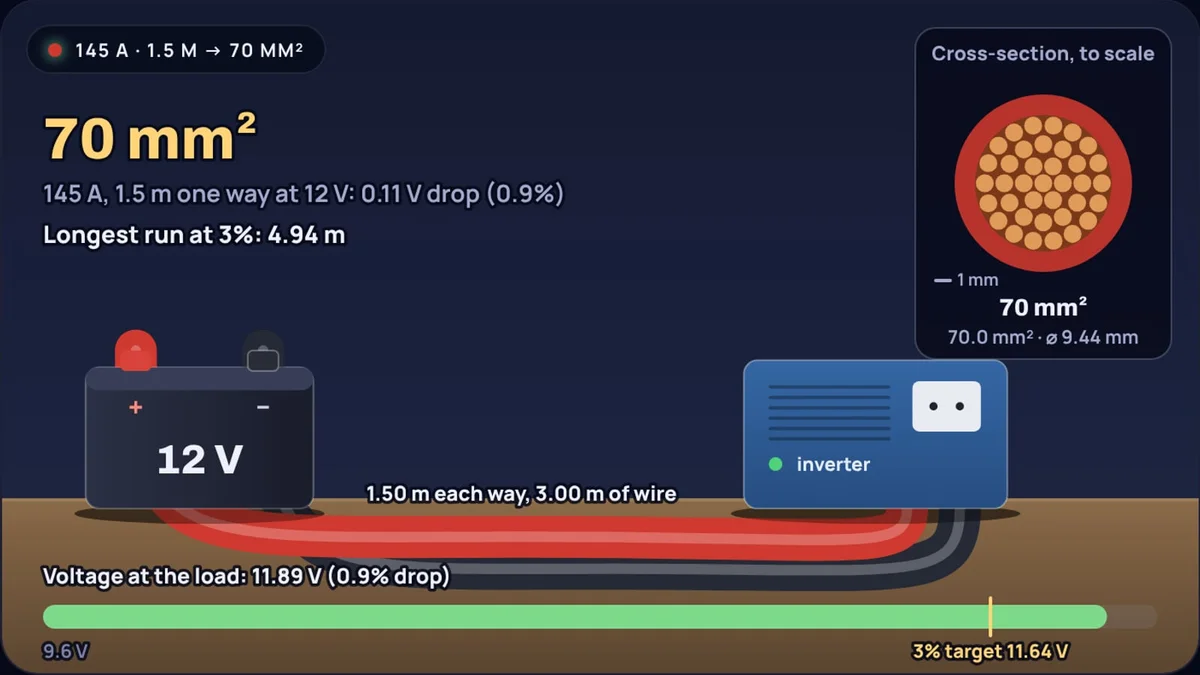
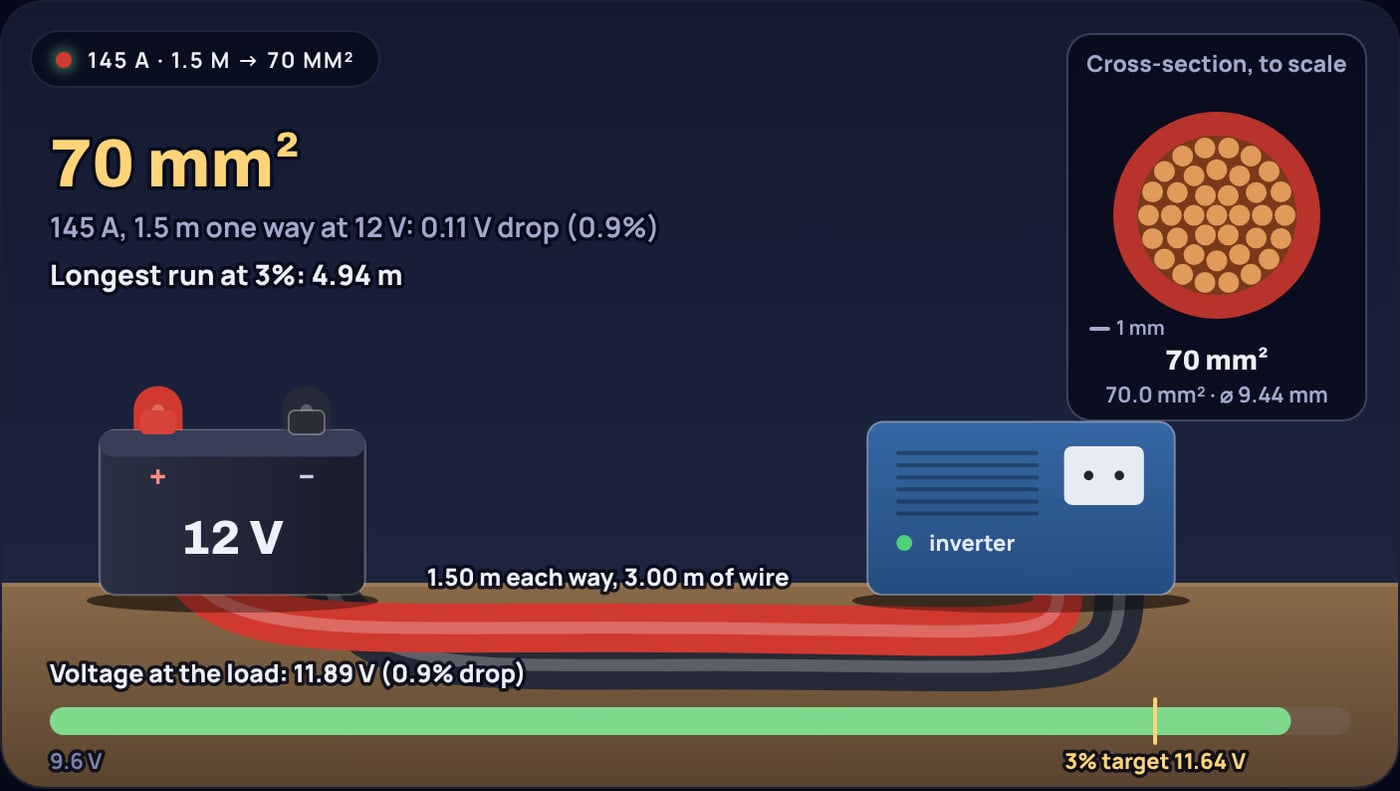
145 A, inverter 1.5 m from the battery, 3% drop
The 3 is the round trip, 2 × 1.5 m. The next standard size up is 25 mm². At Victron's 2.5% the minimum is 25.5 mm², so 35 mm².
As a check on the method, the same formula at 20 °C gives 0.647 V for Victron's 200 A example in two 1.5 m lengths of 16 mm², against the guide's 0.64 V.
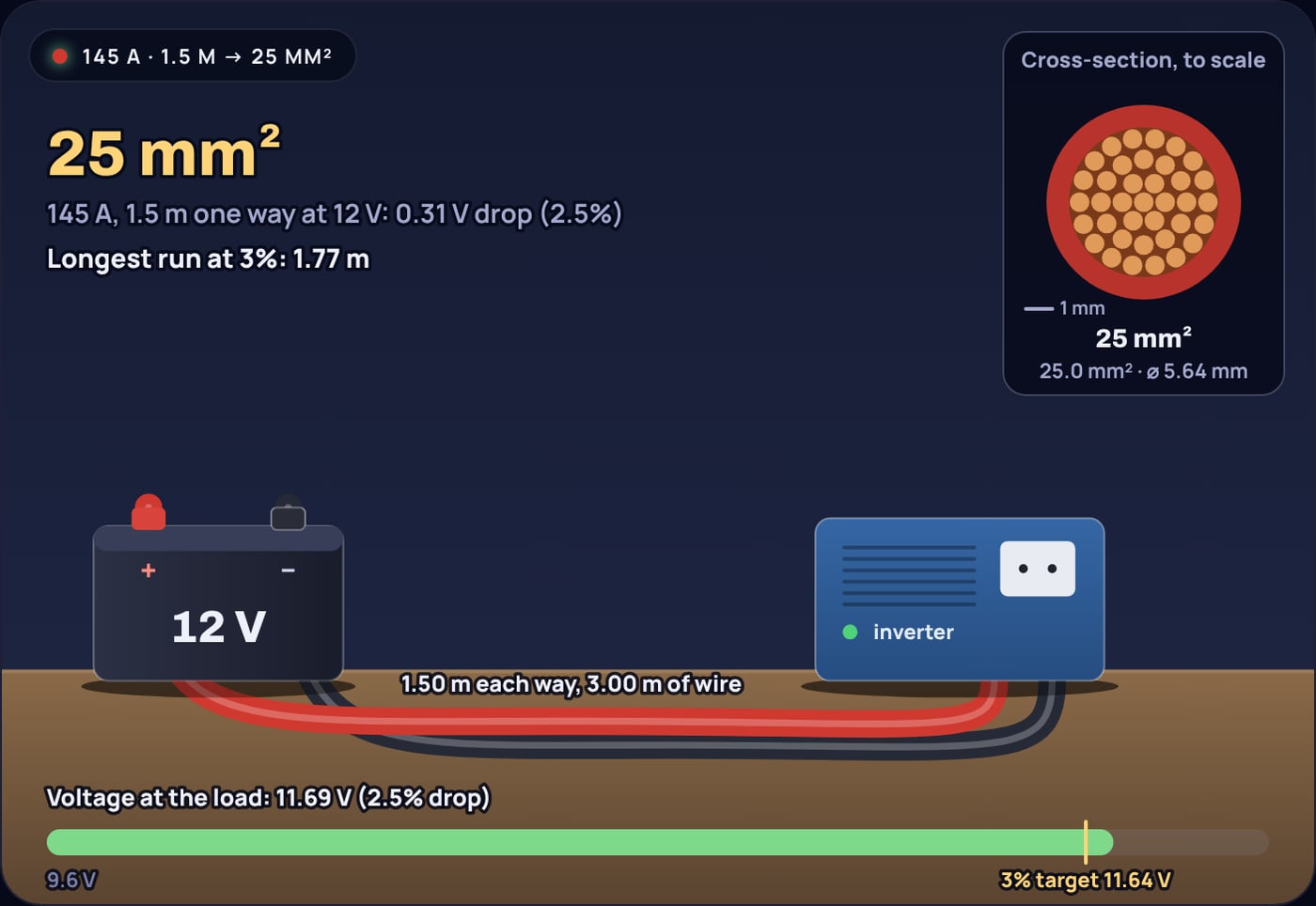
The cable size climbs quickly with length. These are the smallest metric and AWG sizes that hold a 3% drop at 12 V, with copper at 25 °C, checked against the ABYC ampacity as well:
| One-way run | 145 A: area needed | 145 A | 181 A | 145 A in AWG |
|---|---|---|---|---|
| 1 m | 14.2 mm² | 25 mm² (heat) | 35 mm² (heat) | 4 AWG (heat) |
| 1.5 m | 21.2 mm² | 25 mm² | 35 mm² | 2 AWG |
| 2 m | 28.3 mm² | 35 mm² | 50 mm² | 2 AWG |
| 3 m | 42.5 mm² | 50 mm² | 70 mm² | 1/0 AWG |
At 1 m the drop is small enough that heat, not voltage, sets the size; "(heat)" marks those cells.
Step 3: the heat limit and the fuse
Ampacity is how much current a wire can carry before its insulation gets too hot. ABYC E-11 tabulates it by size, insulation rating and location. For cable with 105 °C insulation outside an engine space, bundled with no more than one other current-carrying conductor, the 2003 edition gives 160 A for 4 AWG (21.2 mm²), 210 A for 2 AWG (33.6 mm²), 285 A for 1/0 (53.5 mm²) and 330 A for 2/0 (67.4 mm²). Inside an engine space, or in bigger bundles, the figures fall.
At 145 A, 25 mm² sits above the 4 AWG rating, so continuous current alone is not a problem. The fuse is. A fuse protects the cable, not the inverter: if something shorts, the fuse has to blow before the cable overheats. Victron specifies a 300 A fuse for the 12/2000, high enough to pass the 4,000 W surge when a motor or compressor starts. ABYC E-11 (2003) allows a fuse of at most 150% of the conductor's ampacity, and places it within 7 inches (175 mm) of the battery terminal unless the cable is sheathed.
The smallest cable a 300 A fuse can protect
To carry the full 300 A without relying on the 150% allowance: 2/0 AWG (330 A, 67.4 mm²), which is about 70 mm².
Victron does not show its working for the manual's cable sizes, but 70 mm² is the size that carries the full fuse rating on its own. It also keeps the peak in check: at 362 A, two 1.5 m lengths of 70 mm² drop 0.27 V (2.3%), where 25 mm² would drop 0.76 V (6.4%) and could trip the inverter's low-voltage alarm during the surge.
What Victron’s manual asks for
The installation section of the Phoenix Inverter Smart manual lists a cable size, fuse and battery bank for each model:
| Model | Cable, 0 to 5 m | Cable, 5 to 10 m | Fuse | Battery |
|---|---|---|---|---|
| 12/1600 | 70 mm² | Not recommended | 250 A | 300 to 800 Ah |
| 12/2000 | 70 mm² | Not recommended | 300 A | 350 to 1000 Ah |
| 24/2000 | 50 mm² | 95 mm² | 150 A | 200 to 500 Ah |
| 48/2000 | 25 mm² | 50 mm² | 80 A | 100 to 250 Ah |
| 12/3000 | 90 mm² | 2 × 70 mm² | 400 A | 400 to 1200 Ah |
Two things stand out. The 12 V models have no entry for runs past 5 m: the answer is to move the inverter, not to buy thicker cable. And the 12/1600 gets the same 70 mm² as the 12/2000, which suggests that the fuse and surge, not the average current, drive the size. "Wiring Unlimited" adds that 12 V systems are best kept to inverters of up to 3,000 VA; above that Victron prefers 24 V or 48 V.
If you cannot find or crimp cable that thick, Victron's guide says to run two cables in parallel whose areas add up to the size required, such as two 35 mm² for one 70 mm². Larger Victron units have doubled battery terminals for this.
Connections add as much as the cable
The cable is not the only resistance between the battery and the inverter. "Wiring Unlimited" lists about 0.06 mΩ for each cable connection, 0.10 mΩ for a 500 A shunt and 0.35 mΩ for a 150 A fuse. A simple run has four lugs plus a fuse:
Four connections and a fuse, at 145 A
That is close to the 0.75 mΩ of the 70 mm² cables themselves, which drop 0.11 V. A loose or badly crimped lug can easily be worse than both.
So a cable sized to land exactly on 3% at the inverter will usually end up beyond it once the hardware is counted. A size with some margin, kept short, leaves room for the fittings. The fuse figure is Victron's for 150 A, so treat the sum as a rough guide.
The same inverter on 24 V or 48 V
Double the battery voltage and the same power draws half the current, while a 3% drop is now 0.72 V instead of 0.36 V. Both effects shrink the cable, so voltage drop alone needs a quarter of the copper:
The same 1,600 W from 24 V
The 24 V model's maximum efficiency is 94%. The calculator's example rounds the current up to 72 A for a little margin; at that current heat sets the size at 10 mm² (rated 80 A by taking the 8 AWG figure).
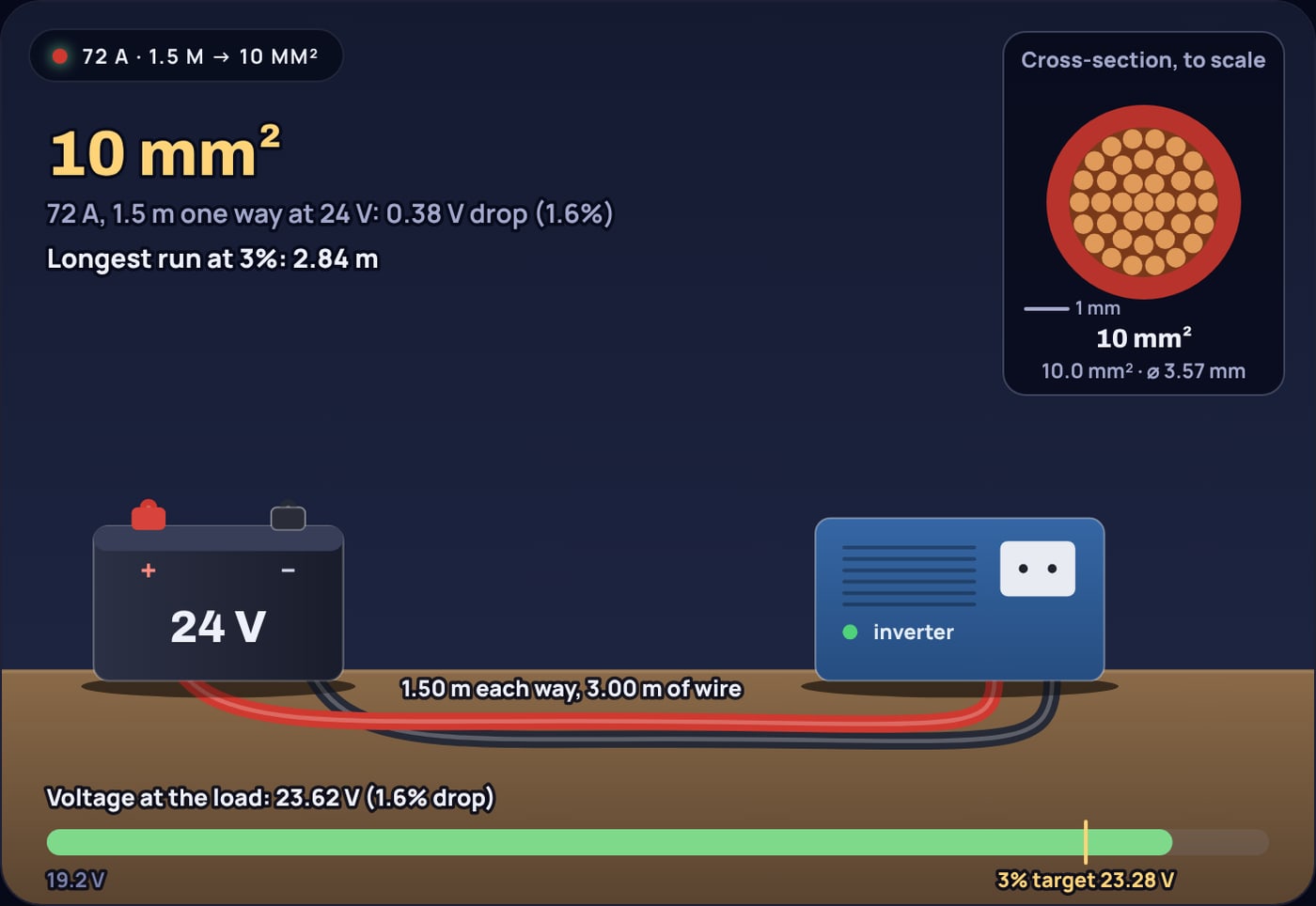
Victron's manual still asks for 50 mm² on the 24/2000, again sized well above the continuous current, with a 150 A fuse. Even so, that is two standard sizes down from the 12 V model, and the 48 V version needs only 25 mm². In "Wiring Unlimited", the 2,400 W example that loses 5% at 12 V loses 1.3% at 24 V and 0.3% at 48 V on the same cable.
Small loads are a different problem
Most other wiring in a van or boat is the opposite of inverter cable: long runs at a few amps, where the drop decides the size. A 5 A fridge 5 m from the battery needs 12 AWG for a 3% drop, though 18 AWG is rated for its current.
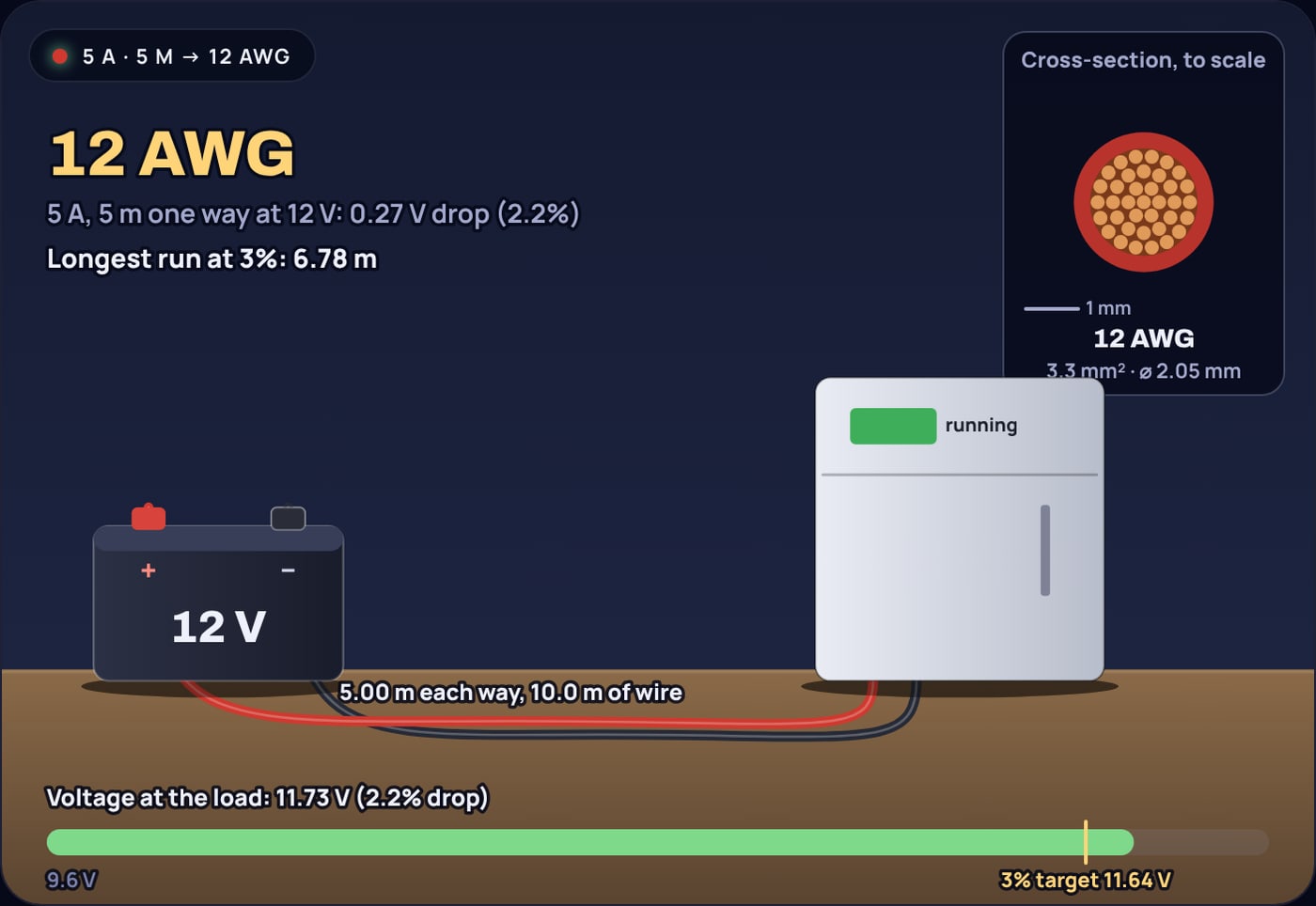
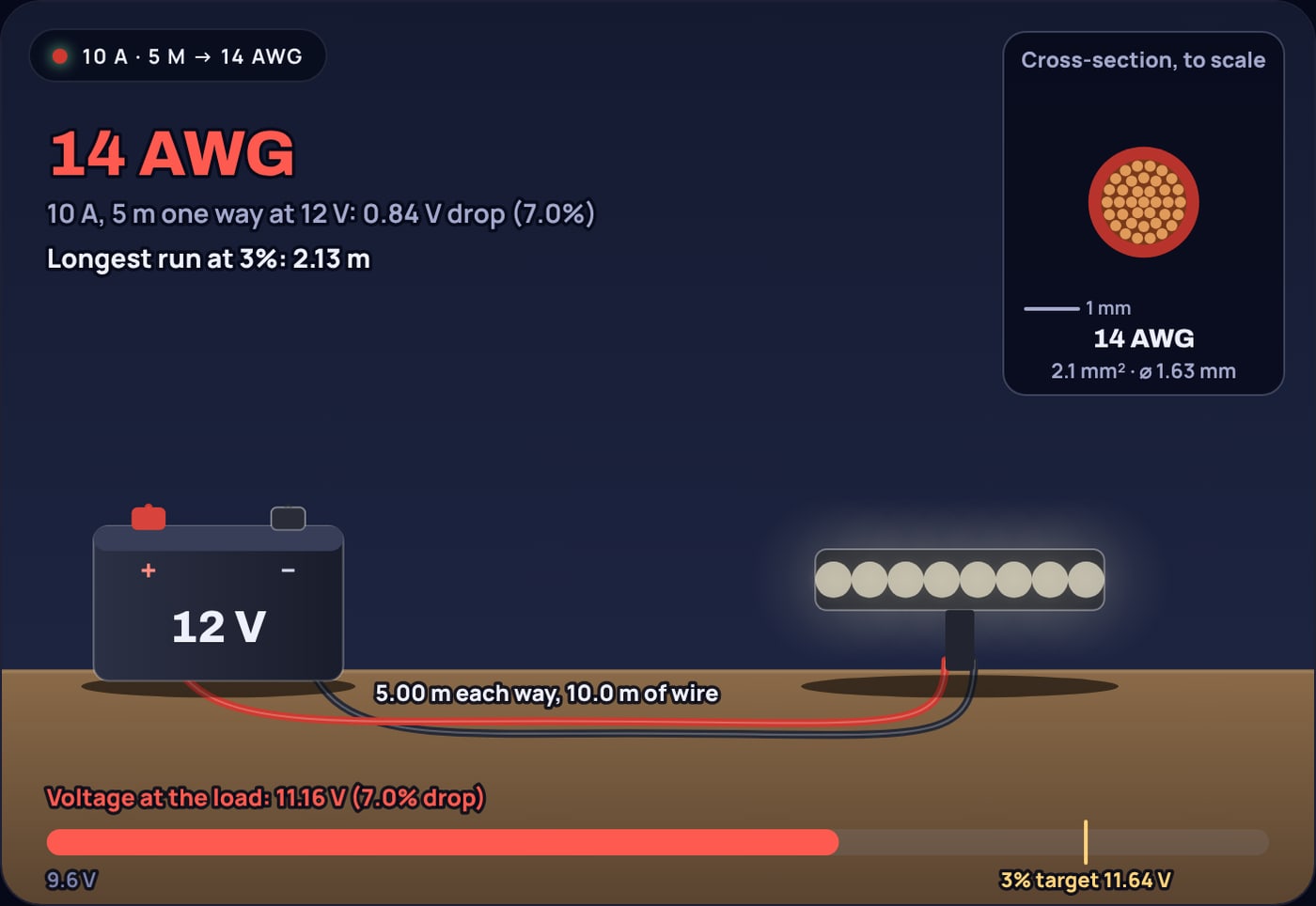
The common mistake on those runs is the reverse of the inverter's. Fourteen AWG is rated for 35 A, so it feels generous for a 10 A light bar, but over 5 m it drops 0.84 V, 7%. The 12 V wire gauge post covers that side in detail, including LED strips and Secop's fridge cable table.
A checklist for inverter cables
- Current: continuous output watts ÷ (efficiency × battery voltage), then allow for a low battery.
- Drop: size for 2.5 to 3% using the round-trip length, and leave margin for lugs and the fuse.
- Fuse: use the rating the manual gives, within 175 mm of the battery, and make sure the cable can carry it.
- Length: keep 12 V runs short; past a couple of metres, move the inverter or go to 24 V.
- Manual first: where the maker gives a size, use it or larger. It accounts for surge current the calculation does not.
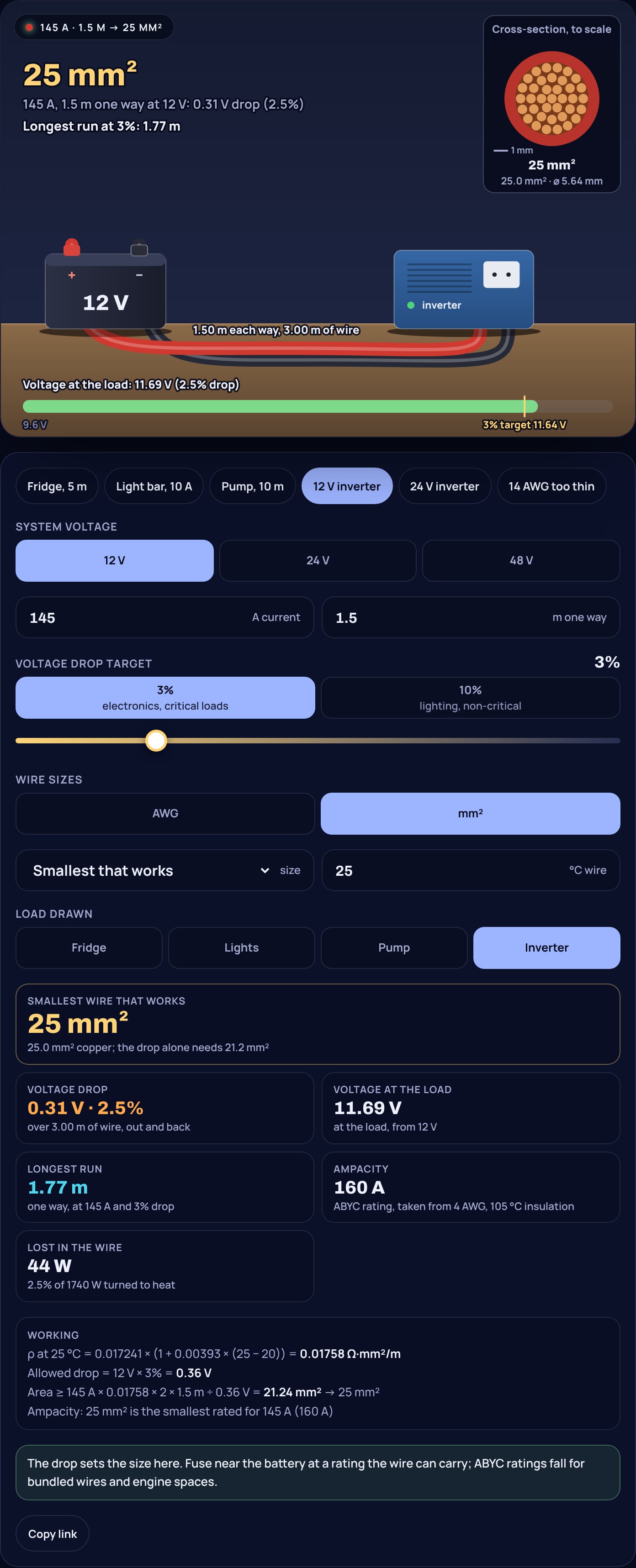
To size your own cables, open the wire size calculator, enter the current and the one-way length, choose AWG or mm², and pick a size from the list to see how much it drops and whether it is rated for the current.
Sources
- Victron Energy, Phoenix Inverter Smart 1600VA to 5000VA datasheet (12/2000: 2,000 VA, 1,600 W at 25 °C, 1,450 W at 40 °C, 4,000 W peak, 92% maximum efficiency at 12 V and 94% at 24 V, input 9.3 to 17 V)
- Victron Energy, Phoenix Inverter Smart manual, installation (cable cross-section, fuse rating and battery capacity for each model)
- Victron Energy, "Wiring Unlimited" (2,400 W example at 12, 24 and 48 V; 2.5% drop advice; resistance of connections, shunts and fuses; preferred inverter sizes per voltage; parallel cables)
- ABYC E-11, AC and DC Electrical Systems on Boats, July 2003 edition (Table VII-A ampacities; 3% and 10% drop categories, 11.16.1.2.7; fuse within 7 inches and at most 150% of conductor ampacity, 11.12.1.2 and 11.12.1.5.2)
- NBS Handbook 100, Copper Wire Tables (resistivity 0.017241 Ω·mm²/m and temperature coefficient 0.00393 at 20 °C; AWG diameters)
Frequently asked questions
What size cable do I need for a 2000 W inverter on 12 V?
Victron lists 70 mm² (about 2/0 AWG) for runs up to 5 m on its Phoenix Inverter Smart 12/2000, with a 300 A fuse, and does not recommend 12 V runs of 5 to 10 m. Voltage drop alone at the 1,600 W continuous rating would allow 25 mm² over 1.5 m, but the cable also has to suit the fuse and the 4,000 W peak.
How many amps does a 2000 W inverter draw at 12 V?
Divide the output power by the efficiency and the battery voltage. A Victron 12/2000 delivers 1,600 W continuously at 25 °C with up to 92% efficiency, so it draws about 145 A at 12 V and 158 A at 11 V. A full 2,000 W at 92% is 181 A, and its 4,000 W peak is about 360 A.
What size fuse for a 2000 W inverter at 12 V?
Victron specifies 300 A for the Phoenix Inverter Smart 12/2000. The fuse protects the cable, so the cable must be able to carry it: under the 2003 edition of ABYC E-11, a fuse may be at most 150% of the conductor’s ampacity, and 70 mm² cable is rated above 300 A on its own.
Can I use thinner cable for a 2000 W inverter on 24 V?
Yes. The same power draws half the current and the allowed drop doubles, so voltage drop alone needs a quarter of the copper. Victron lists 50 mm² for its 24/2000 with a 150 A fuse, and 25 mm² for the 48/2000 with an 80 A fuse.
How long can inverter cables be?
As short as you can make them. Victron’s manual gives no cable size for its 12 V inverters beyond 5 m, and at 145 A a 3% drop already needs 50 mm² for a 3 m run. Mount the inverter next to the battery and run the AC side further instead.