How do you work out the heat sink you need?
The junction temperature is TJ = TA + P × (θJC + θCS + θSA), so the heat sink you need is θSA = (TJ,max − TA) ÷ P − θJC − θCS. A 7805 dropping 12 V to 5 V at 1 A turns 7.04 W into heat; with a 125 °C limit in 25 °C air it needs a heat sink of 8.2 °C/W or better.
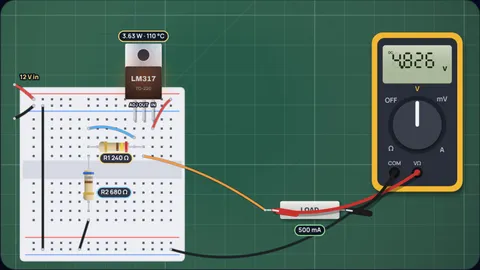
For the full 7805 story, read does my 7805 need a heatsink?. To set an LM317's output, see the LM317 formula explained.
What the datasheets give
- 7805 and LM317 in TO-220: θJC 5 °C/W and θJA 65 °C/W (onsemi MC7800 and LM317 datasheets). The MC7805C draws 3.2 mA quiescent current, typical.
- Bare TO-220 limit: (125 − 25) ÷ 65 = 1.54 W in 25 °C air, if you keep to the 125 °C range the electrical tables are specified over.
- 78L05 in TO-92: θJA 200 °C/W, and no θJC: onsemi says the plastic package sheds its heat through the leads.
- IRFZ44N MOSFET: θJC 1.5 °C/W max, θCS 0.50 °C/W greased, θJA 62 °C/W, RDS(on) 17.5 mΩ max, 175 °C maximum junction.
- Interface, TO-220 (onsemi AN1040): bare metal, dry 1.2, bare metal, greased 1, mica washer, greased 1.6, mica washer, dry 3.4 °C/W.
Nine heat problems
Each one loads the part, the heat sink (if any) and the thermometer into the calculator.
7805, 12 V to 5 V at 1 A
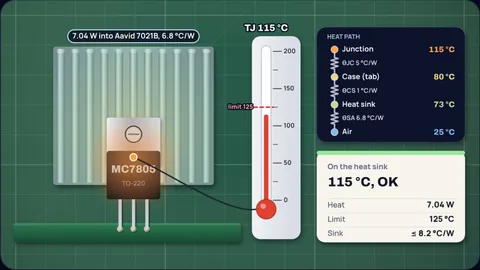
115 °C(12 − 5) × 1 + 12 × 0.0032 = 7.04 W. Bare, that would be 482 °C on paper, so a heat sink is not optional. It needs θSA ≤ 8.2 °C/W.
A 6.8 °C/W finned sink with greased mounting gives 115 °C. A 12.5 °C/W channel sink would leave it at 155 °C, over the limit.
7805, 9 V in, 0.5 A
157 °C bareOnly 2.03 W, but a bare TO-220 at 65 °C/W reaches 157 °C. Even a 43 °C/W heat sink is enough, so the smallest clip-on fixes it.
7805, 12 V in, 100 mA
73 °C0.74 W gives 73 °C at the junction: no heat sink needed.
The same 7805 in a 50 °C box, on mica
144 °CWarmer air and a greased mica washer (1.6 °C/W) push the junction to 144 °C on the 6.8 °C/W sink. It now needs θSA ≤ 4.1 °C/W.
LM317, 12 V to 3.3 V at 1.5 A
13 W8.7 V × 1.5 A = 13.05 W. It would need θSA ≤ 1.66 °C/W, and even a 4.4 °C/W sink leaves the junction at 161 °C. This is a job for a switching regulator.
IRFZ44N switching 10 A
2.8 W10² × 17.5 mΩ × 1.6 = 2.8 W, using the datasheet's normalized curve (about 1.6 times at 100 °C). Bare it reaches 199 °C, past 175 °C; a 24.4 °C/W clip brings it to 99 °C.
IRFZ44N at 20 A
11.2 WTwice the current is four times the heat: 11.2 W. θSA must be 11.4 °C/W or less; a 6.8 °C/W sink gives 124 °C.
78L05 in TO-92
72 °C9 V to 5 V at 50 mA is 0.23 W, about 72 °C. At 12 V and 100 mA it would be 0.75 W and 174 °C: the TO-92 tops out near 0.5 W in 25 °C air.
The Aavid catalogue example
10.7 °C/W6 W, θJC 3 °C/W, 0.5 °C/W interface, 150 °C limit and 65 °C air: (150 − 65) ÷ 6 − 3 − 0.5 = 10.7 °C/W, the same answer the catalogue gives.
7805 power and heat sink needed (25 °C air, 125 °C limit, greased)
| Input | 0.1 A | 0.5 A | 1 A |
|---|---|---|---|
| 7 V | 0.22 W, none | 1.02 W, none | 2.02 W, ≤ 43.4 |
| 9 V | 0.43 W, none | 2.03 W, ≤ 43.3 | 4.03 W, ≤ 18.8 |
| 12 V | 0.74 W, none | 3.54 W, ≤ 22.3 | 7.04 W, ≤ 8.2 |
| 15 V | 1.05 W, none | 5.05 W, ≤ 13.8 | 10.05 W, ≤ 4 |
| 24 V | 1.98 W, ≤ 44.6 | 9.58 W, ≤ 4.4 | 19.1 W, too much |
Power in watts, then the heat sink thermal resistance needed in °C/W; "none" means the bare TO-220 stays under 125 °C.
How the calculator works
Power: (Vin − Vout) × I + Vin × Iq for a linear regulator, I² × RDS(on) × a hot factor for a MOSFET, or the watts you type.
Bare: TJ = TA + P × θJA. On a heat sink: TJ = TA + P × (θJC + θCS + θSA), with the case and heat sink temperatures in between.
The heat sink needed is the θSA that puts TJ exactly at your limit; the calculator suggests the first catalogue sink at or below it.
What the model leaves out
- Airflow and orientation. Catalogue θSA values are for natural convection; a fan lowers them, an enclosure raises them.
- Board copper. θJA depends on the board; surface-mount parts lean on copper area, which this does not model.
- Transients. Short pulses heat the part less than the steady-state figure suggests; this is the steady state.
Common misconceptions
"A hot case means a failing part." In the 1 A example the tab sits at 80 °C while the junction, at 115 °C, is still inside its 125 °C limit.
"A small load needs no heat sink." It is the voltage dropped times the current that counts: a 7805 from 9 V at 0.5 A already passes 125 °C bare.
"A bigger heat sink always fixes it." θJC and the interface set a floor; at high power no heat sink is enough.
Frequently asked questions
How do I calculate the heat sink I need?
θSA = (TJ,max − TA) ÷ P − θJC − θCS. Pick a heat sink with a thermal resistance at or below that number.
How much power can a TO-220 handle without a heat sink?
With θJA 65 °C/W, about 1.5 W in 25 °C air for a 125 °C junction.
Does a 7805 need a heat sink?
Above about 1.5 W, yes. That is roughly (Vin − 5) × I; 12 V in at 1 A is 7 W and needs about 8 °C/W.
What is θCS?
The thermal resistance between the part's tab and the heat sink. onsemi measures about 1.0 °C/W greased and 1.6 °C/W with a greased mica washer for TO-220.
Why does a MOSFET get hotter than its RDS(on) suggests?
RDS(on) rises with temperature. The IRFZ44N datasheet curve shows about 1.6 times the 25 °C value at 100 °C.
Keep learning
Does My 7805 Need a Heatsink? Work It Out in Two Lines
A 7805 needs a heatsink above about 1.5 W. Work out the power, the junction temperature and the heatsink you need from the datasheet numbers.
LM317 Formula Explained, With Worked Examples
Vout = 1.25(1 + R2/R1) + Iadj R2. Where the LM317 formula comes from, how to pick R1 and R2, why it needs 3 V of headroom and when it needs a heat sink.

How Does a Buck Converter Work? Worked 12 V to 3.3 V
How a buck converter works, from volt-second balance to Vout = D·Vin, with a worked 12 V to 3.3 V, 2 A design, computed waveforms and efficiency.