Does My 7805 Need a Heatsink? Work It Out in Two Lines
The 7805 on your board is hot enough to hurt a fingertip, and the question is whether that matters. The answer comes from two numbers on the datasheet and one line of arithmetic: how many watts the regulator turns into heat, and how many degrees each watt adds. A 7805 from 9 V at half an amp already runs past its rated range with no heatsink, while the same part at 100 mA from 12 V is fine.
This guide works out both cases, sizes the heatsink when one is needed, and shows where a heatsink stops helping. Our heatsink calculator runs the same sums for a 7805, an LM317, a MOSFET or your own part, and draws the temperature at each step from the junction to the air.
Where does the heat come from?
A linear regulator is a transistor that drops whatever voltage is not needed. All the load current flows through it, so the power it turns into heat is the voltage across it times that current, plus a little for its own quiescent current drawn at the input voltage:
onsemi's MC7800 datasheet gives the MC7805C a quiescent current of 3.2 mA typical. At 12 V that is 0.04 W, small next to the main term. What matters is the drop. From 12 V to 5 V at 1 A the 7805 burns 7 W to deliver 5 W to the load, which is why linear regulators run hot and why the input voltage is the first thing to look at.
How hot does the 7805 get with no heatsink?
Datasheets give a thermal resistance from the junction, the silicon itself, to the surrounding air: θJA, in degrees per watt. For the MC7800 in the TO-220 package (case 221A), onsemi lists 65 °C/W. The junction temperature is the air temperature plus the rise:
Now the question is how hot is too hot. onsemi gives the MC7800 an operating junction temperature of 150 °C, but its electrical characteristics are specified for TJ up to 125 °C. Above 125 °C the regulator still works, but nothing on the datasheet promises how well. In this guide 125 °C is the design limit, and the calculator lets you change it.
Take a common case: a 9 V supply and 0.5 A of load.
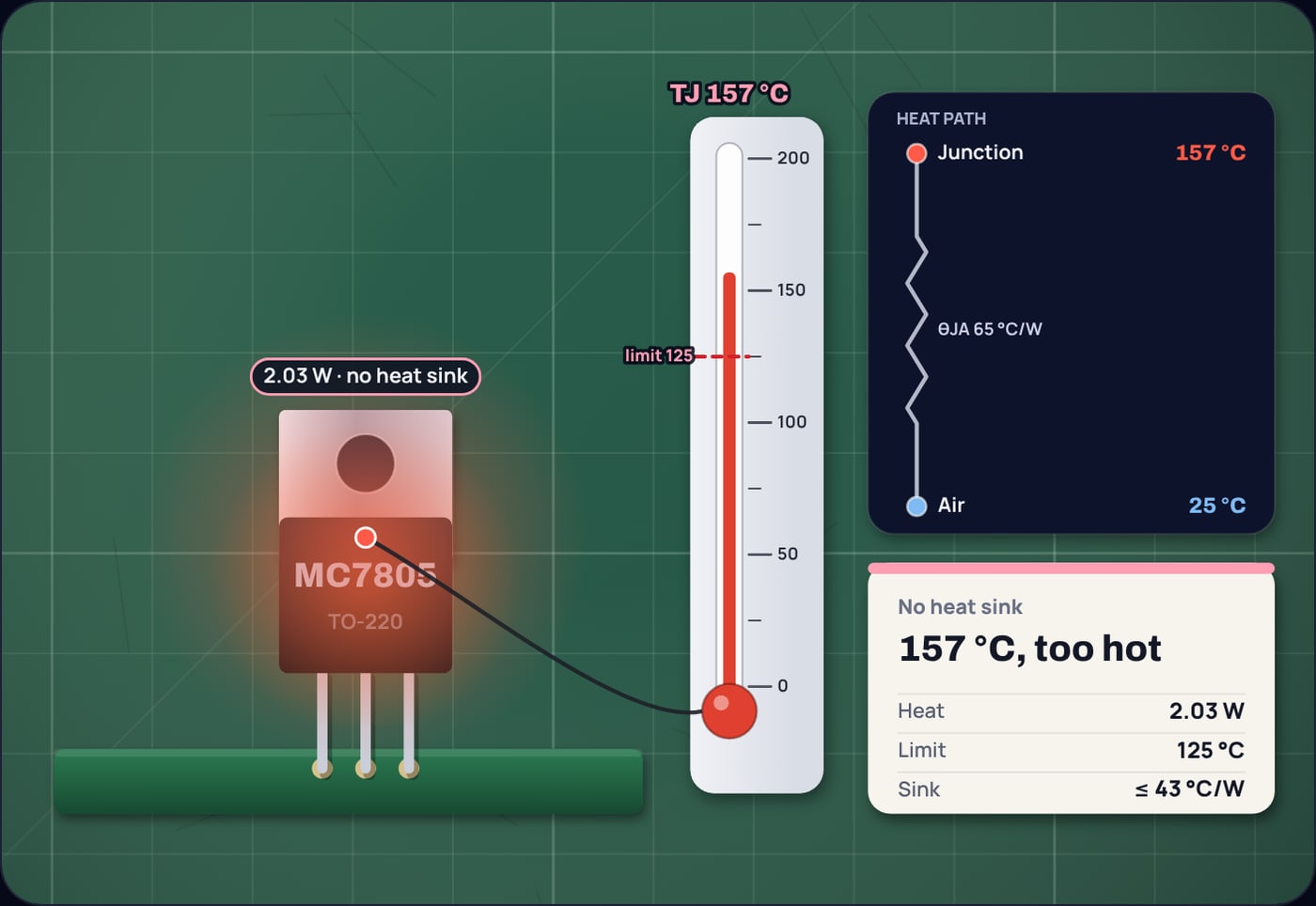
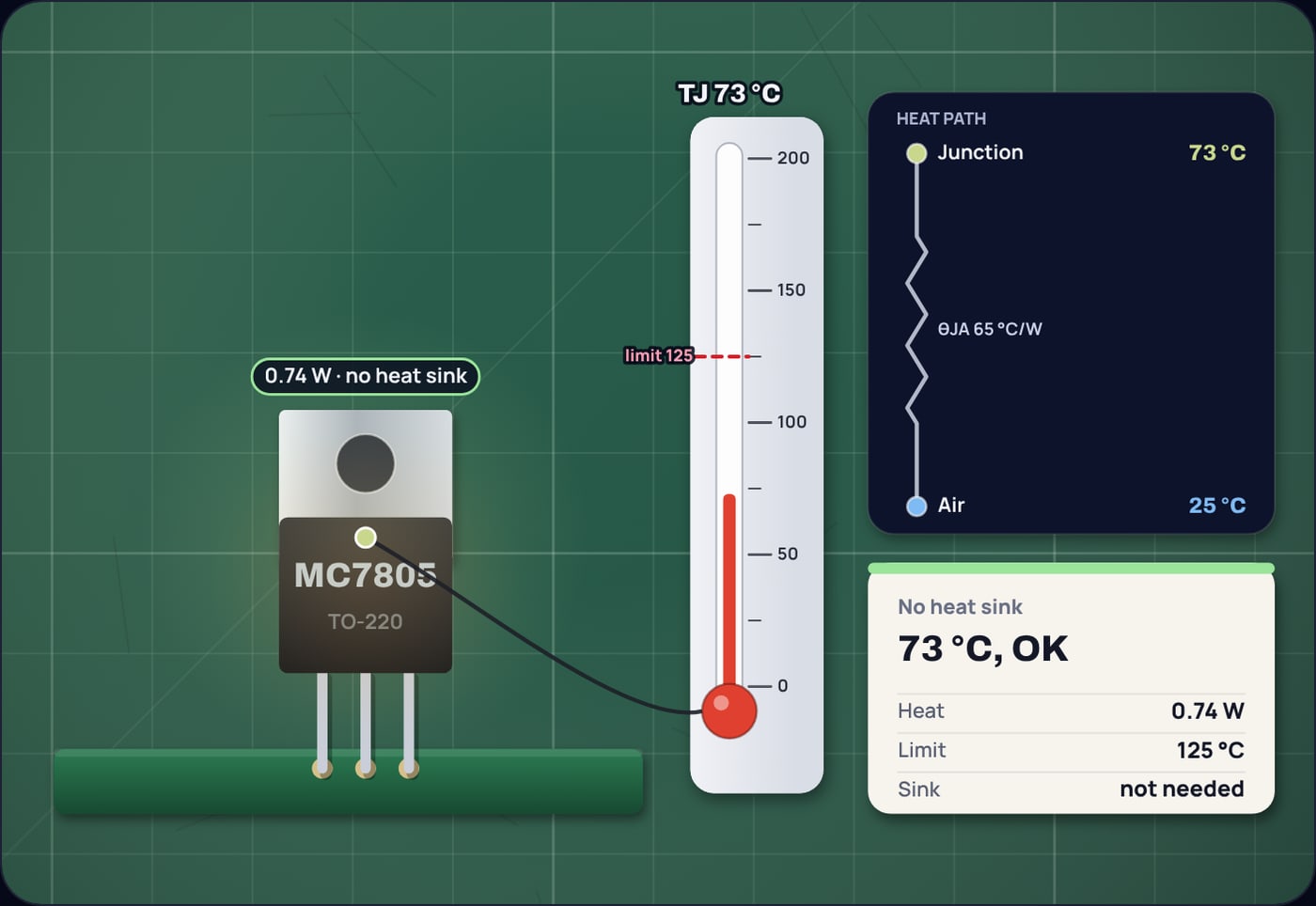
Only 2 W, and the junction is already 32 °C past the range the datasheet covers. A 100 mA load from 12 V is a different story: 0.74 W gives about 73 °C, comfortably inside.
What is the most a bare 7805 can handle?
Turn the formula round. The largest power that keeps the junction at 125 °C in 25 °C air is
Divide by the voltage dropped and you get the most load current the bare regulator can supply. The higher the input, the less current it can give:
| Input voltage | Voltage dropped | Most current with no heatsink |
|---|---|---|
| 7 V | 2 V | 0.76 A |
| 9 V | 4 V | 0.38 A |
| 12 V | 7 V | 0.21 A |
| 15 V | 10 V | 0.15 A |
These are for 25 °C air, with the 3.2 mA quiescent current taken off. Inside a box the air is warmer and the numbers shrink in proportion: at 40 °C the bare limit is (125 − 40) ÷ 65 = 1.31 W. And 7 V is about as low as the input can go. The datasheet gives a typical dropout of 2.0 V at 1 A, and the MC7805C's output tolerance is specified from a 7 V input.
How do you size the heatsink?
With a heatsink, the heat takes a different path: from the junction to the metal tab of the package, across the interface into the heatsink, and from the fins into the air. Each step has its own thermal resistance, and they add in series:
- θJC, junction to case, is set by the package: 5.0 °C/W for the MC7805 and for onsemi's LM317 in TO-220.
- θCS, case to sink, is the interface. onsemi's application note AN1040 measured a TO-220 at 1.2 °C/W bolted dry, 1.0 °C/W with thermal grease, 3.4 °C/W on a dry mica washer and 1.6 °C/W on a greased one.
- θSA, sink to air, is the number on the heatsink datasheet.
Set TJ to the limit and solve for the one number you get to choose:
For the 7805 from 12 V at 1 A, greased to the heatsink:
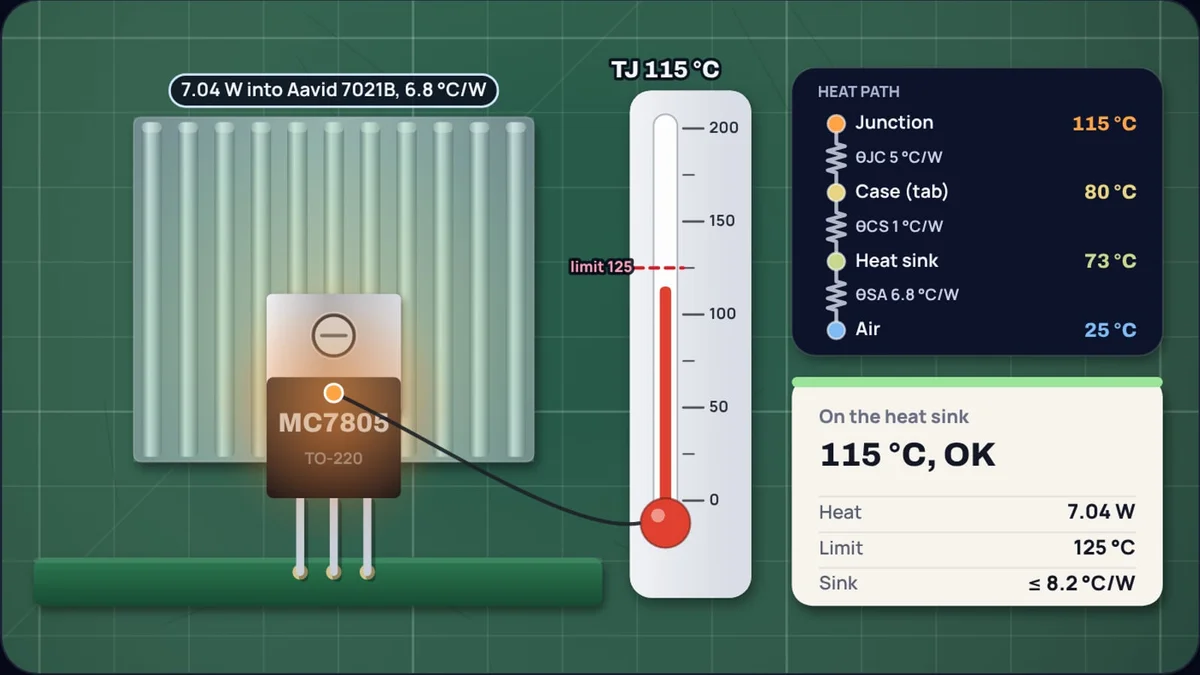
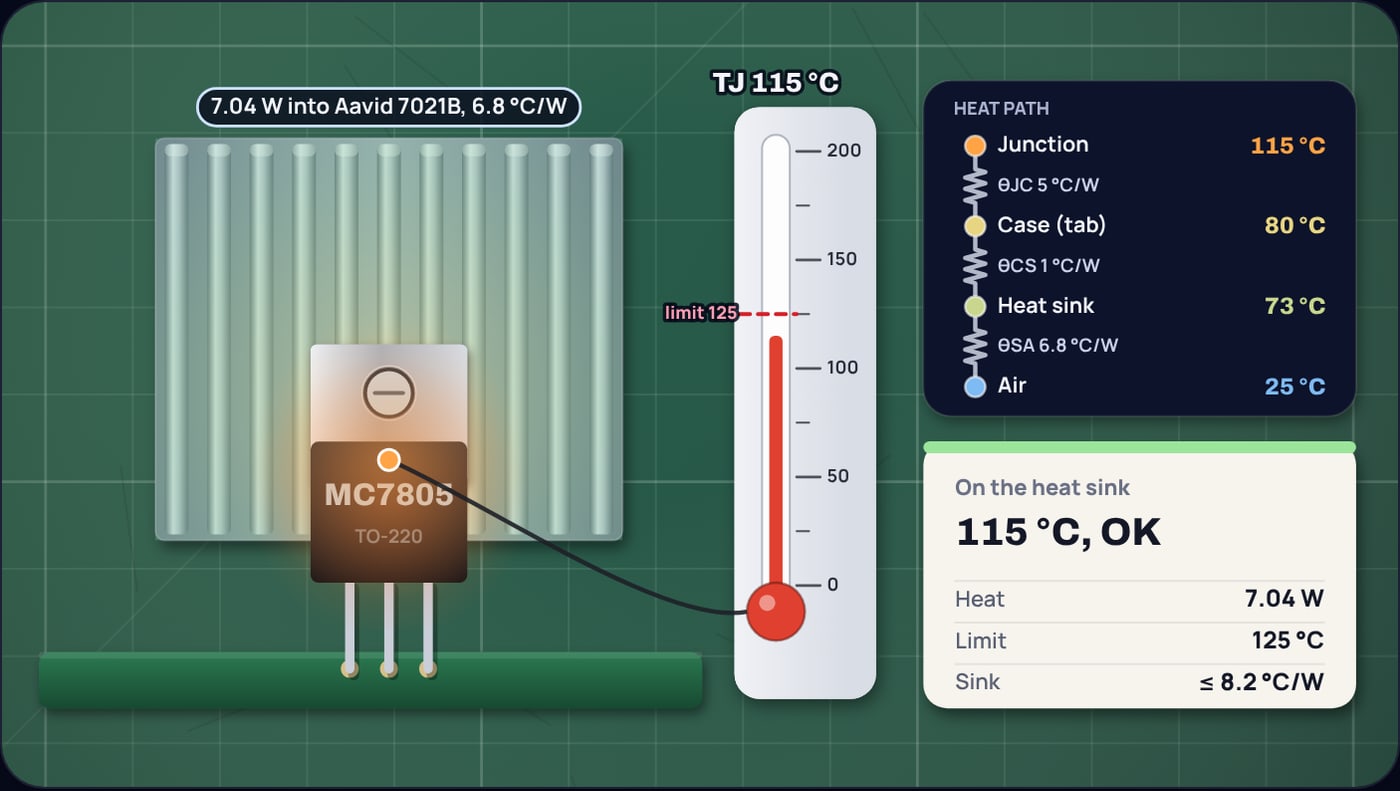
Any heatsink rated 8.2 °C/W or lower will do. Aavid's catalogue lists natural convection figures for its TO-220 heatsinks, among them the 577202B clip at 24.4 °C/W, the 6021PB channel at 12.5 °C/W, the finned 7021B at 6.8 °C/W and the larger 7023B at 4.4 °C/W. The 7021B passes. The junction lands at 115 °C, the tab at 80 °C and the heatsink at 73 °C. The 6021PB looks almost big enough, but at 12.5 °C/W it leaves the junction at 155 °C.
The method is not ours. Aavid's own "How to select a heat sink" page works the same equation for a 6 W part with θJC of 3 °C/W, a 0.5 °C/W pad, a 150 °C limit and 65 °C air, and gets (150 − 65) ÷ 6 − 3 − 0.5 = 10.7 °C/W. The calculator's catalogue example preset gives the same answer.
What changes inside a box?
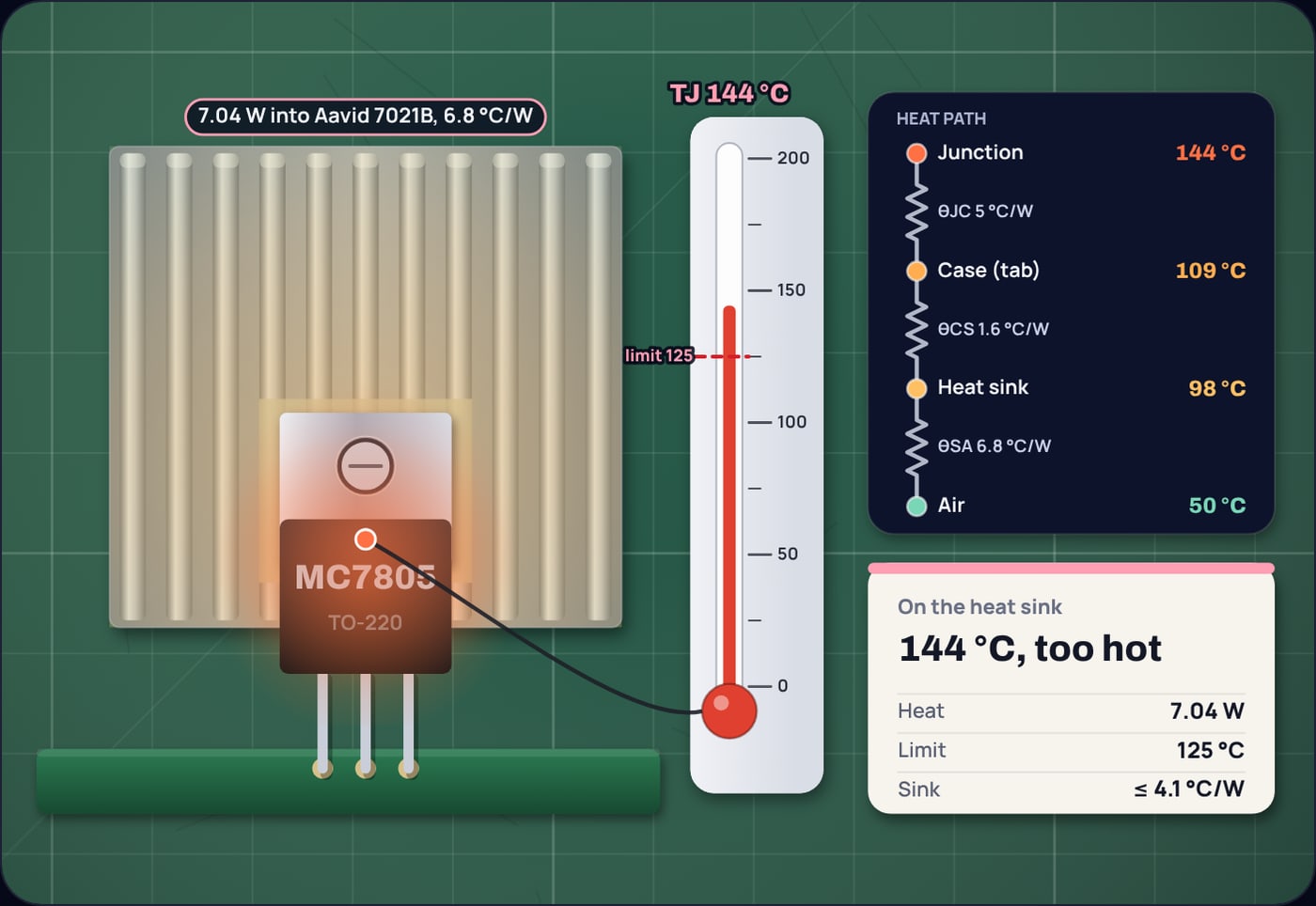
Heatsink ratings assume free air at the temperature you give. Put the same 1 A regulator in an enclosure at 50 °C and isolate the tab with a greased mica washer, as you must when the heatsink is grounded and the tab is not:
The heatsink that worked on the bench now leaves the junction 19 °C over the limit. The requirement drops to (125 − 50) ÷ 7.04 − 5 − 1.6 = 4.1 °C/W, which is more than any of the four catalogue parts above can give. Warm air eats into the budget twice: once as a higher starting point, and once because there are fewer degrees left to share between the three resistances.
When does a heatsink stop helping?
θJC and θCS set a floor that no heatsink can get under. Even a perfect heatsink at 0 °C/W leaves 6 °C/W between the junction and the air. At 7 W that is 42 °C of rise. At 13 W it is 78 °C.
Take an LM317 asked for 3.3 V at 1.5 A from 12 V. It drops 8.7 V and dissipates 13.05 W. The heatsink would have to be 1.66 °C/W, and even the 4.4 °C/W finned part leaves the junction at 161 °C. At that point the answer is not a bigger heatsink but less heat: a lower input voltage, or a switching regulator that does not burn the difference. The buck converter is the usual choice, since it converts the voltage instead of dropping it across a transistor.
Does the 7805 protect itself?
Partly. onsemi says the MC7800 series is designed with thermal overload protection that "shuts down the circuit when subjected to an excessive power overload condition", along with short circuit current limiting. A 7805 that runs too hot usually cuts out and comes back as it cools, so the symptom is a supply that drops out under load rather than one that fails for good. That protection is a safety net. It is not a design margin, and a regulator cycling in and out of shutdown is not a working power supply.
What about the little 78L05?
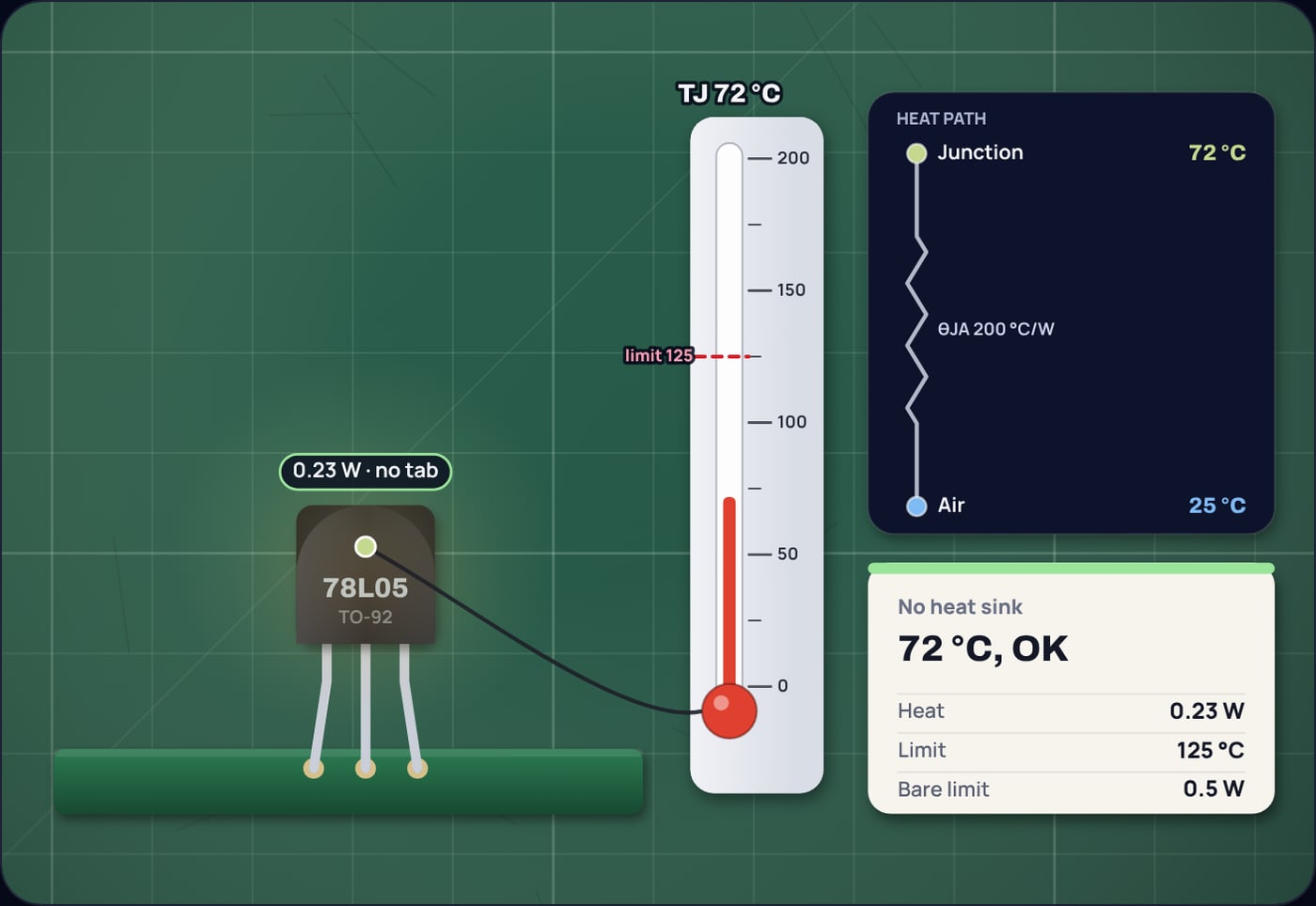
The TO-92 version is a different thermal animal. onsemi's MC78L00A datasheet gives it θJA of 200 °C/W and no junction to case figure at all, noting that the plastic package has no tab and that most of its heat leaves through the leads into the board. In 25 °C air it can shed (125 − 25) ÷ 200 = 0.5 W. That covers 9 V to 5 V at 50 mA, about 0.23 W and 72 °C, but 100 mA from 12 V is 0.75 W and about 174 °C, with no tab to bolt a heatsink to.
Does the same method work for a MOSFET?
Yes, with a different power formula. A MOSFET that is fully on dissipates I² × RDS(on), and RDS(on) rises as it warms. Infineon's IRFZ44N datasheet gives 17.5 mΩ maximum at 25 °C, and its normalized curve shows about 1.6 times that at 100 °C. At 10 A that is 2.8 W. With θJA of 62 °C/W the bare part would reach about 199 °C, past its 175 °C maximum. A 24.4 °C/W clip-on heatsink and the datasheet's 0.5 °C/W greased interface bring it to about 99 °C. Load the MOSFET presets in the calculator to try other currents.
How do you check your own design?
- Work out the power: (Vin − Vout) × I, plus Vin × Iq. Use the highest input voltage and the largest load you expect.
- Check the bare part: TA + P × θJA. If that is under the limit, you are done.
- If not, solve for θSA with the hottest air the board will see, and pick a heatsink rated at or below it.
- If θSA comes out below about 2 °C/W, or negative, cut the power instead.
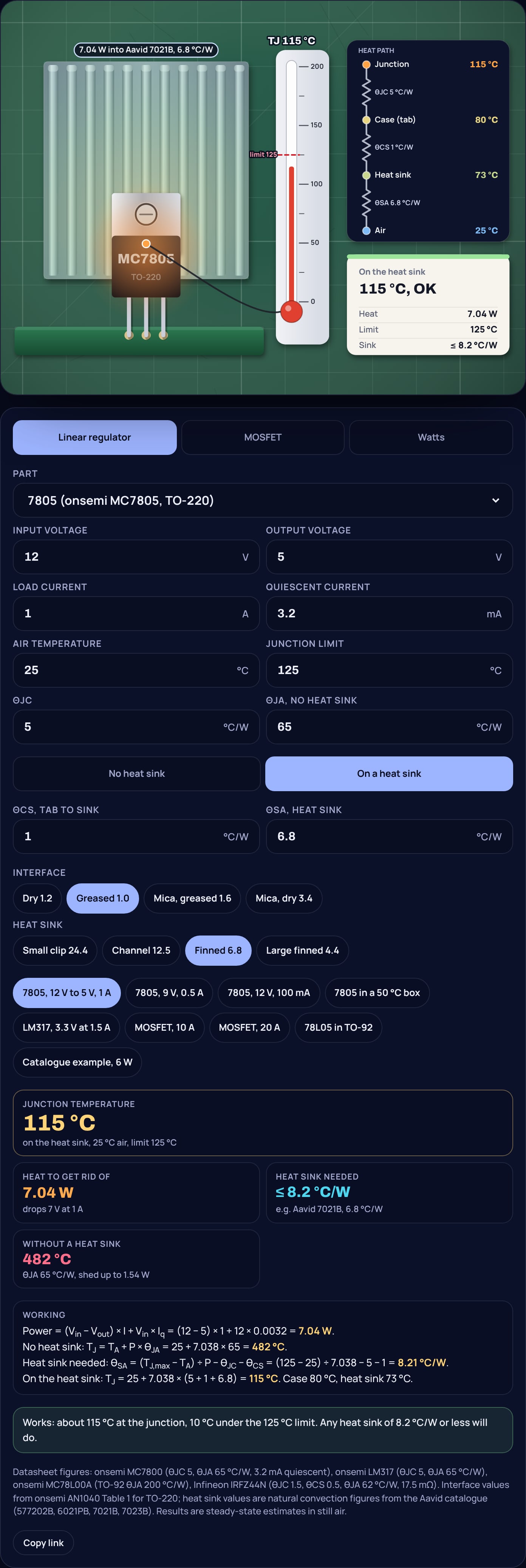
The heatsink calculator does all four steps and shows the working. If you are setting an adjustable regulator's output as well, the LM317 formula explained covers the resistor pair and the 3 V of headroom it needs.
Sources
- onsemi, MC7800, MC7800A, MC7800AE, NCV7800 datasheet, MC7800/D Rev. 29, November 2021 (TO-220 θJA 65 °C/W and θJC 5.0 °C/W, operating junction temperature 150 °C, electrical characteristics to 125 °C, 3.2 mA quiescent current, 2.0 V dropout at 1 A, thermal overload protection): onsemi.com MC7800/D
- onsemi, LM317 datasheet, LM317/D Rev. 18, September 2026 (case 221A θJA 65 °C/W, θJC 5.0 °C/W, LM317T specified 0 to 125 °C): onsemi.com LM317/D
- onsemi, MC78L00A series datasheet, MC78L00A/D Rev. 21, July 2025 (TO-92 θJA 200 °C/W, no θJC, heat leaves through the leads): onsemi.com MC78L00A/D
- Infineon, IRFZ44NPbF datasheet, Rev. 2.1, 2026-08-11 (θJC 1.5, θCS 0.50, θJA 62 °C/W, RDS(on) 17.5 mΩ, normalized on-resistance curve, 175 °C): infineon.com IRFZ44NPbF
- onsemi, AN1040/D Mounting Considerations for Power Semiconductors, Rev. 5, August 2021, Table 1 (TO-220 interface thermal resistance dry, greased and with mica): onsemi.com AN1040/D
- Aavid Thermalloy, standard heat sink catalogue (natural convection θ for TO-220 heatsinks, "How to select a heat sink" worked examples), as hosted by Future Electronics: futureelectronics.com Aavid catalogue PDF
Frequently asked questions
Does a 7805 need a heatsink?
It does once it dissipates more than about 1.5 W. The power is roughly (Vin − 5 V) × load current. With onsemi’s θJA of 65 °C/W, 1.54 W lifts the junction from 25 °C air to 125 °C, the top of the range the electrical tables cover. From 12 V that is only about 210 mA of load.
How hot can a 7805 get?
onsemi lists an operating junction temperature of 150 °C for the MC7800 series and specifies its electrical characteristics up to 125 °C. The regulator also has internal thermal overload protection that shuts it down when it overheats, which is why an overloaded 7805 often cuts out rather than failing outright.
What size heatsink does a 7805 need at 1 A?
From 12 V at 1 A it dissipates 7.04 W. For a 125 °C junction in 25 °C air, θSA = (125 − 25) ÷ 7.04 − 5 − 1.0 = 8.2 °C/W with a greased tab, so a heatsink rated 8.2 °C/W or lower. A 6.8 °C/W finned TO-220 sink keeps the junction near 115 °C.
How much current can a 7805 supply without a heatsink?
In 25 °C air, about 0.76 A from 7 V, 0.38 A from 9 V and 0.21 A from 12 V, keeping the junction at 125 °C. The higher the input voltage, the less current it can give bare.
Is a 78L05 in TO-92 the same as a 7805?
Electrically similar, thermally very different. onsemi gives the TO-92 78L05 a θJA of 200 °C/W and no θJC at all, so it can shed only about 0.5 W in 25 °C air and cannot take a heatsink.