How long should an antenna be?
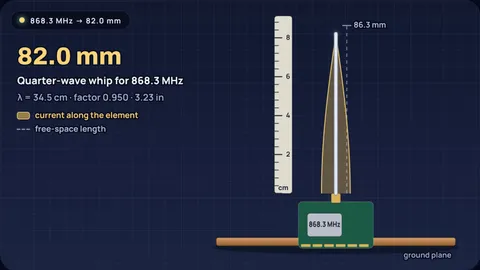
A quarter-wave whip is a quarter of the wavelength, trimmed about 5% for end effect: 164 mm at 433.92 MHz, 82.0 mm at 868 MHz, 77.8 mm at 915 MHz and 29.2 mm at 2.4 GHz. A half-wave dipole for FM at 100 MHz is 1.424 m tip to tip.
Why the trim depends on wire thickness, and why it is not a velocity factor, is covered in quarter-wave antenna length. For LoRa modules in particular, see how long should a LoRa antenna be.
Key results from the calculator
- 868 MHz LoRa: 82.0 mm (3.23 in) quarter-wave whip; 86.3 mm before shortening.
- 915 MHz LoRa: 77.8 mm (3.06 in).
- FM 100 MHz dipole: 1.424 m in total, 712 mm each arm.
- 2 m at 146 MHz: a 5/8-wave whip is about 1.219 m, with a matching coil at the base.
Seven antennas
Each example loads the frequency, antenna type and the 0.95 shortening factor.
A 433 MHz whip for a remote or sensor module
Quarter waveAt 433.92 MHz, the centre of the 433.05 to 434.79 MHz band, the wavelength is 691 mm. A quarter is 173 mm; with the 0.95 factor, 164 mm.
A LoRa whip for 868 MHz
EU868868.3 MHz is the middle of LoRaWAN's three default EU channels (868.1, 868.3 and 868.5 MHz). The quarter-wave whip is 82.0 mm.
A LoRa whip for 915 MHz
US915915 MHz sits in the middle of the US 902 to 928 MHz band. The whip is 77.8 mm, about 4.2 mm shorter than the 868 MHz one.
A 2.4 GHz whip
Wi-Fi, BluetoothAt 2.44 GHz the wavelength is only 123 mm, so the whip is 29.2 mm. At this size a millimetre of wire is a large part of the length, and thickness matters most.
An FM receiving dipole at 100 MHz
Half wave468 ÷ 100 = 4.68 ft, 1.424 m tip to tip: two arms of 712 mm fed at the centre. It covers the 88 to 108 MHz band well enough for reception.
A 5/8-wave whip for the 2 m band
Amateur VHFFive-eighths of a wavelength at 146 MHz is 1.283 m; with the 0.95 factor, 1.219 m. It is not resonant by itself and is sold with a matching coil at the base.
A quarter-wave for 70 cm at 435 MHz
Amateur UHF435 MHz is inside the 70 cm band in every ITU region. The whip is 164 mm, almost the same as a 433 MHz one.
Antenna lengths with the 0.95 factor
| Frequency | Wavelength | ¼-wave whip | ½-wave dipole | ⅝-wave whip |
|---|---|---|---|---|
| 100 MHz | 2.998 m | 712 mm | 1,424 mm | 1,780 mm |
| 146 MHz | 2.053 m | 488 mm | 975 mm | 1,219 mm |
| 433.92 MHz | 69.1 cm | 164 mm | 328 mm | 410 mm |
| 868.3 MHz | 34.5 cm | 82.0 mm | 164 mm | 205 mm |
| 915 MHz | 32.8 cm | 77.8 mm | 156 mm | 195 mm |
| 2.4417 GHz | 12.3 cm | 29.2 mm | 58.3 mm | 72.9 mm |
Dipole lengths are tip to tip; each arm is half. Thin wire at low frequencies needs less shortening than 5%, thick elements at high frequencies more.
How the calculator works
Wavelength: λ = c ÷ f with c = 299,792,458 m/s, the exact value fixed in the SI.
Fraction: ¼ λ for a whip over a ground plane, ½ λ for a dipole, ⅝ λ for a 5/8-wave whip.
End effect: the US Army manual TM 11-666 shortens a half-wave antenna by about 5%, L = 0.95 × 492 ÷ f = 468 ÷ f feet, and notes that thicker conductors need more. The factor is adjustable.
Current: the gold band is the standing wave sin(2π(h − z)/λ), zero at the tip.
What the model leaves out
- Conductor thickness: the right factor ranges from nearly 1 for thin wire to below 0.95 for fat elements.
- Insulation and PCB traces: plastic or board material around the element slows the wave and shortens it further.
- Ground plane size: a small board or case changes both the resonant length and the impedance.
- Matching: a quarter-wave whip is not exactly 50 Ω, and a 5/8-wave whip needs a coil; the length alone does not guarantee a low SWR.
Common misconceptions
"Cut it to exactly a quarter wavelength." A full free-space length resonates a few percent low; cut long and trim.
"The 0.95 is the velocity factor of the wire." It comes from end effect, and it changes with thickness.
"A whip works on its own." A quarter-wave is half of an antenna; the ground plane is the other half.
Frequently asked questions
How long is a quarter-wave antenna for 868 MHz?
About 82.0 mm (3.23 in) with the usual 5% end-effect trim; 86.3 mm is the free-space quarter wavelength.
How long is a quarter-wave antenna for 915 MHz?
About 77.8 mm (3.06 in).
What is the 468/f formula?
The length in feet of a half-wave dipole for a frequency in MHz: 492 ÷ f is a free-space half wavelength, and 468 is 95% of it to allow for end effect. 234 ÷ f is the quarter-wave version.
How long is a dipole for FM radio?
About 1.424 m tip to tip for 100 MHz, two arms of 712 mm.
Why is a 5/8-wave antenna used?
For gain on VHF and UHF mobiles. Commercial 5/8-wave whips, such as Comtelco’s base-loaded UHF models, are rated at 3 dB and use a matching coil at the base, because the bare 5/8-wave element is not a good match for the radio.
Keep learning
How Long Should a LoRa Antenna Be? 868 MHz and 915 MHz Lengths
A quarter-wave LoRa whip is about 82 mm for 868 MHz and 78 mm for 915 MHz; a dipole is twice that. Where the numbers come from, which channels they cover, and why the full quarter wavelength is too long.
Quarter Wave Antenna Length: 234/f, 246/f and Why
A quarter wave is 246/f feet (74.95/f m), but a resonant whip is 2 to 7% shorter, depending on wire thickness. Worked 433 MHz and 2.4 GHz lengths.
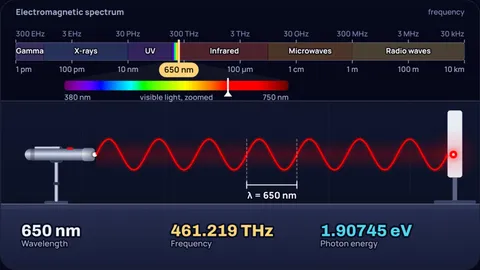
How to Convert Wavelength to Frequency (With Examples)
Convert wavelength to frequency with f = v/λ: worked examples for a red laser, FM radio, Wi-Fi and a 440 Hz note, plus photon energy and the unit traps.