How Long Should a LoRa Antenna Be? 868 MHz and 915 MHz Lengths
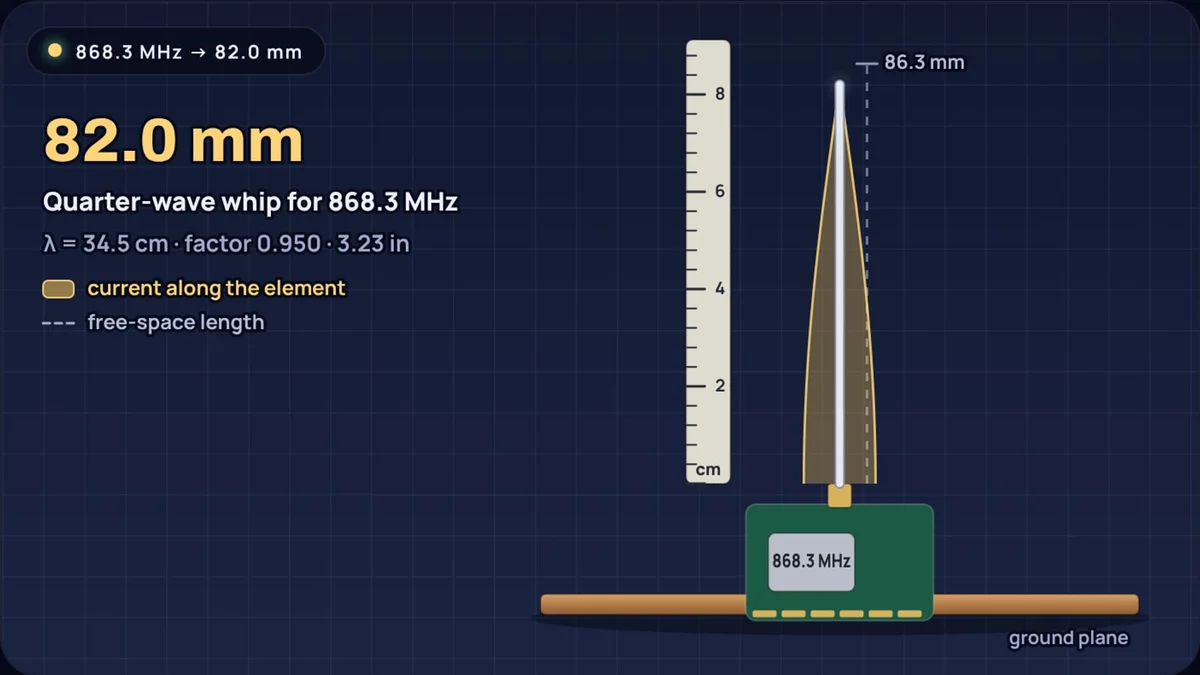
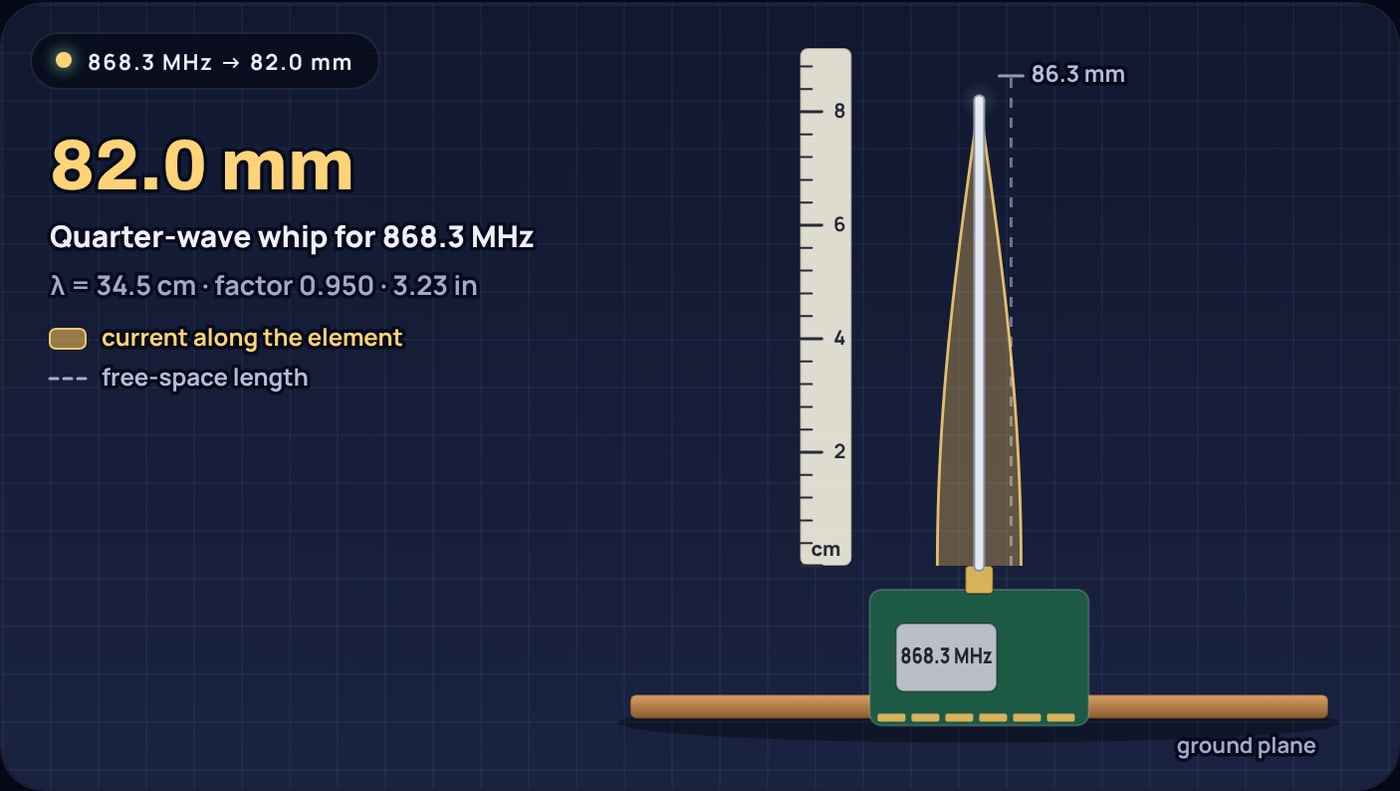
A LoRa module arrives with a pad or a connector marked ANT and, often, no antenna. The usual fix is a piece of wire, and the usual question is how long to cut it. For 868 MHz the short answer is about 82 mm; for 915 MHz, about 78 mm. The longer answer explains why those numbers are a little shorter than a quarter of a wavelength, which frequency to cut for when LoRa hops between channels, and what the wire needs underneath it to work.
The antenna length calculator works out quarter-wave, half-wave and 5/8-wave lengths for any frequency and draws the antenna to scale beside the module; every length here comes from it. Why the trim depends on wire thickness, with a model of the feed impedance, is covered in quarter-wave antenna length.
Which frequency to cut for
LoRa does not sit on one frequency. It uses a set of channels, and the antenna has to work across all of them. The LoRa Alliance's regional parameters document (RP002) sets the channel plans:
- Europe (EU863-870): devices must be able to operate from 863 to 870 MHz, and every device implements three default channels at 868.1, 868.3 and 868.5 MHz.
- North America (US902-928): 64 uplink channels from 902.3 to 914.9 MHz in 200 kHz steps, 8 wider uplink channels from 903.0 to 914.2 MHz, and 8 downlink channels from 923.3 to 927.5 MHz. The US rules for the band itself are in 47 CFR 15.247, which covers 902 to 928 MHz.
For an EU device, 868.3 MHz is the obvious centre. For a US device, the antenna both transmits near the bottom of the band and listens near the top, so 915 MHz, the middle of 902 to 928 MHz, is the sensible design frequency.
| Frequency | Use | Wavelength | ¼-wave whip (0.95) |
|---|---|---|---|
| 863 MHz | EU band edge | 347 mm | 82.5 mm |
| 868.3 MHz | EU default channels | 345 mm | 82.0 mm |
| 870 MHz | EU band edge | 345 mm | 81.8 mm |
| 902.3 MHz | US first uplink | 332 mm | 78.9 mm |
| 915 MHz | US band centre | 328 mm | 77.8 mm |
| 927.5 MHz | US last downlink | 323 mm | 76.8 mm |
Across the EU band the length changes by less than a millimetre. Across the whole US plan it changes by about 2 mm, or 2.7%, which is why one antenna centred on 915 MHz serves both directions.
Step 1: the wavelength
A radio wave in air travels at very nearly the speed of light, which is exactly 299,792,458 m/s by definition of the metre (NIST). The wavelength is that speed divided by the frequency:
Wavelength at 868.3 MHz and 915 MHz
A quarter of each: 86.3 mm and 81.9 mm.
Step 2: shorten it for end effect
Cut a wire to exactly 86.3 mm and it resonates a few percent below 868 MHz. The reason is end effect: the open tip of the wire has capacitance to its surroundings, which makes the element behave as if it were longer than it is. The US Army's 1953 technical manual TM 11-666, "Antennas and Radio Propagation", describes it and gives the standard correction: make the antenna about 5% shorter, so a half-wave antenna is
with f in MHz. The quarter-wave version is 234/f. The same manual notes that the correction depends on the conductor: a thin wire changes the wave's behaviour less than a fat one. So 0.95 is a starting point, not a law, and the calculator lets you change it.
Quarter-wave whips with the 0.95 factor
As a check, 234 ÷ 868.3 = 0.2695 ft = 82.1 mm, the same within the rounding of 468.
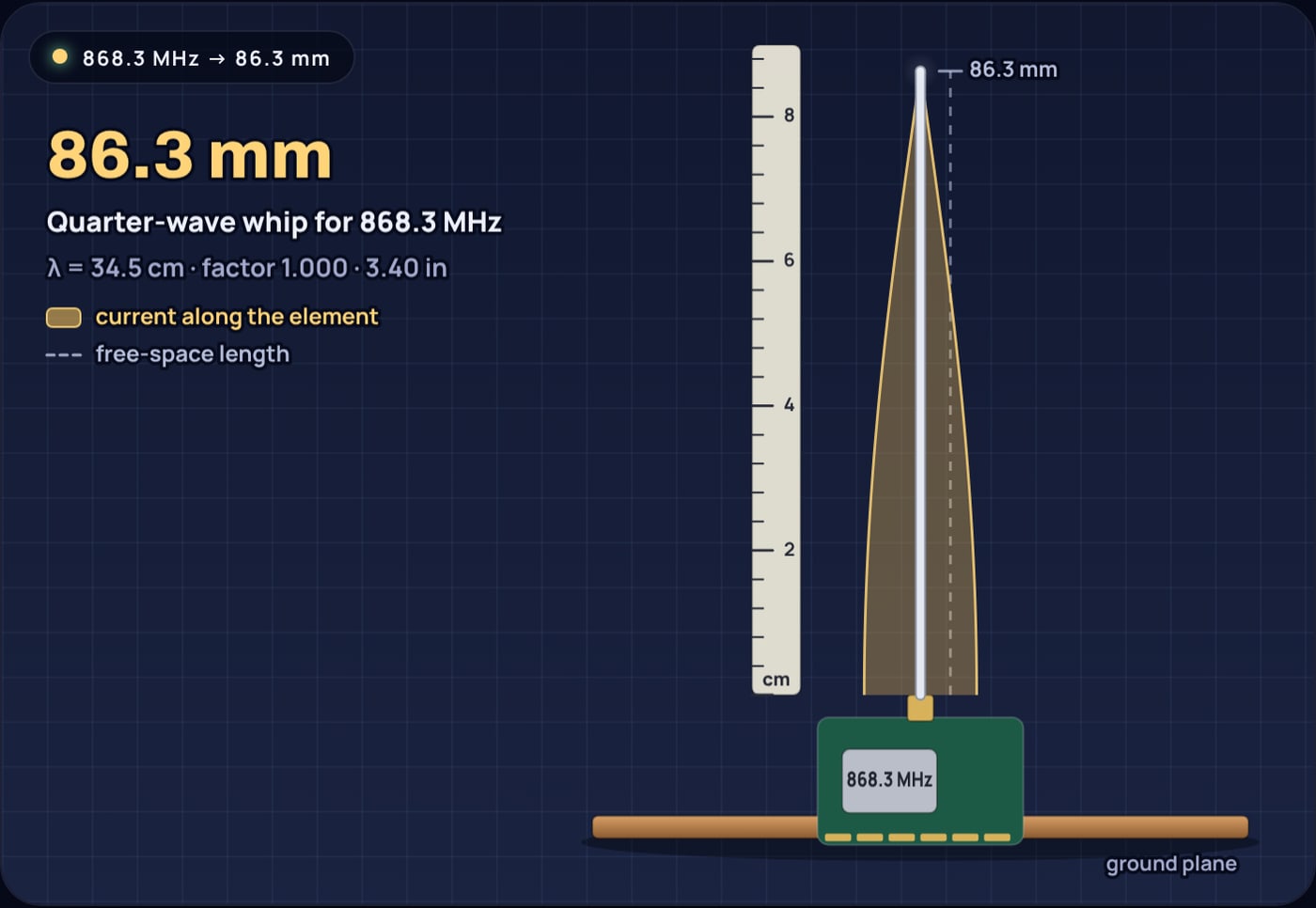
In practice, cut the wire a few millimetres long, connect it, and trim while watching the SWR or the received signal strength. If you cannot measure, cut to the 0.95 length; it is closer than the full quarter wave.
868 MHz and 915 MHz antennas are not interchangeable
The two bands are only 5.4% apart, so the antennas look alike: 82.0 mm against 77.8 mm, a difference of 4.2 mm. That is still about the same as the end-effect trim itself. A 915 MHz whip used at 868 MHz resonates above the band, and an 868 MHz whip used at 915 MHz resonates below it. Both will still radiate, but the mismatch costs range, so it is worth buying or cutting the antenna for the band you use.
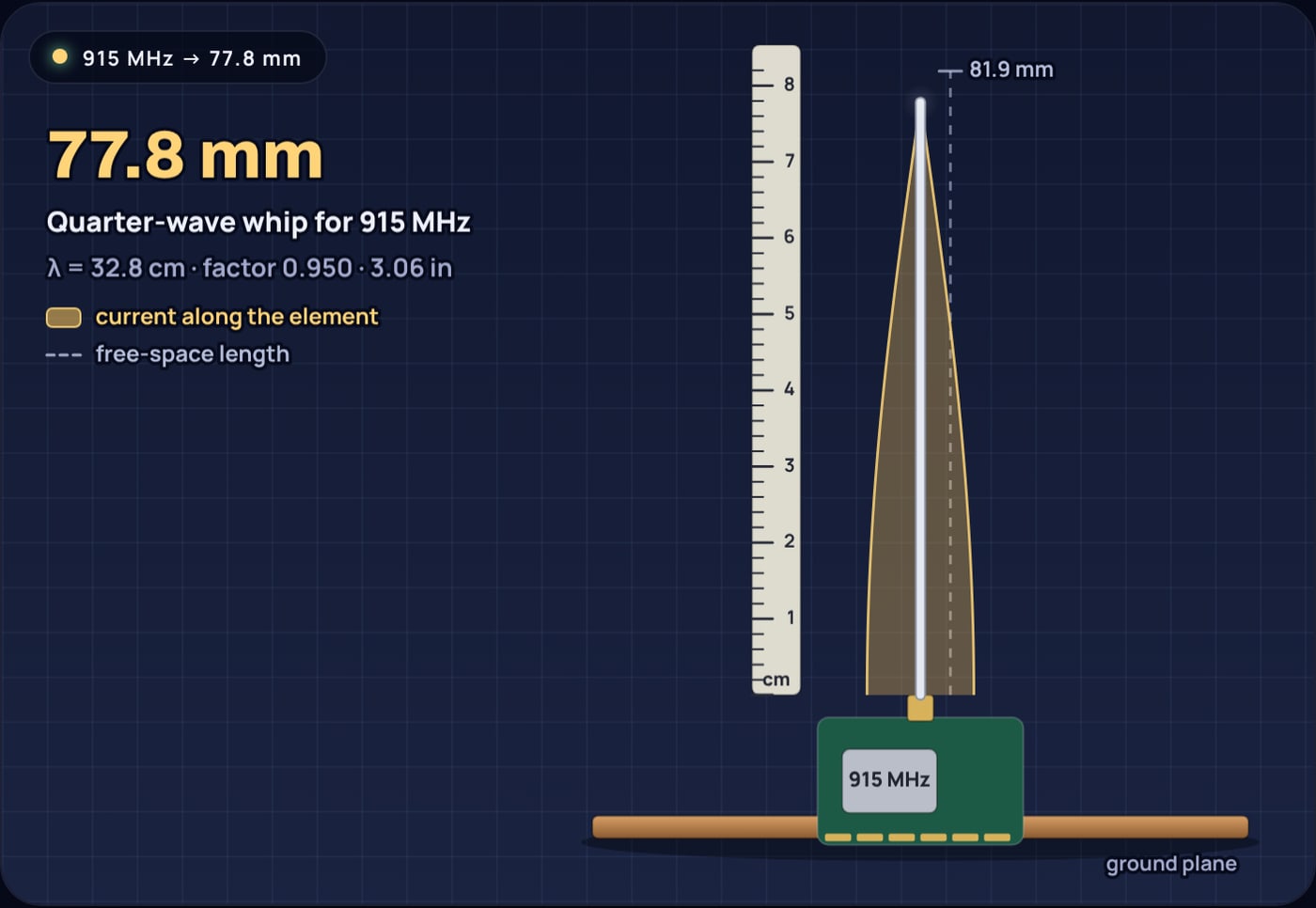
Commercial antennas are usually marked with their band, and many of the short, stubby ones are not straight quarter-wave wires at all; they use a coil or a helix to fit the same electrical length into less space. Their physical length tells you little, so go by the marking.
The whip needs a ground plane
A quarter-wave whip is only half of an antenna. TM 11-666 describes the ground-plane antenna as a quarter-wave vertical radiator that "carries its own artificial ground": a metal disc or a set of rods at its base. The current flowing up the whip is matched by current in that ground, and without it the coax shield or whatever the board is connected to becomes the other half, with unpredictable results.
On a LoRa board the ground plane is the module's ground copper, the main board under it, or a metal case. For a wire antenna on a bare module, a few quarter-wave wires soldered to ground and spread out at the base will do the same job. The same manual notes that bending those radials down below horizontal raises the feed impedance toward 50 Ω, which suits ordinary coax.
A dipole for a gateway or a test
If there is no good ground plane, a half-wave dipole avoids the problem: two quarter-wave arms fed at the centre, each the same length as the whip.
Half-wave dipoles with the 0.95 factor
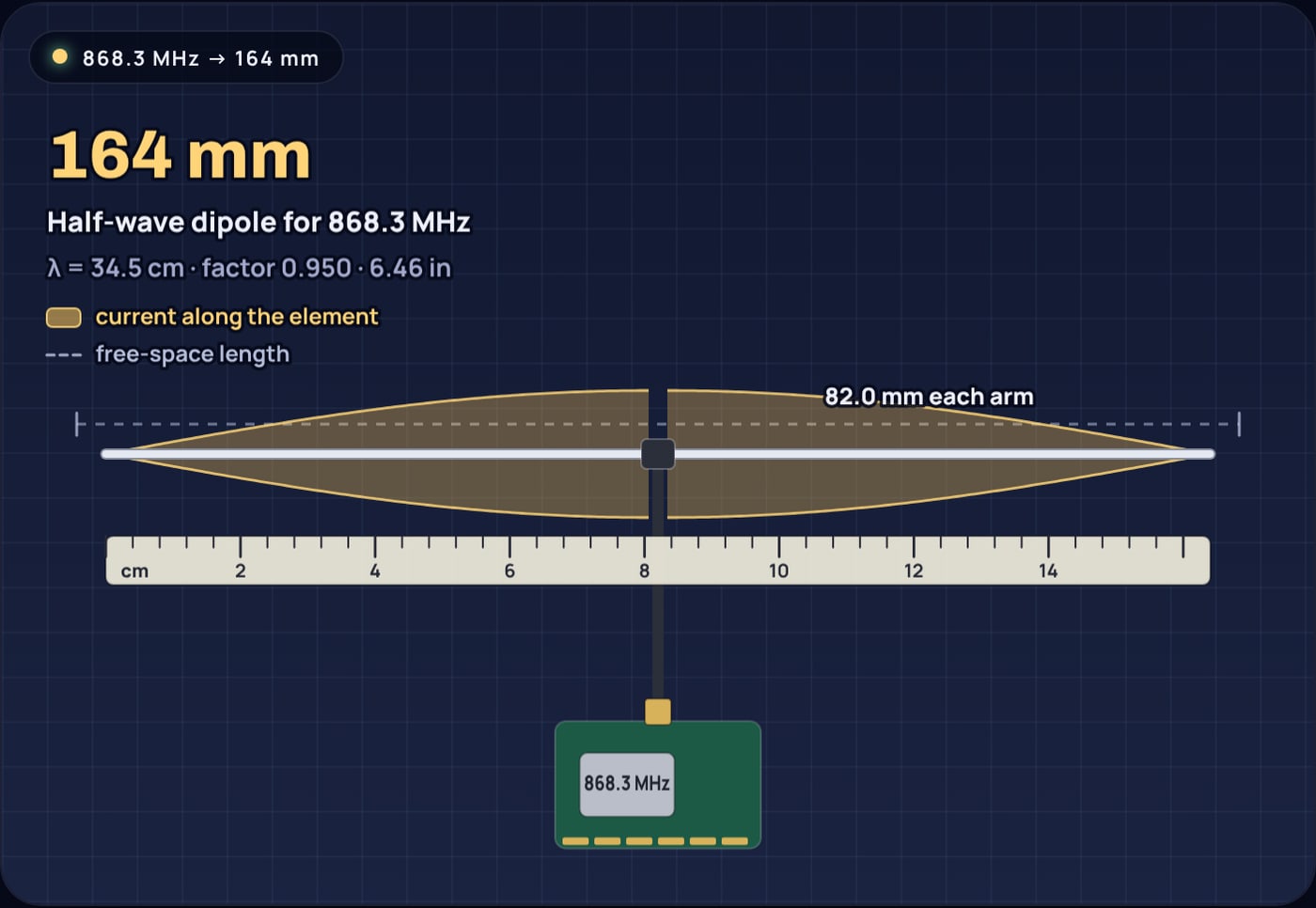
Hang it vertically to match the polarisation of the whips on your other nodes, and keep it clear of metal.
Compared with a 433 MHz antenna
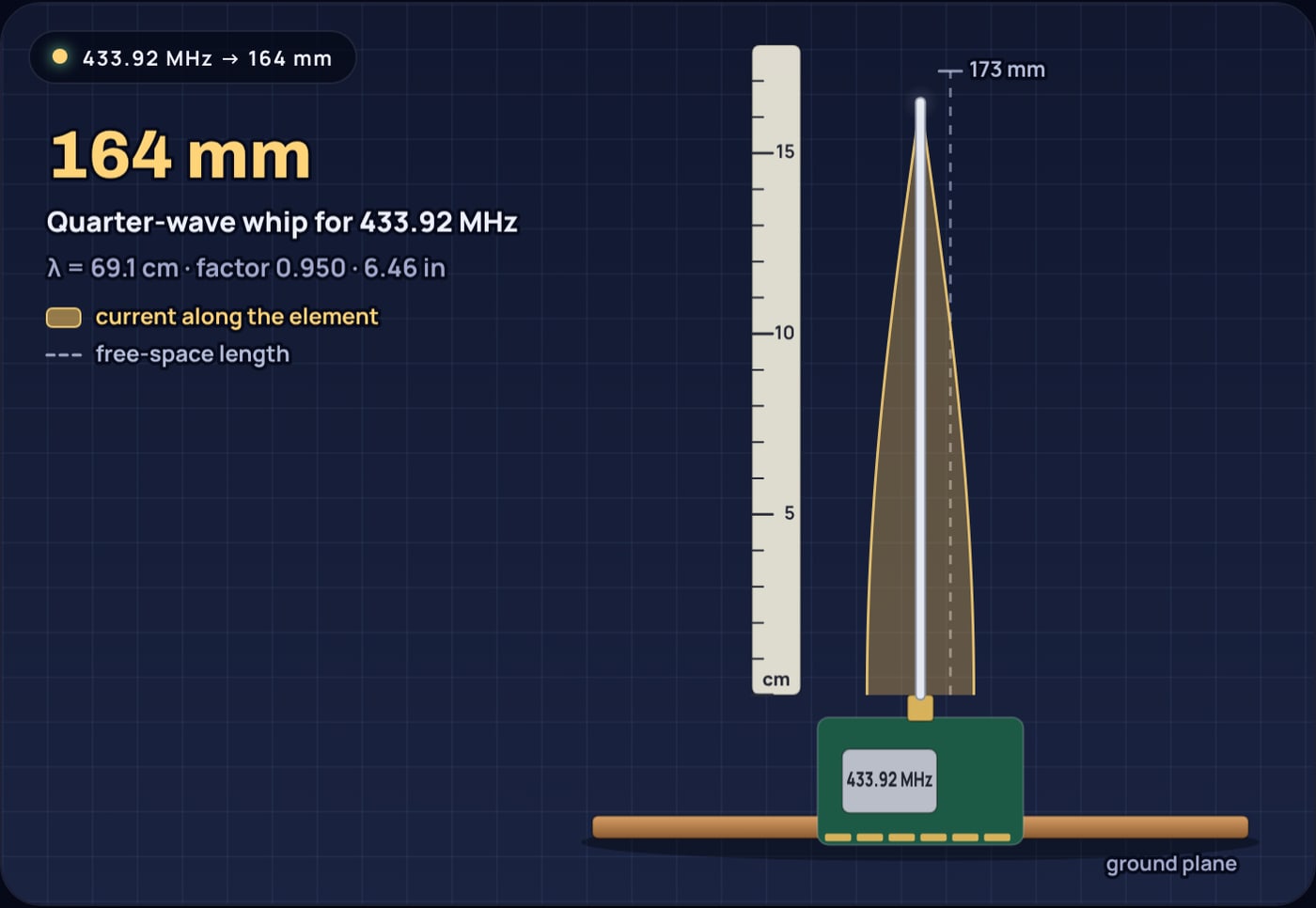
LoRaWAN also has an EU433 plan, and many remote-control modules use the same 433.05 to 434.79 MHz band. Half the frequency means twice the length: a 433.92 MHz whip is 164 mm, the same as an 868 MHz dipole. A 433 MHz whip on an 868 MHz module is a half wavelength long, which presents a very different impedance from the quarter-wave the module expects, so it is not a substitute.
Power limits include the antenna
The regional parameters set the default maximum radiated power as EIRP, which includes the antenna's gain: +16 dBm for EU868 and +30 dBm for US915. A higher-gain antenna does not let you exceed those limits; it means turning the transmitter down. In Europe the default channels also carry a duty cycle under 1%.
Checklist
- Cut for 868.3 MHz in Europe or 915 MHz in North America.
- Quarter-wave whip: 82 mm or 78 mm. Dipole: 164 mm or 156 mm.
- Start a few millimetres long and trim, if you can measure.
- Give a whip a ground plane; a dipole does not need one.
- Keep the antenna away from metal and batteries, and vertical on every node.
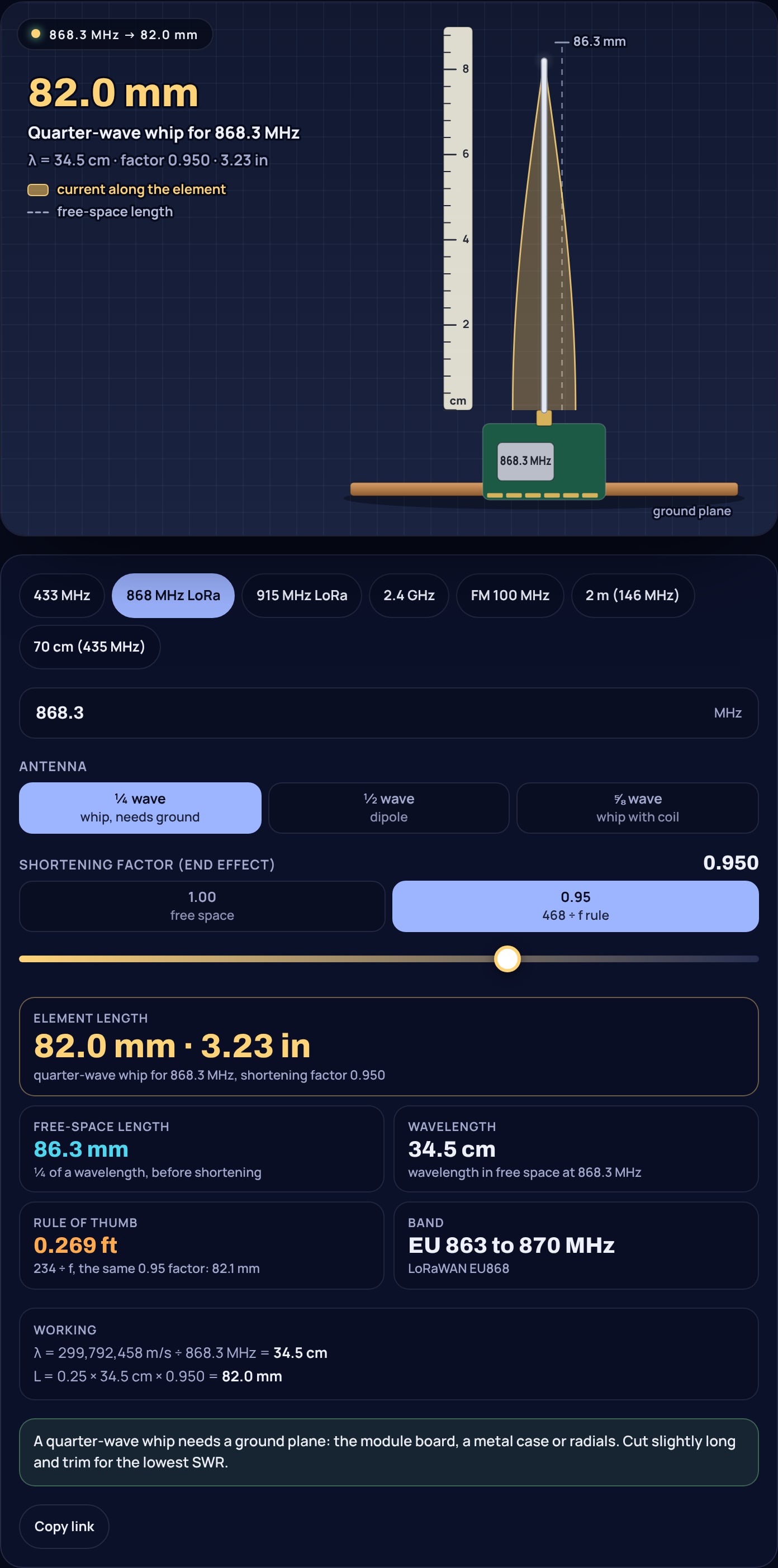
For other frequencies or antenna types, open the antenna length calculator, enter the frequency, choose a quarter-wave whip, a dipole or a 5/8-wave whip, and adjust the shortening factor for your wire.
Sources
- LoRa Alliance, RP002-1.0.3 LoRaWAN Regional Parameters (EU863-870: 863 to 870 MHz, default channels 868.1, 868.3 and 868.5 MHz, duty cycle under 1%, default max EIRP +16 dBm; US902-928: uplink 902.3 to 914.9 MHz in 200 kHz steps and 903.0 to 914.2 MHz, downlink 923.3 to 927.5 MHz, max EIRP +30 dBm)
- 47 CFR 15.247, Operation within the bands 902-928 MHz, 2400-2483.5 MHz and 5725-5850 MHz
- Department of the Army, TM 11-666, Antennas and Radio Propagation (February 1953) (end effect; L = 0.95 × 492/f = 468/f feet; thicker conductors shorten more; the ground-plane antenna and its radials)
- NIST CODATA, speed of light in vacuum (299,792,458 m/s, exact)
- CEPT Report 85 (non-specific short range devices in 433.05 to 434.79 MHz and 863 to 870 MHz)
Frequently asked questions
How long should a LoRa antenna be for 868 MHz?
About 82 mm (3.23 in) for a quarter-wave wire whip, using the usual 5% end-effect trim on the 86.3 mm free-space quarter wavelength at 868.3 MHz. A half-wave dipole is about 164 mm tip to tip, two 82 mm arms.
How long should a LoRa antenna be for 915 MHz?
About 78 mm (3.06 in) for a quarter-wave whip at 915 MHz, and about 156 mm for a half-wave dipole. Across the US channels it ranges from 78.9 mm at 902.3 MHz to 76.8 mm at 927.5 MHz.
Can I use a 915 MHz antenna on 868 MHz?
It will work, but not at its best. The two frequencies are about 5.4% apart, so a 915 MHz whip is about 4 mm shorter than an 868 MHz one and resonates above the 868 MHz channels. For the best range, use an antenna made or cut for your band.
Does a LoRa wire antenna need a ground plane?
A quarter-wave whip does: it is half of an antenna, and the ground plane supplies the other half. On a module that is the board’s ground copper, a metal case or a few quarter-wave radial wires. A half-wave dipole needs no ground plane.
Why is a LoRa antenna shorter than a quarter wavelength?
Because of end effect. Capacitance at the tip makes the element behave as if it were longer than it is, so it is cut about 5% short to resonate. The US Army’s TM 11-666 gives the classic half-wave form as 468 divided by the frequency in MHz, in feet, and notes that thicker conductors need more shortening.