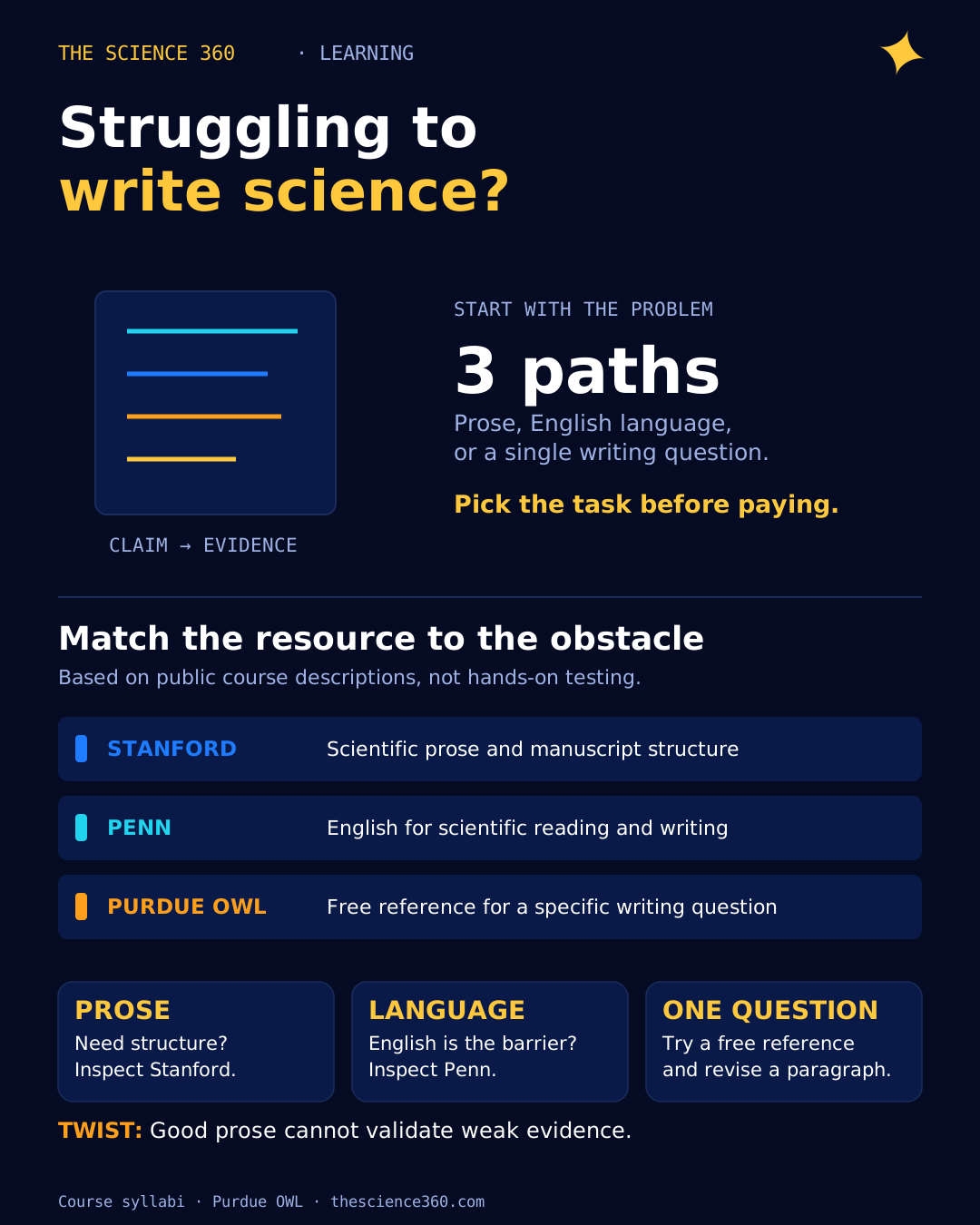
Which science-writing course do you need: clearer prose, stronger English or neither?

If you understand your research but struggle to explain it clearly, Stanford’s Writing in the Sciences is the closer syllabus match. If English vocabulary and reading scientific material are the main barriers, Penn’s English for Science, Technology, Engineering, and Mathematics addresses a different need. If you only need help with a particular paragraph or sentence, start with a free reference and a revision session.
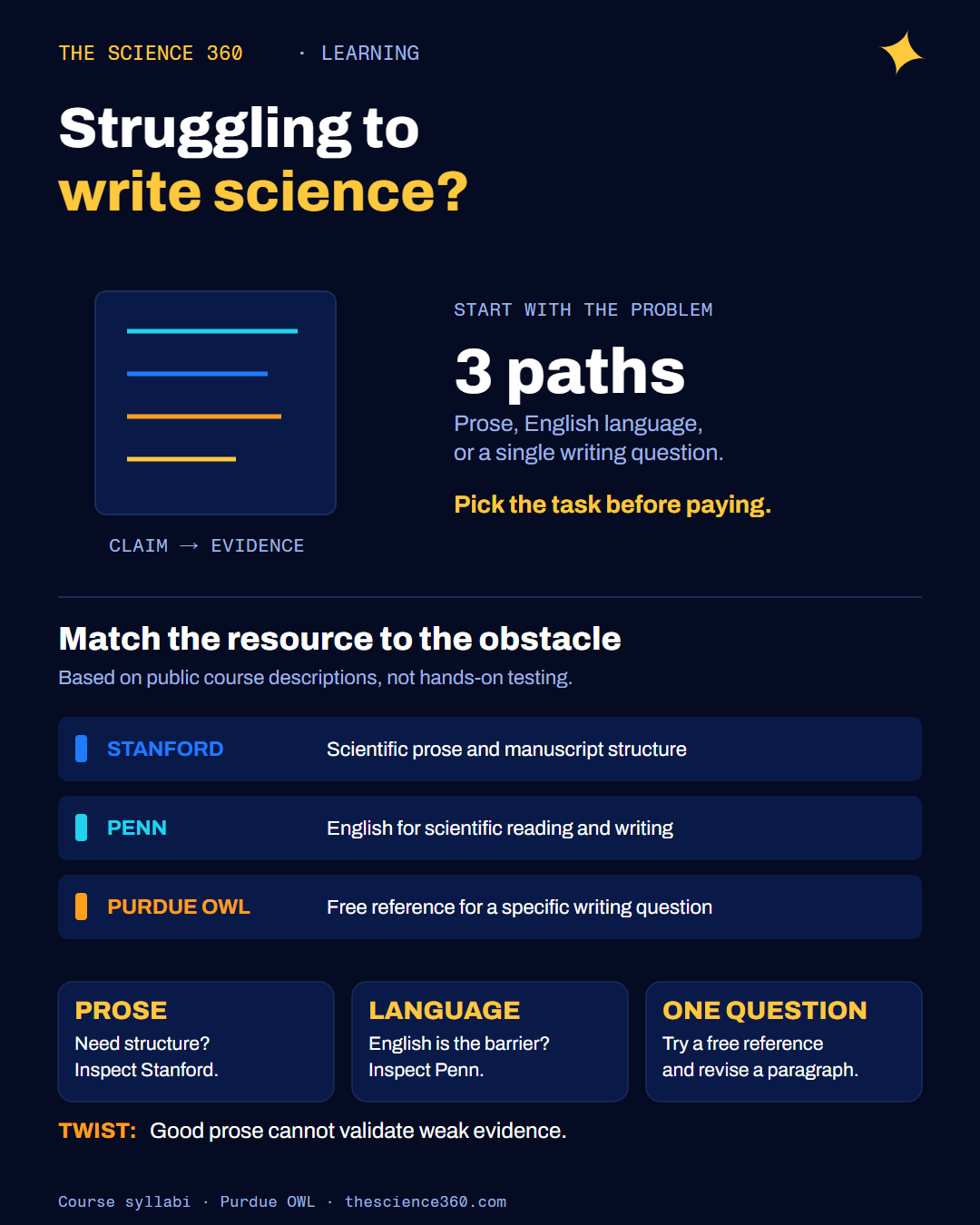
A course cannot decide whether your scientific claim is justified. It can help you express and organize a claim, but checking the evidence remains a separate responsibility. That distinction is worth making before paying for polished prose that leaves the underlying problem untouched.
This is a comparison of public syllabi and access information checked on 27 October 2026 IST. Free alternatives are included and recommendations follow the task. We have not completed these courses or tested instructor feedback, and we do not promise publication, admission, employment or grant success.
Diagnose the obstacle first
Take a short paragraph from your own work. Without changing its meaning, try to identify the main claim, the evidence supporting it and the limit on what it establishes. Then ask where you got stuck.
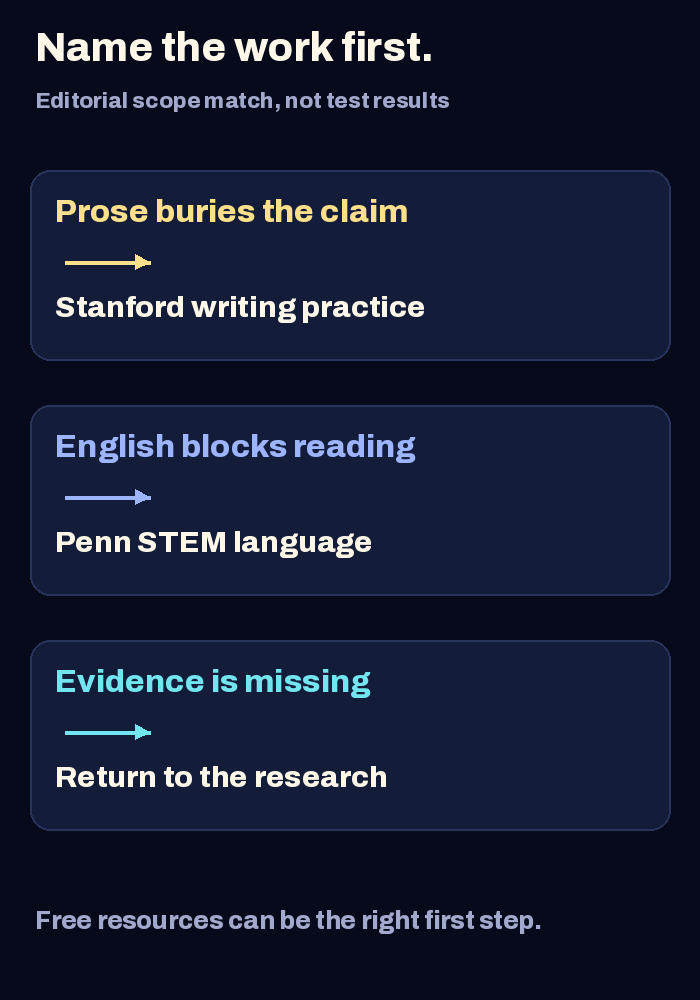
If you know all three but your sentences bury them, a prose-and-structure course is a reasonable fit. If unfamiliar English stops you understanding the source material, language practice may be the better first step. If you cannot identify the evidence or the limitation, revisit the analysis or ask a knowledgeable colleague before treating the problem as writing style.
This is an editorial decision aid, not a validated language assessment. It is meant to prevent buying a solution to a different problem.
| Resource | What its published scope supports | Choose it when | What it does not establish |
|---|---|---|---|
| Stanford: Writing in the Sciences | Clear writing, manuscript organization and scientific publication topics | You can work in English but need to revise scientific prose and structure | Personal editing of your manuscript or acceptance by a journal |
| Penn: English for STEM | English skills through scientific topics, including comparisons and cause-and-effect language | Language is the main barrier to reading and sharing scientific information | A complete manuscript-submission or advanced statistics course |
| Purdue OWL | Free academic-writing reference and exercises | You have a specific question and can practise independently | A sequenced taught course or individualized feedback |
The scope descriptions come from the Stanford course listing, Penn course listing and Purdue OWL. These are different formats, so counting modules would not be a fair quality ranking.
Stanford: when the science is ready but the prose is not
The Stanford listing describes eight modules covering clear prose, stronger sentences, the writing process and scientific manuscript work. Its wider topics include peer review, publication ethics and writing for broader audiences. That range makes it the better fit of the two courses for someone revising a report or preparing to write a scientific paper.
Look for practice that you can connect to your own work. After a lesson about sentences, revise a paragraph; after a lesson about structure, outline a section. Completing videos without returning to a draft may leave the skill you wanted unpractised.
Do not assume a public course listing means the instructor will personally edit your paper. Check the current assessment and feedback arrangements before paying if that is the feature you need. A course certificate is also not evidence that your research is sound.
We may earn a commission if you enrol through these links.
Check Writing in the Sciences and its current local enrolment options.
Penn: when language is the bottleneck
Penn’s English for STEM is designed for non-native English speakers. The public syllabus uses scientific subjects to practise reading, vocabulary and ways of communicating information, including comparisons and cause-and-effect relationships. Its five units are not five stages of submitting a journal manuscript.
Choose it when you can describe an idea comfortably in your first language but scientific English slows you down. Skip it as your main purchase if your actual need is detailed manuscript organization, discipline-specific reporting guidance or expert feedback on research methods.
The official course page currently describes a Full Course, No Certificate enrolment path. Verify that option in your account before paying for a certificate experience. A generic “enrol” button does not by itself explain which access tier you selected. We are not claiming that every certificate, assessment or access arrangement is free.
Check English for STEM, including the currently offered access paths.
Try one revision before buying anything
Here is an original exercise using a deliberately invented sentence, not a report of a real experiment:
An investigation into the effect of the coating on the performance of the device was conducted, and it was found that an improvement was observed.
The sentence withholds the useful information. Who did what? Which performance measure changed? Compared with what? In which conditions?
A revision might begin:
We compared coated and uncoated devices using the same test procedure. The coated devices showed lower leakage in that test.
This is still incomplete scientific reporting. It needs the actual measure, result, uncertainty and relevant experimental details. We have deliberately supplied no invented percentage or sample size. Better wording has exposed the missing evidence; it has not supplied it.
Now try the same process on your own paragraph. Highlight the action, comparison and result. Circle anything the reader would need to know to evaluate the claim. If the edit reveals missing analysis, solve that problem before searching for a stronger adjective.
Where free resources are enough
Purdue OWL offers academic-writing references, including work on concision and sentence clarity. It is useful when you can name the problem and practise a revision yourself. It is less useful as a substitute for personal feedback if you cannot tell whether your revision is accurate.
The University of Guelph’s Writing in the Sciences project is another free resource to inspect. We verified that its site was reachable, but did not evaluate every module or exercise; it is an additional starting point, not a tested replacement for either course.
For an advanced writer facing a particular journal’s requirements, the journal’s own author instructions may be more immediately relevant than a general course. Follow the requirements of the destination you actually intend to use rather than assuming one universal scientific-writing style.
India and US: check the cost of the feature you need
No fixed INR or USD price is quoted here because the public pages did not establish one universal final charge. Check the logged-in enrolment screen for your market, applicable taxes, certificate access, renewal terms and cancellation conditions. Distinguish a temporary trial from an ongoing free option and a subscription from a single payment.
The existing affiliate program includes India and the US, and both course-specific tracking links resolved to the intended official pages during our test. That does not guarantee regional payment availability, a promotion or commission attribution. We make no discount claim.
Our recommendation is to pay only when you can name the extra benefit you need and verify that the selected enrolment includes it. If your immediate goal is improving one paragraph, start with that paragraph and a free reference. If a repeatable difficulty remains, choose the course whose exercises match it.
For practice explaining a bounded calculation, read our orbital-sunlight analysis and try writing a two-sentence account that includes both the result and the model’s limit. Keeping both is the writing skill worth developing.