Which Python course should a science learner choose? Start with the task
Affiliate disclosure: This article may earn The Science 360 a commission if you purchase through an affiliate link. The comparison is based on published syllabi, not our completion of or hands-on testing of these courses.
Before choosing a Python course, identify the next scientific task you cannot complete. Writing your first loop, cleaning an untidy measurement table, and deciding whether a result supports a claim are three different problems. Buying a larger course bundle does not automatically solve the one you have.
We compared three University of Michigan offerings on Coursera against those tasks and included two free alternatives. Information was checked on 26 October 2026. We have not assigned numerical quality scores or reused student ratings as evidence of learning outcomes.
Choose the missing skill
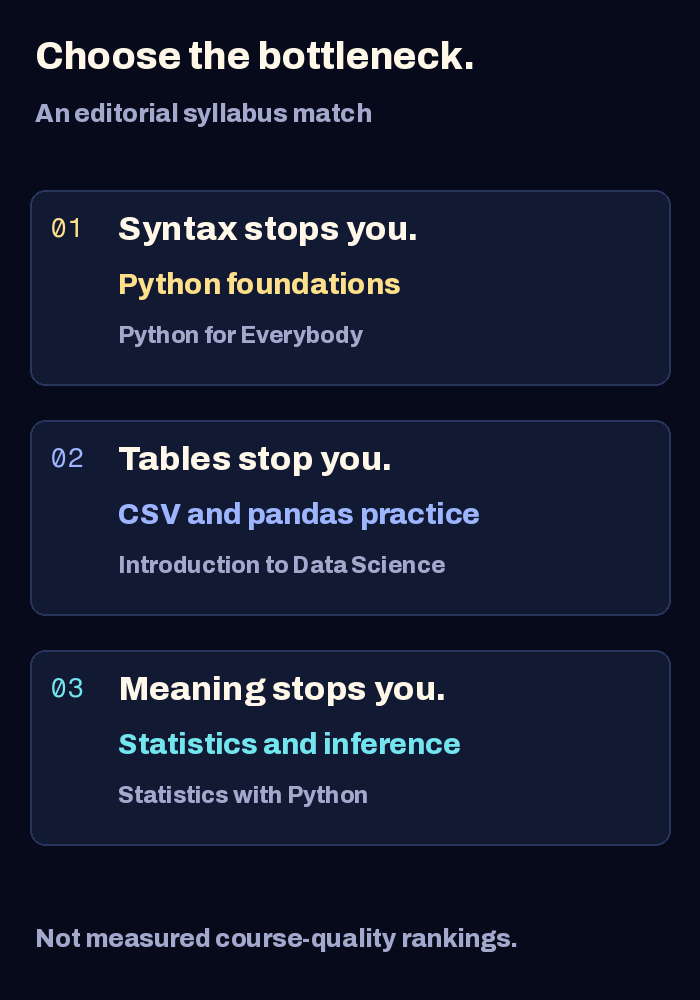
| Your next task | Course to examine | Why it fits | Where to be careful |
|---|---|---|---|
| Write programs that read files, use loops, and retrieve data | Python for Everybody | Starts with programming fundamentals and develops file, web-data, and database work | Programming foundations are different from statistical inference |
| Clean CSVs, manipulate columns, merge tables, and work with pandas | Introduction to Data Science in Python | Its published modules focus on data handling and DataFrames | Coursera labels it intermediate; do not mistake “Introduction” for no prerequisites |
| Interpret uncertainty, confidence intervals, tests, and fitted models | Statistics with Python | Connects analysis methods with research questions and interpretation | Statistical thinking still requires practice beyond running a library function |
These are editorial matches between tasks and syllabus topics, not measured rankings of teaching quality.
1. If programming is the obstacle
Python for Everybody is a five-course series. Its early work covers variables, loops, functions, and data structures, with later material on web data, databases, and a capstone. The official listing identifies it as beginner level with no prior experience required.
That makes it the first option to inspect if a scientific notebook’s syntax feels opaque. Its value is less obvious if you already write small scripts confidently and mainly need to reshape an instrument export. Check the actual lessons against the task you have, rather than paying to repeat familiar material.
There is also the author’s PY4E lesson site, which provides a free route through programming topics. A paid certificate is a separate decision from whether you need access to introductory explanations.
2. If your data will not behave
Introduction to Data Science in Python lists four modules and work with CSVs, pandas DataFrames, merging, grouping, and dates. Its published outcomes also include distributions, sampling, and t-tests. The intermediate label is a useful warning to check your readiness first.
Before enrolling, try a small task with a public dataset: load it, identify missing values, convert one column to the correct type, group by a meaningful category, and explain the unit of each result. This is our proposed readiness exercise, not a course assessment or a claim that completing it guarantees success.
If syntax stops you immediately, start with foundations. If you can write the code but cannot decide what the comparison means, you may need statistics rather than another collection of pandas operations.
3. If the interpretation is the obstacle
The Statistics with Python specialization has three courses covering visualization, inference, and statistical models. Its listed outcomes include interpreting inferential procedures and relating research questions to analysis methods.
It is the option to investigate when you can produce a plot but are unsure what population it describes, what assumptions a confidence interval makes, or whether a fitted relationship supports the explanation you want to write. A syllabus can establish that a topic is covered; it cannot prove how much you personally will learn.
A free research-oriented alternative
Software Carpentry’s Programming with Python lesson uses a research-data example to teach programming and analysis. Its inflammation dataset is a fictional teaching scenario, not clinical evidence. It is worth trying before purchasing if you prefer to learn by following a concrete scientific workflow. It does not replace every topic in the Coursera options, and it is not the same product as a paid certificate.
What to check before paying
Use the official checkout for the current price in India or the US. Prices, taxes, access options, and subscriptions can vary; this comparison does not promise a specific discount or a free certificate. Check whether you are purchasing one course, a specialization, or a subscription, and read the cancellation and renewal terms presented to you.
The existing site affiliate program covers Coursera, but a course can still be a poor fit. Start with the free materials when they solve your problem. Consider paying when the particular structure, assessments, or credential meet a need you can name.
For a concrete example of what a small, reproducible analysis looks like, see our flood-probability calculation. The useful outcome of learning Python is an analysis you can explain and check, with a certificate as an optional extra.
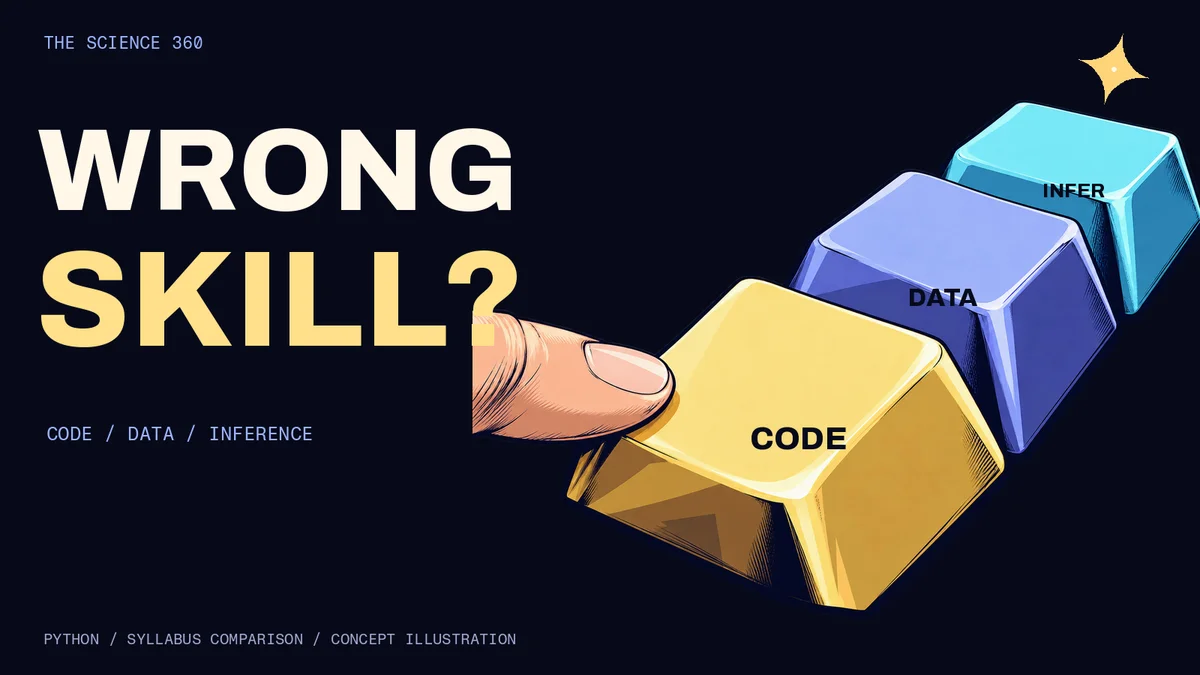
Cover: an AI-assisted illustration of oversized keyboard keys, with independently composed labels, typography and the publication’s star. It is conceptual artwork, not a product photograph or a course-provider endorsement.