


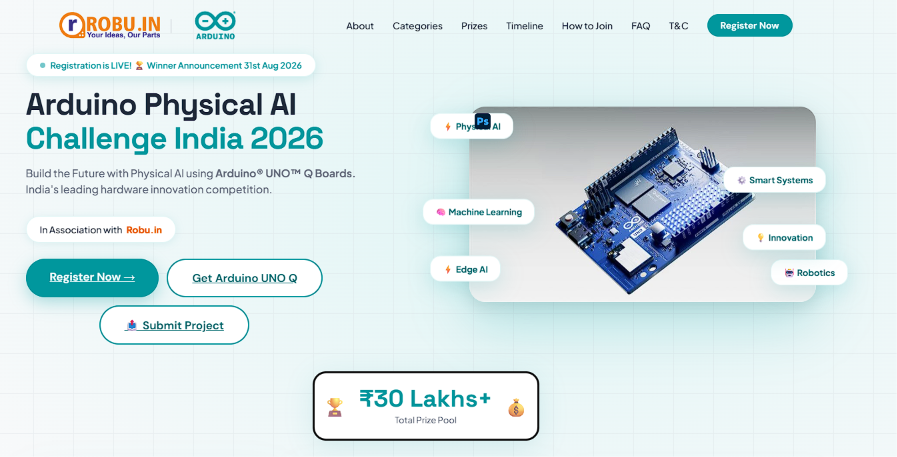
Physical AI shifts intelligence from the cloud to the edge, where systems perceive their environment and execute real-time actions locally. The Arduino Physical AI Challenge India 2026 is an engineering sprint focused on this integration. With a ₹30 Lakhs prize pool and mentorship from Qualcomm, you have until August 23 to submit your functional hardware prototype. This guide breaks down the essential hardware constraints, scoring logic, and technical strategies required to build a competitive edge AI system.
Registration Roadmap
- Register: Sign up solo or as a team of up to four.
- https://robu.in/register-arduino-physical-ai-challenge/
- use code ARD400
- Build: Develop a physical AI project within one of the three contest tracks.
- Submit: Provide a demo video, GitHub repository, and PDF project report by August 23.
Quick Reference: Challenge Mechanics
Before designing your system architecture, you need to understand the constraints and incentives of the competition. Here is the structured breakdown of the deadlines, tracks, and prize tiers.
Critical Dates
- Competition Start: May 20, 2026
- Final Registration Deadline: August 15, 2026
- Project Submission Deadline: August 23, 2026
- Winner Announcement: August 31, 2026
Main Track Categories and Prizes You must align your project with one of three primary tracks: Smart Homes and Consumer AI, Gaming Robotics and Interactive AI, or Industrial and Sustainability AI.
| Prize Tier | Cash Prize | Hardware and Perks |
| Grand Winner | ₹1,00,000 | AI Laptop, UNO Q Kit, Qualcomm India Mentorship, Global Feature |
| Second Place | ₹75,000 | AI Laptop, UNO Q Kit, Qualcomm India Mentorship, Global Feature |
| Third Place | ₹50,000 | Snapdragon Phone, UNO Q Kit, Qualcomm India Mentorship, Global Feature |

Special Awards and Innovation Picks In addition to the main tracks, the judges will award specific demographic and community prizes.

| Award Category | Cash Prize | Perks and Submission Requirements |
| Best Women Project in AI | ₹50,000 | 1 Award. Snapdragon Smartphone, Qualcomm India Mentorship, Global Media Feature. |
| People’s Choice Award | ₹50,000 | 1 Award. Requires highest social media engagement. Snapdragon Smartphone, Qualcomm India Mentorship, Global Media Feature. |
| Best School Team | ₹50,000 | 3 Awards. 10x UNO Q Kits for School Lab. Requires institution approval on official letterhead. |
| Best College Team | ₹50,000 | 3 Awards. 10x UNO Q Kits for College Lab. Requires institution approval on official letterhead. |
Hardware Requirements You must use the Arduino UNO Q as the primary compute module for your system. As noted in the registration steps, proof of purchase is required for your final submission.
Deconstructing Heterogeneous Compute
If your background is primarily with the 8-bit AVR boards of the past, you need to adjust your approach to system design. The UNO Q is a hybrid architecture designed specifically for the latency demands of physical AI.
The board features a microprocessor capable of running a Linux environment alongside a dedicated microcontroller. This dual-core approach solves a fundamental bottleneck in edge computing. You do not want a high-level operating system handling microsecond-level timing for stepper motors or reading rapid pulse-width modulation signals. The scheduler overhead in Linux introduces jitter and ruins hardware control loops.
Conversely, you cannot run complex tensor operations or vision models efficiently on a standard microcontroller. The UNO Q splits these workloads. The microprocessor handles the heavy mathematical lifting required for neural network inference. The microcontroller handles the real-time input and output operations.
Your software architecture must reflect this physical split. The microcontroller acts as a high-speed data acquisition unit. It reads sensor data, applies basic low-pass filters to remove electrical noise, and buffers the clean data.
The two cores communicate via an inter-processor communication bridge. You must design this data exchange carefully. Do not send raw floating-point numbers across this bridge if you can avoid it. Pack your sensor data into efficient byte arrays on the microcontroller, transmit them over the bridge, and unpack them on the microprocessor side. The microprocessor then runs the inference model and sends a simple command back to the microcontroller to trigger an actuator.
Power Budgeting for Edge AI
In real-world applications, your hardware will likely run on a battery. Constantly running a Linux microprocessor at maximum clock speed will drain a standard lithium-ion cell in hours.
To build a truly functional system, you need to implement a state machine that manages power consumption. The microcontroller should remain active in a low-power state, polling sensors at a defined interval. The power-hungry microprocessor should remain asleep.
When the microcontroller detects a threshold event, such as a sudden spike in acceleration or a specific acoustic trigger, it wakes up the microprocessor via a hardware interrupt. The microprocessor boots, pulls the buffered data, runs the inference, logs the result, and goes back to sleep. This duty-cycling strategy is the only way to deploy physical AI in remote industrial environments or smart home sensors.
Maximizing the Functionality Score
The judging criteria heavily favor systems that actually work in the real world. A full 40 points out of 100 are allocated to Project Functionality and Execution. You will not win this competition with a simulated model or a cleanly curated dataset. Your system must handle the chaos of physical environments. Sensor drift, electrical noise, and unpredictable lighting conditions break poorly designed AI systems.
To score high in functionality, you need to implement digital signal processing before your data ever hits the neural network. Do not feed raw analog reads directly into your inference model.
If you are building an acoustic anomaly detector for predictive maintenance, implement a Fast Fourier Transform to convert time-domain audio data into frequency-domain data. Before running the mathematical transformation, apply a Hanning window to your raw audio samples. This prevents spectral leakage and gives your neural network cleaner frequency bins to analyze. Feeding these processed frequency bins into your model dramatically reduces the memory footprint and increases inference accuracy compared to raw audio waveforms.
Latency is another vital metric for the functionality score. An autonomous navigation robot cannot wait two seconds for a cloud API response to decide if it should brake. Run your models locally using post-training quantization.
Integer quantization converts your 32-bit floating-point weights into 8-bit integers. This process relies on finding the minimum and maximum values of your tensors and mapping them linearly to an 8-bit scale. This reduces the overall model size by a factor of four and significantly speeds up matrix multiplication on the processor. You sacrifice less than one percent of accuracy in most edge applications while gaining massive performance improvements.
Code Execution at the Edge
Here is an architectural example of how you might structure the inference loop in Python on the microprocessor side of the UNO Q. Notice the strict absence of network calls. Everything happens locally in system memory.
import time
import numpy as np
import tflite_runtime.interpreter as tflite
from sensor_library import SensorBridge
from actuator_library import MotorController

model_path = "quantized_edge_model.tflite"
interpreter = tflite.Interpreter(model_path=model_path)
interpreter.allocate_tensors()

input_details = interpreter.get_input_details()
output_details = interpreter.get_output_details()

bridge = SensorBridge()
motor = MotorController()

def preprocess_data(raw_data):
    normalized_data = raw_data / 255.0
    return np.expand_dims(normalized_data, axis=0).astype(np.float32)

def run_inference_loop():
    while True:
        raw_sensor_read = bridge.get_latest_buffer()

        if len(raw_sensor_read) > 0:
            input_tensor = preprocess_data(raw_sensor_read)

            interpreter.set_tensor(input_details[0]['index'], input_tensor)
            interpreter.invoke()

            prediction = interpreter.get_tensor(output_details[0]['index'])
            confidence = prediction[0][0]

            if confidence > 0.85:
                motor.engage_brake()

        time.sleep(0.01)

if __name__ == '__main__':
    run_inference_loop()
This Python loop prioritizes raw speed. It pulls pre-buffered data from the inter-processor bridge, normalizes it, feeds it to a quantized TensorFlow Lite model, and triggers a physical action based on a hard confidence threshold. Keeping your control loops tight and deterministic is the key to reliable physical AI.
The Importance of Technical Documentation
Engineers often neglect documentation in favor of writing more code. In this challenge, Technical Documentation accounts for 20 points. A brilliant hardware system will lose to an average system if the judging panel cannot understand how it was built.
Your GitHub repository must be spotless. Do not upload a massive zip file of source code. Structure your repository logically. Separate your microcontroller firmware from your microprocessor inference scripts. Include a requirements file for all dependencies.
Your Bill of Materials must be exact. List every resistor, capacitor, sensor module, and power supply used in the project. Include specific part numbers and links to distributors. If a judge wants to replicate your build, they need to know exactly which components to purchase.
Circuit schematics are mandatory. Hand-drawn diagrams are unacceptable at this level of competition. Use a proper Electronic Design Automation tool like KiCad or Eagle to draft your wiring diagrams. Label every GPIO pin clearly. Indicate your power rails and logic level converters. If your AI model requires 5V logic to trigger a relay but your sensor outputs 3.3V, your schematic needs to show exactly how you handled that electrical discrepancy.
Innovation and Presentation
Innovation makes up 25 points of your total score. Building a basic weather station will not secure a spot on the podium. You need to solve a specific, difficult problem. Look at the industrial track as an example. Factories lose massive amounts of money to unplanned machine downtime. An AI system that listens to the acoustic profile of a CNC spindle and predicts a bearing failure a week before it happens is highly innovative. It provides direct, measurable financial value.
Presentation accounts for the final 15 points. You must submit a three to five-minute demonstration video. Do not spend three minutes talking to the camera. Show the hardware working in its intended environment. Show the raw sensor data alongside the inference output in real time. Prove that the system handles physical edge cases gracefully without crashing.
Next Steps for Builders
We have roughly 40 days until the submission portal closes. Get your hardware ordered immediately so you have time to iterate on your physical design. Outline your system architecture, establish communication between the two cores on your UNO Q, and start capturing raw data to build your training datasets.
Create your public project repository today and commit your initial schematic drafts. Let me know in the comments which competition track you are targeting and what physical constraints you are running into with your initial sensor arrays.

